
Are there any specific considerations when choosing a reconditioned stairlift for curved versus straight staircases?
When choosing a reconditioned stairlift, the main consideration is whether it is designed for a straight or curved staircase. Straight stairlifts generally use a standard reconditioned rail, while curved stairlifts require a professionally measured, compatible rail system—often with greater attention to the staircase layout, access points, seating position and installation support.
A reconditioned stairlift for a straight staircase is usually simpler to match and install than one for a curved staircase. Straight models commonly use a standard rail that can be inspected, refurbished and reused, whereas curved installations require a rail system shaped to the individual staircase. For that reason, the condition and compatibility of the rail are just as important as the condition of the stairlift carriage, seat and controls.
Considerations for a straight staircase
- Rail compatibility: A straight stairlift normally travels along one continuous rail. The reconditioned rail must be the correct length and suitable for the stair width, fixing points and parking position.
- Staircase dimensions: The installer should check the available width, the position of the bottom and top steps, and whether doors, radiators or furniture could obstruct the lift.
- Parking space: The lift may need to stop at the top or bottom, or use a hinged or sliding rail where a doorway or narrow landing is affected. These options must be compatible with the reconditioned model.
- Power supply and charging: The batteries, charger and charging points should be tested as part of the refurbishment. The installer should also confirm that the lift can charge where it is normally parked.
Straight stairlifts are often easier to relocate or replace because the rail is less dependent on one particular staircase. However, this does not mean that any used straight stairlift will fit. A professional survey remains necessary to confirm measurements, electrical requirements, user needs and safe access at both ends of the stairs.
Considerations for a curved staircase
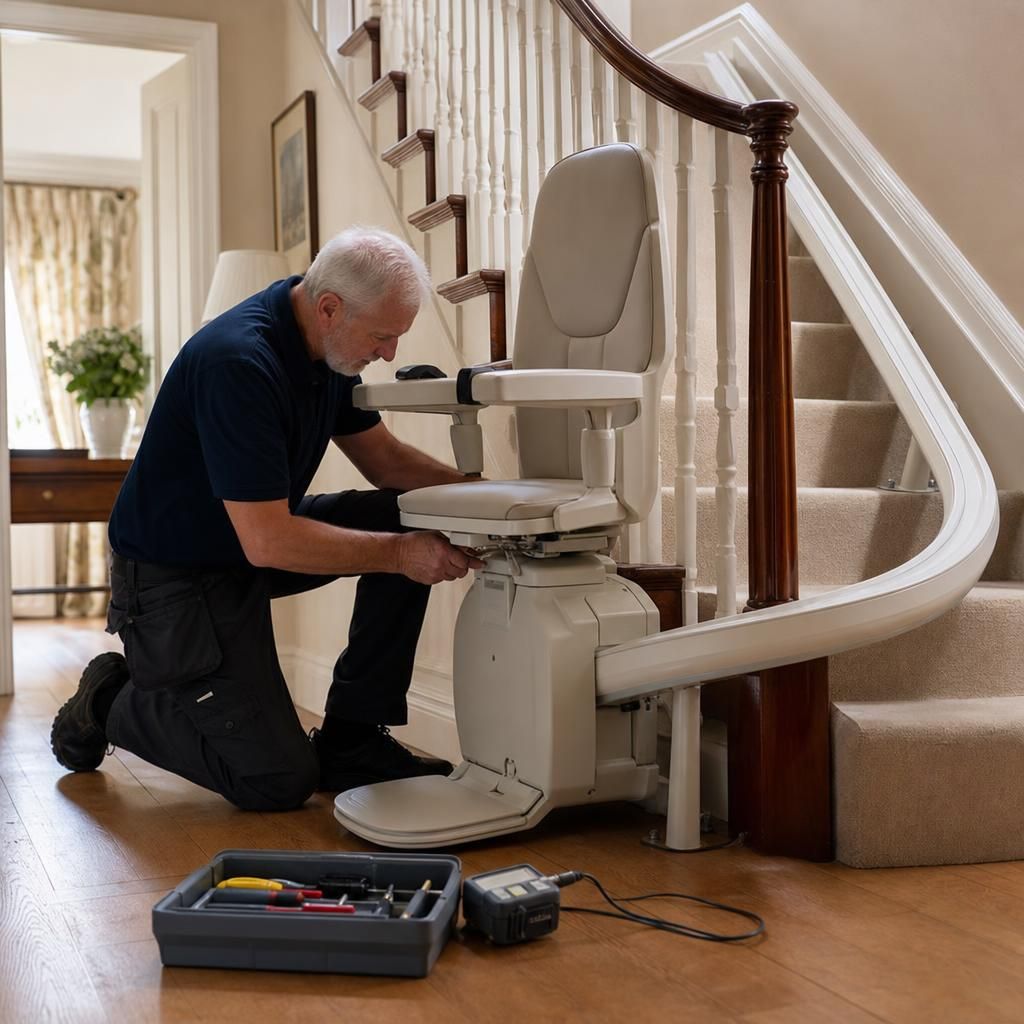
- Made-to-measure rail: A curved rail follows the precise shape of the stairs, including bends, intermediate landings, changes in direction and the required parking area. A previously used rail is only suitable if its design and measurements match the staircase, or if it can be adapted safely by the manufacturer or installer.
- Carriage and rail compatibility: The carriage, drive system, controls and safety sensors must work correctly with the particular curved rail. Components from different systems should not be combined unless the installation has been specifically approved and tested.
- Travel position: The survey should establish whether the user needs to travel facing forwards throughout, or whether the seat needs to swivel or rotate at a landing. The available space at the top and bottom affects which seat and parking arrangement can be used.
- Clearance: Curved stairs can have tighter bends or narrower sections. The installer should check knee, footrest and armrest clearance, as well as whether other people can safely use the stairs when the lift is parked or in transit.
- Installation complexity: A curved installation involves more detailed measurement, rail positioning and testing. The quality of the survey and fitting is therefore particularly important when selecting a reconditioned system.
With curved stairlifts, the term reconditioned may refer to the stairlift carriage and its working components rather than a ready-made rail. In some cases, a suitable existing rail can be refurbished and reused; in others, a new rail is required while the carriage is reconditioned. This distinction should be made clear in the quotation, together with what has been inspected, replaced or newly manufactured.
Check the user’s requirements as well as the staircase
The right choice depends on more than whether the stairs are straight or curved. The assessment should consider the user’s mobility, balance, ability to transfer into the seat, preferred operating hand, body position and any difficulty bending the knees. Seat width, swivel functions, armrests, footrest design and controls can affect comfort and safe use. If more than one person will use the lift, the specification must accommodate everyone without compromising safe positioning.
Weight capacity, travel speed, stopping position and the ability to use the controls should be checked against the manufacturer’s requirements. A user who needs extra support or has limited dexterity may need different controls or a powered seat function. These features are model-specific, so they should be confirmed before a reconditioned lift is selected rather than assumed from its appearance.
Questions to ask before agreeing to the installation
- Is the stairlift intended for a straight or curved rail, and is the rail being reused, adapted or newly made?
- Which parts have been inspected, serviced or replaced, including the batteries, charger, safety sensors, drive components and seat mechanism?
- Has the complete system been tested together on the customer’s staircase?
- Where will the lift park, and will it obstruct a doorway, landing or access route?
- Does the proposed seat and control arrangement suit the user’s mobility and transfer needs?
- What warranty applies to the carriage, rail, batteries and workmanship, and who should be contacted if a fault develops?
- Are future servicing, battery replacement and call-out support available for the specific model?
The main practical difference is that a straight reconditioned stairlift is generally selected around a standard rail and verified staircase length, while a curved reconditioned stairlift must be matched to a bespoke rail layout and a more detailed installation plan. In either case, the safest approach is to have the staircase surveyed, confirm exactly which components are reconditioned, and ensure that the complete installation is tested and supported by a qualified stairlift installer.
For a curved reconditioned stairlift, confirm whether the rail is being reused, adapted or newly manufactured. Unlike a straight rail, a curved rail is made to follow the precise bends, landings and parking points of a particular staircase, so a previously installed rail will not automatically fit another home.
Ask for the quotation to identify clearly which parts are reconditioned and which are new. The carriage, drive system, seat, batteries, charger and safety sensors should be checked as a complete system, while the rail must be measured and fitted for the staircase. The finished installation should then be tested for smooth travel, safe clearance and reliable charging at its parking position.
Arrange a professional assessment for your staircase
Arrange a professional assessment of your staircase so we can confirm whether a reconditioned straight or curved stairlift, rail and seating arrangement are suitable for your home and needs. We will also explain which components are reconditioned or new before installation.