
What should I consider when choosing between a new and a reconditioned stairlift?
Choosing between a new and reconditioned stairlift depends on your budget, the layout of your staircase, the features you need and how quickly you require installation. A reconditioned model can provide a cost-effective solution when a suitable lift is available, while a new stairlift offers the widest choice of specifications, finishes and bespoke options.
The choice between a new and a reconditioned stairlift should be based on the user’s mobility needs, staircase layout, required features, available budget and the level of customisation needed. A reconditioned stairlift can offer a reliable, lower-cost option where a suitable model is available, while a new stairlift usually provides the broadest choice of specification, finish, controls and bespoke design.
Both options should be assessed in the home before a decision is made. The stairlift must suit the shape and structure of the staircase, provide a safe and comfortable transfer for the user, and allow sufficient space for other people to use the stairs. A home assessment also identifies practical considerations such as landing clearance, power supply, parking space and whether the lift needs to be used indoors or outdoors.
Consider the following factors when comparing the two options.
- The staircase layout: A straight staircase is generally simpler to accommodate, whereas a curved staircase may require a track made specifically for the home. Reconditioned curved stairlifts may be available, but their track is normally designed for a particular staircase and may not be suitable for another property. A new curved stairlift offers more flexibility because the track can be specified for the exact bends, landings and changes in direction.
- The user’s mobility and posture: Consider whether the user can transfer safely on and off the seat, bend their knees comfortably and operate the controls. Seat size, swivel action, armrests, footrest design, seat height and the position of the controls can all affect usability. If the user has limited balance, joint pain or difficulty bending, these details may be more important than whether the lift is new or reconditioned.
- Features and customisation: A new stairlift is more likely to provide a complete choice of upholstery, colours, seat styles, control positions, power options and other features. A reconditioned model may have fewer choices because the specification depends on the available equipment. This does not make it unsuitable, but the existing specification needs to be checked against the user’s requirements rather than assumed to be adequate.
- Budget and overall value: Reconditioned equipment can reduce the initial cost, which may be helpful when a stairlift is needed within a particular budget. The comparison should include the complete installation and any required adaptations, rather than focusing only on the equipment price. A new model may cost more initially but could be the better value if it provides essential features, a closer fit or a specification that is likely to remain suitable as the user’s needs change.
- Availability and timescale: A suitable reconditioned stairlift depends on stock, the staircase design and the required features. If the available model does not match the home or user, waiting for an alternative may be necessary. A new stairlift can usually be ordered to the required specification, although the installation timetable will depend on the design and supply arrangements. The assessment should establish what is realistically available rather than relying on a standard timescale.
- Indoor or outdoor conditions: Outdoor installations require equipment and finishes appropriate for exposure to rain, temperature changes and other environmental conditions. A reconditioned stairlift should only be considered if it has been refurbished and specified for the intended outdoor environment. An indoor model should not be used outside simply because it appears physically similar.
- Condition, refurbishment and safety checks: Reconditioning should involve more than cleaning or cosmetic preparation. The lift should be inspected, tested and serviced, with attention given to the drive system, batteries, charging equipment, controls, seat, footrest, safety sensors, track and fixings. Components showing excessive wear or failing inspection should be repaired or replaced. Ask what checks are included and whether the proposed model is suitable for the expected frequency and type of use.
- Aftercare and maintenance: Find out what support is available after installation, including fault reporting, servicing, replacement parts and warranty arrangements. The terms may differ between new and reconditioned equipment, so they should be explained before you proceed. Regular use of the charging points, keeping the track clear and following the operating instructions will also help maintain dependable performance.
- Appearance and integration with the home: A reconditioned stairlift may have limited upholstery or finish choices, although it can still be selected to sit discreetly within the property. A new stairlift normally gives more scope to choose a finish that works with the existing décor. Safety, comfort and suitability should remain the priority, but appearance can be relevant where the stairlift will be installed in a prominent hallway or living area.
When a reconditioned stairlift may be appropriate
A reconditioned stairlift may be a practical choice for a straightforward staircase, particularly when a suitable model is available and the user’s requirements can be met by its existing specification. It can also be appropriate where a cost-conscious solution is needed without compromising on essential safety checks, installation quality or aftercare. The key point is that the equipment must be matched to the property and user; a lower purchase price should not mean accepting an unsuitable seat, control arrangement or track.
When a new stairlift may be preferable
A new stairlift is often the more suitable option for a complex curved staircase, an unusual layout or a user who needs specific seating, controls or positioning. It may also be preferable when the stairlift will be used frequently, when the user’s needs require a highly tailored specification, or when the available reconditioned models do not provide the necessary fit. New equipment offers greater choice from the outset and avoids selecting from the limitations of existing stock.
It is also worth considering how the user’s needs may develop. A lift that is comfortable now should remain manageable if strength, balance or confidence changes. Features such as powered swivelling, a suitable seat position, easy-to-reach controls and appropriate safety sensors may make a meaningful difference over time. The assessment should include the person who will use the stairlift, and where appropriate, a family member or carer who can help explain daily routines and practical concerns.
There is no universal advantage to choosing new equipment over reconditioned equipment. The right decision is the one that provides a safe fit, suitable operation, dependable condition and appropriate support at a cost that is manageable. Independent Stairlifts can assess the staircase and discuss both options, explaining which models are genuinely compatible, what features are included and what installation and aftercare arrangements apply before you make a decision.
The main difference between a new and reconditioned stairlift is the choice available, not necessarily the level of safety. A reconditioned stairlift should be inspected, serviced and tested before installation, with worn or unsuitable components repaired or replaced. Its suitability must then be checked against both the staircase and the user’s needs.
Ask for the proposed model’s condition, included specification and support arrangements before making a decision. Particular attention should be given to:
- the seat, swivel mechanism, armrests, footrest and controls;
- the batteries, charging equipment, drive system and safety sensors;
- the track, fixings and any parts exposed to outdoor conditions; and
- the warranty, fault-reporting process, servicing and replacement-parts support.
A lower initial cost should not mean accepting a stairlift that is uncomfortable, difficult to operate or poorly matched to the property. If a reconditioned model cannot provide the required seating position, controls or track configuration, a new stairlift may offer better long-term value because it can be specified more closely to the home and the user.
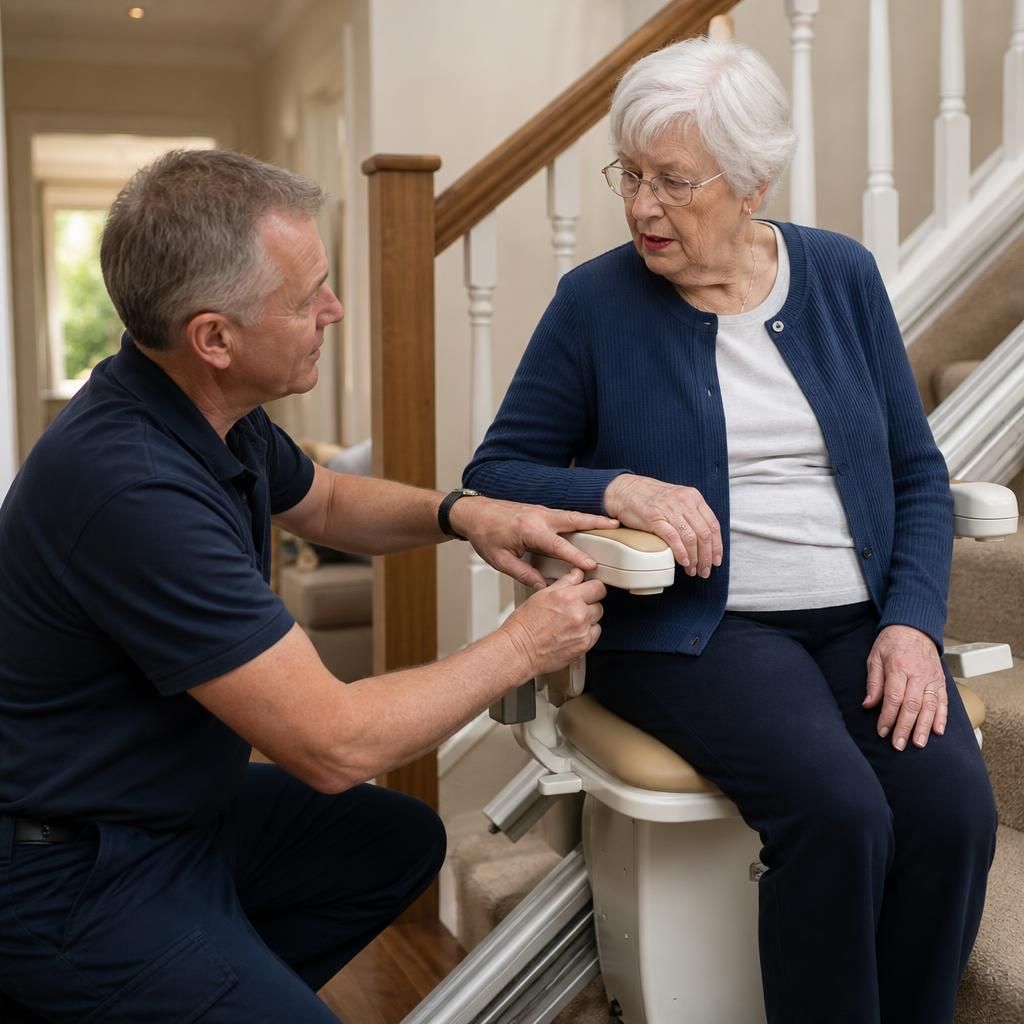
Arrange your home assessment today
Arrange your home assessment with Independent Stairlifts to compare suitable new and reconditioned options for your staircase, mobility needs and budget. We’ll explain the available specifications, installation requirements and aftercare before you decide.