
What environmental considerations should be addressed when installing a reconditioned stairlift in a home?
Installing a reconditioned stairlift should consider its energy use, the reuse of existing components, responsible recycling of replaced parts and batteries, and the effect of installation on the home. The assessment should also confirm that indoor or outdoor conditions, including moisture, temperature and ventilation, will not reduce the stairlift’s efficiency, safety or service life.
Installing a reconditioned stairlift has environmental considerations beyond the condition of the lift itself. A suitable assessment should consider the energy required to operate and charge it, the benefits of reusing serviceable equipment, the responsible disposal of replaced components and batteries, and the conditions within or around the home that could affect its service life. The installation should improve access without creating avoidable waste, damage or future maintenance requirements.
Reuse and refurbishment
The main environmental benefit of a reconditioned stairlift is the continued use of an existing lift, rail, seat, motor or control equipment that remains safe and suitable after inspection and refurbishment. Reusing these components reduces the demand for new raw materials and avoids sending usable equipment to waste. This benefit depends on proper refurbishment: components should be assessed, cleaned, tested and replaced where their condition, age or performance does not meet the required safety standard.
Reuse should never take priority over suitability. A lift that requires frequent repairs, has outdated components or is poorly matched to the staircase may have a greater environmental impact over time than a more appropriate replacement. The assessment should therefore consider the lift’s expected service life, compatibility with the staircase and the availability of replacement parts, as well as its initial environmental benefit.
Energy use and charging
Most domestic stairlifts use rechargeable batteries and draw relatively little electricity during normal operation. Even so, the condition of the batteries, charger and control system affects energy efficiency. Batteries that are deteriorating may require more frequent charging or fail to hold power reliably, while a faulty charger can waste energy and compromise availability.
During fitment, the engineer should check that the charging points, batteries and electrical connections are functioning correctly. The stairlift should be left on its designated charging point when required by the manufacturer’s instructions, rather than being allowed to discharge unnecessarily. Keeping the track and moving parts clean and arranging maintenance when performance changes can also help the mechanism operate efficiently.
Responsible handling of removed parts
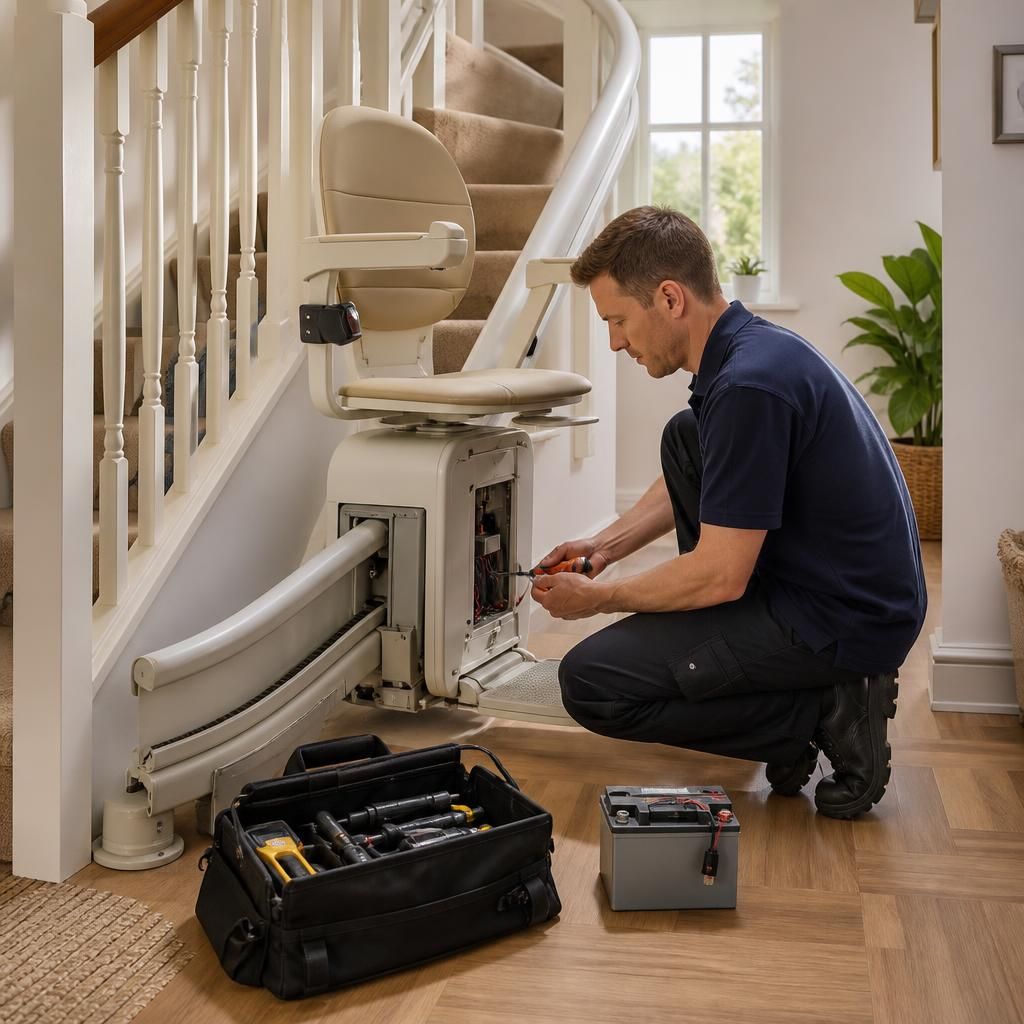
Refurbishment may involve replacing batteries, wiring, switches, covers, rollers or other components. These items should not simply be placed in household waste. Electrical and electronic parts, batteries, metals and plastics may require separate handling, recovery or recycling through appropriate waste channels. Batteries in particular must be stored and transported safely because they can present a fire or leakage risk if damaged or disposed of incorrectly.
Where components cannot be reused, they should be directed to an appropriate recycling or waste-treatment route. The installer can explain how removed parts are handled and whether any reusable components are retained for future refurbishment. This provides a more complete view of the environmental impact of the installation than considering only the equipment fitted in the home.
Condition of the indoor environment
Indoor stairlifts are generally installed in a relatively controlled environment, but the location still matters. Excessive damp, condensation, dust, heat or cold can affect electrical connections, batteries, sensors and lubricated mechanical parts. A staircase close to an external door, unheated area, bathroom or poorly ventilated space may need particular attention.
The engineer should identify sources of moisture and confirm that the stairlift will not be exposed to conditions outside its intended operating environment. Ventilation around the charger and electrical equipment should not be obstructed. Cleaning products, decorating materials and stored items should also be kept away from the rail, charging contacts and moving components. Managing these conditions can help prevent premature component replacement.
Outdoor and exposed installations
An outdoor or partly exposed stairlift requires a separate environmental assessment. Rain, humidity, frost, salt, direct sunlight, wind-blown debris and large temperature changes can accelerate corrosion and affect batteries, controls and protective covers. Equipment must be specifically suitable for the location; an indoor stairlift should not be installed outside simply because it fits the staircase.
The assessment should consider whether the lift can be protected from direct weather, whether drainage is adequate and whether electrical connections can remain dry and secure. The condition of the surface, nearby walls and any shelter should also be checked. Regular cleaning, inspection and maintenance may be more important for an outdoor installation because environmental exposure can shorten the service life of otherwise sound components.
Effect on the home during installation
A well-planned fitment should limit waste and avoid unnecessary alteration to the property. Most stairlifts are fixed to the stairs rather than requiring major structural work, but the installation may still create packaging, drilling dust, cable offcuts or small amounts of removed material. The installer should use the existing layout wherever safely possible, protect floors and surrounding surfaces, and remove installation waste rather than leaving it for the household to manage.
Any proposed changes to handrails, flooring, skirting or access routes should be discussed before work begins. This is particularly important in older homes, listed properties or homes with fragile finishes. The least disruptive option is not automatically the most sustainable if it creates an unsafe route or makes future servicing difficult, so environmental considerations must be balanced with safe access and maintainability.
Materials, packaging and future removal
Packaging should be kept to what is necessary and separated for appropriate recycling where facilities are available. When the stairlift eventually reaches the end of its serviceable life, its materials should be considered for reuse, parts recovery or recycling rather than disposal as mixed household waste. Keeping installation and service records can help a future engineer identify the model and determine which parts may be recoverable.
It is also sensible to consider removal at the assessment stage. A lift that can be serviced, adapted or removed without avoidable damage to the staircase is easier to manage throughout its lifecycle. If the stairlift is being installed temporarily, the installer should explain what will happen to the equipment when it is no longer required and which alterations, if any, may remain.
Maintenance as an environmental measure
Regular servicing supports both safety and sustainability. Checks can identify battery deterioration, unusual charging behaviour, friction, corrosion or damaged seals before these problems lead to a larger component failure. Keeping the stairlift in good condition may extend the useful life of refurbished parts and reduce the need for premature replacement.
Do not attempt to modify the electrical system, use unsuitable lubricants or fit non-approved parts to improve efficiency. If the lift becomes noisier, moves unevenly, loses charge quickly or shows signs of moisture damage, stop relying on assumptions about its condition and contact the service team. A prompt inspection is safer and may prevent avoidable waste.
Before installation, the key checks are the lift’s condition and expected service life, energy and battery performance, the route for recycling removed parts, indoor or outdoor exposure, the effect of the work on the property and the practical maintenance plan. Addressing these points ensures that environmental responsibility supports, rather than compromises, safe and dependable access in the home.
Responsible handling of replaced parts is an important environmental consideration when installing a reconditioned stairlift. Batteries, electrical components, metals and plastics should be assessed for reuse or directed through appropriate recycling and waste-treatment channels rather than placed in household waste.
During the fitment, ask how removed batteries and other parts will be stored, transported and disposed of. Safe handling is particularly important for batteries, which can leak or present a fire risk if damaged. Keeping service records also helps future engineers identify components that may be recoverable when the stairlift is eventually removed or refurbished again.
Arrange Your Reconditioned Stairlift Assessment
Arrange your reconditioned stairlift assessment with Independent Stairlifts to review energy use, component reuse, waste handling and the environmental conditions around your staircase. We can also advise on suitable equipment, installation requirements and ongoing maintenance.