
What conditions typically warrant the replacement of components during the refurbishment of a reconditioned stairlift?
Components are replaced during refurbishment when they are worn, damaged, unreliable, unsafe, or outside the manufacturer’s acceptable operating condition. This may include batteries, chargers, wiring, switches, sensors, drive parts, safety edges, seat components and other items identified through inspection, testing or the stairlift’s service history.
Components are replaced during refurbishment when inspection, testing or service history shows that they are worn, damaged, unreliable, unsafe, unsuitable for continued use or outside the manufacturer’s acceptable operating condition. The decision is based on the condition and function of the individual part, rather than simply on the age of the stairlift.
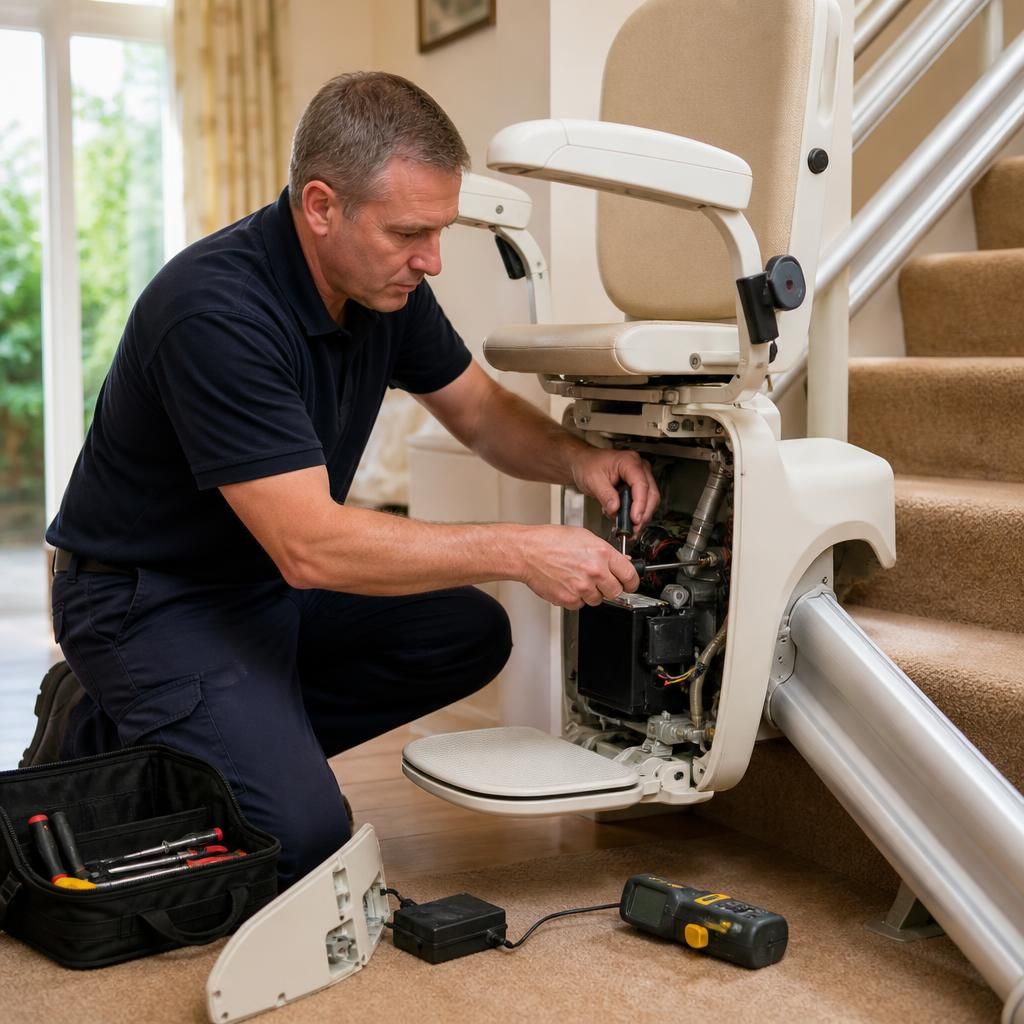
A reconditioned stairlift is normally assessed systematically before it is installed. The engineer checks the mechanical parts, electrical systems, safety devices, seating and controls, then tests the lift under operating conditions. Parts that can be safely cleaned, adjusted or serviced are not automatically replaced. However, any item that could affect safe operation, reliability or compatibility is repaired or renewed as necessary.
Common conditions that warrant component replacement include:
- Excessive wear: Drive components, rollers, bearings, gears, belts or other moving parts may be replaced if wear has reached a point where it could cause noise, slipping, uneven movement, vibration or reduced performance.
- Physical damage: Cracked, bent, broken or distorted parts cannot usually be made suitable through adjustment alone. This may include armrests, footplates, seat parts, covers, brackets, switches or sections of wiring.
- Electrical faults: Wiring, connectors, circuit boards, charging contacts, switches or control components may be replaced if they are burnt, loose, corroded, intermittently faulty or unable to operate consistently during testing.
- Battery deterioration: Batteries are commonly renewed when they no longer hold an adequate charge, discharge quickly, fail to provide reliable power or show signs of leakage or physical damage. A stairlift may still move during a basic check while having insufficient battery capacity for dependable everyday use.
- Charger or charging faults: A charger may need replacement if it does not charge the batteries correctly, overheats, produces inconsistent readings or fails to maintain the stairlift when it is parked at its charging point.
- Safety-device failure: Safety edges, sensors, limit switches, swivel-seat switches, obstruction sensors and related devices are replaced if they fail to respond correctly or do not give the expected safety signal. Safety devices are not bypassed as a substitute for proper repair.
- Corrosion or environmental damage: Moisture, condensation, dirt, salt, temperature changes and outdoor exposure can affect electrical connections, fixings and mechanical parts. Components are replaced where corrosion has weakened them or could affect their operation.
- Incompatibility: A part may be replaced if it is not the correct specification for the stairlift, track, seating arrangement or intended installation. Previously fitted parts are not retained merely because they are present; they must be suitable for the finished installation.
- Obsolescence or lack of dependable support: If a component is no longer appropriately supported or cannot be verified as suitable, the engineer may recommend a compatible replacement rather than relying on an uncertain or unsuitable part.
Particular attention is given to the drive system and track interface. Excessive wear, damaged teeth, unusual movement or inconsistent travel can indicate that drive-related parts need attention. The track itself is inspected for damage, distortion, insecure fixings and other conditions that could affect smooth travel. Replacement is considered where repair or adjustment cannot restore the required condition.
The seat and user-contact components are also checked. A damaged swivel mechanism, loose armrest, insecure seat, defective seat belt or faulty interlock may require replacement before the stairlift is used. Upholstery and covers may be renewed where they are torn, unhygienic or significantly deteriorated, although cosmetic wear alone does not necessarily mean that a functional part must be replaced.
Not every unusual sound or operating issue means that a component needs to be renewed. Engineers may first clean the track, remove contamination, tighten connections, adjust the alignment or correct the charging position. Replacement is appropriate when those steps cannot resolve the fault, when the part has failed a test or when retaining it would leave an avoidable safety or reliability concern.
After any replacement, the stairlift should be tested as a complete system rather than relying only on a check of the new part. This includes checking travel, stopping, charging, controls, safety sensors, seat functions and operation at relevant points on the staircase. The engineer also considers the specific installation, including the user’s access requirements, the staircase layout and whether the lift is intended for indoor or outdoor use.
Where a component is borderline rather than clearly defective, its condition and likely reliability are considered alongside the manufacturer’s guidance and the planned use of the stairlift. This helps avoid both unnecessary replacement and the retention of a part that may cause a preventable fault soon after installation. Any recommended work should be explained to you, particularly where it affects the cost, expected maintenance or suitability of the refurbished stairlift.
The result should be a reconditioned stairlift made up of parts that have been inspected, tested and confirmed as suitable for continued service. Refurbishment is therefore more than cleaning and presentation: it involves identifying components that no longer meet the required standard and replacing them so that the completed installation can operate safely and reliably.
Safety-critical components are replaced when they fail testing, respond inconsistently or show damage that could affect the stairlift’s ability to stop or prevent movement. This can include safety edges, obstruction sensors, limit switches, swivel-seat interlocks and seat-belt mechanisms.
These parts are not bypassed or retained simply because the stairlift can still travel. The engineer checks that each device gives the correct signal during operation, then tests the complete stairlift after replacement to confirm reliable stopping, controls and safe movement on the staircase.
Discuss Your Reconditioned Stairlift Assessment
Discuss your reconditioned stairlift assessment with our team to review any recommended component replacements, safety checks and ongoing support.