
What factors should I consider when evaluating a reconditioned stairlift?
When evaluating a reconditioned stairlift, consider its safety and mechanical condition, suitability for your staircase and user, installation quality, warranty and aftercare, and the total cost of ownership. Ask for a clear assessment of the lift’s condition and service history, and confirm that it will be professionally fitted and supported in your home.
A reconditioned stairlift should be evaluated on more than its purchase price. The key considerations are its safety and mechanical condition, suitability for the user and staircase, quality of the reconditioning work, professional installation, warranty and aftercare, and the total cost of ownership. Before agreeing to buy, ask for a clear explanation of what has been inspected, replaced or tested, and ensure the lift is assessed in your home rather than selected from a catalogue alone.
Safety and mechanical condition
Safety is the first priority. A reputable supplier should inspect and test the stairlift’s essential operating and safety systems before installation. This includes the drive mechanism, motor, braking system, seat swivel and locking mechanism, footrest, armrests, safety belt, controls and sensors. The lift should start, stop and travel smoothly, without unusual noise, jolting, slipping or hesitation.
Ask whether worn or damaged components have been replaced with suitable parts, rather than simply cleaned and cosmetically improved. Pay particular attention to the condition of the batteries, charger, charging points and remote controls, as these affect day-to-day reliability. Batteries are consumable components, so ask about their condition and whether their replacement is covered if they fail soon after installation.
Suitability for the person using it
The stairlift must be appropriate for the user’s mobility, balance, strength and daily routine. Consider whether the seat is comfortable and supportive, whether the controls can be operated easily, and whether the user can safely transfer on and off the seat at the top and bottom of the stairs. A powered swivel seat, powered footrest or other option may be useful where reaching, bending or turning is difficult, but these features should be assessed against the user’s specific needs.
Also consider the user’s size, posture and ability to keep their feet within the footrest while travelling. If more than one person will use the lift, it should be comfortable and safe for each regular user. A proper assessment should take account of the staircase, not just the lift model.
Fit with the staircase and surrounding space
A reconditioned stairlift is not automatically suitable because it was previously installed elsewhere. Straight stairlifts are generally designed for straight flights, while a staircase with bends, intermediate landings or multiple flights may require a rail made specifically for that layout. Even where a rail can be adapted or reused, its dimensions and fixing points must be checked carefully.
The assessment should consider the width and shape of the stairs, available space at the top and bottom, doorways, landings, radiators and other obstructions. It should also establish whether the lift will leave enough room for other people to use the staircase safely. For outdoor stairs, the assessment should include exposure to rain, temperature changes and other environmental conditions, as well as the suitability of the charging arrangement.
Do not rely on photographs or measurements taken without professional guidance. An in-home survey can identify clearance, access and installation issues before an order is placed, and can confirm whether the proposed rail and seat configuration are suitable.
Quality of the reconditioning process
The term “reconditioned” should be supported by a clear process. Ask what happens to the stairlift before it is offered for sale. This may include cleaning, inspection, electrical and operational testing, replacement of worn parts, battery checks and safety testing. It is reasonable to ask which components are original, which have been replaced and whether replacement parts are approved for the lift.
Cosmetic condition is useful but should not be confused with mechanical quality. Scratches or minor signs of previous use may be acceptable if the lift is safe, reliable and correctly serviced. Conversely, a clean appearance does not demonstrate that the drive system, batteries or safety devices are in good condition.
Ask whether the supplier can provide the model details, available service records and a written description of the work carried out. If a history is unavailable, this does not necessarily make the stairlift unsuitable, but it makes the inspection, warranty and aftercare arrangements especially important.
Installation quality
Correct installation is essential, particularly when a lift is being moved from another property. The rail must be fixed securely and positioned to provide safe clearance. The installer should test the lift throughout the full route, check charging at the relevant points, confirm that safety sensors operate correctly and demonstrate the controls to the user.
Ask whether installation, removal and any making-good work are included in the quoted price. A professional installer should explain how to use the stairlift, what the warning indicators mean, how to charge it and what to do if it stops. They should also confirm whether the lift can be removed or relocated later and whether this would affect the warranty.
Warranty and aftercare
A written warranty provides important protection, but its scope matters as much as its length. Check what is covered, including parts, labour, call-outs, batteries and faults that occur after installation. Establish when the warranty starts, whether it applies to the particular user and property, and whether any exclusions apply to misuse, accidental damage or unauthorised repairs.
Find out who will provide support if the stairlift stops working. Ask about telephone assistance, engineer visits, response arrangements and the availability of replacement parts. A reconditioned stairlift should come with clear instructions for reporting a fault and using any manual lowering or emergency procedures. Keep the warranty, service documents and installer’s details in an accessible place.
Total cost rather than purchase price
Compare the complete cost of obtaining and running the stairlift. The quotation should make clear whether it includes the survey, delivery, installation, VAT where applicable, removal of an existing lift, alterations to the staircase and aftercare. You should also understand whether future servicing, battery replacement, repairs or relocation would incur additional charges.
A lower initial price may not represent good value if the lift needs significant work, has limited warranty cover or is difficult to support. Conversely, a well-inspected model with suitable features, professional fitting and dependable aftercare may provide a practical solution even if it is not the cheapest option.
Questions to ask before agreeing
- Has the stairlift been inspected and tested by a qualified technician?
- Which parts, if any, have been replaced during reconditioning?
- What is known about its previous use and service history?
- Are the batteries, charger, controls and safety sensors included and tested?
- Will a survey confirm that the lift fits the staircase and the user?
- Does the quotation include installation, demonstration and any necessary removal or making-good work?
- What exactly does the warranty cover, and who provides repairs?
- Are parts and technical support available for this model?
- What ongoing costs should be expected?
The right reconditioned stairlift is one that has been properly assessed, is safe and mechanically sound, fits the staircase, meets the user’s needs and is supported after installation. If any of these points is unclear, ask for further information before proceeding. A home assessment and written quotation should give you the evidence needed to compare options on reliability and suitability, not price alone.
An in-home assessment is essential when evaluating a reconditioned stairlift because a lift previously fitted elsewhere may not suit the dimensions, bends or access points in your staircase. The survey should check the rail route, stair width, clearances at the top and bottom, doorways, landings and any obstructions such as radiators.
The assessment should also confirm that the proposed seat and controls are suitable for the user, including safe transfers on and off the lift. Ask for the survey findings and a written quotation covering installation, testing and any required alterations. This helps identify fitting problems before purchase and confirms that the reconditioned stairlift is suitable for your home, rather than simply available from stock.
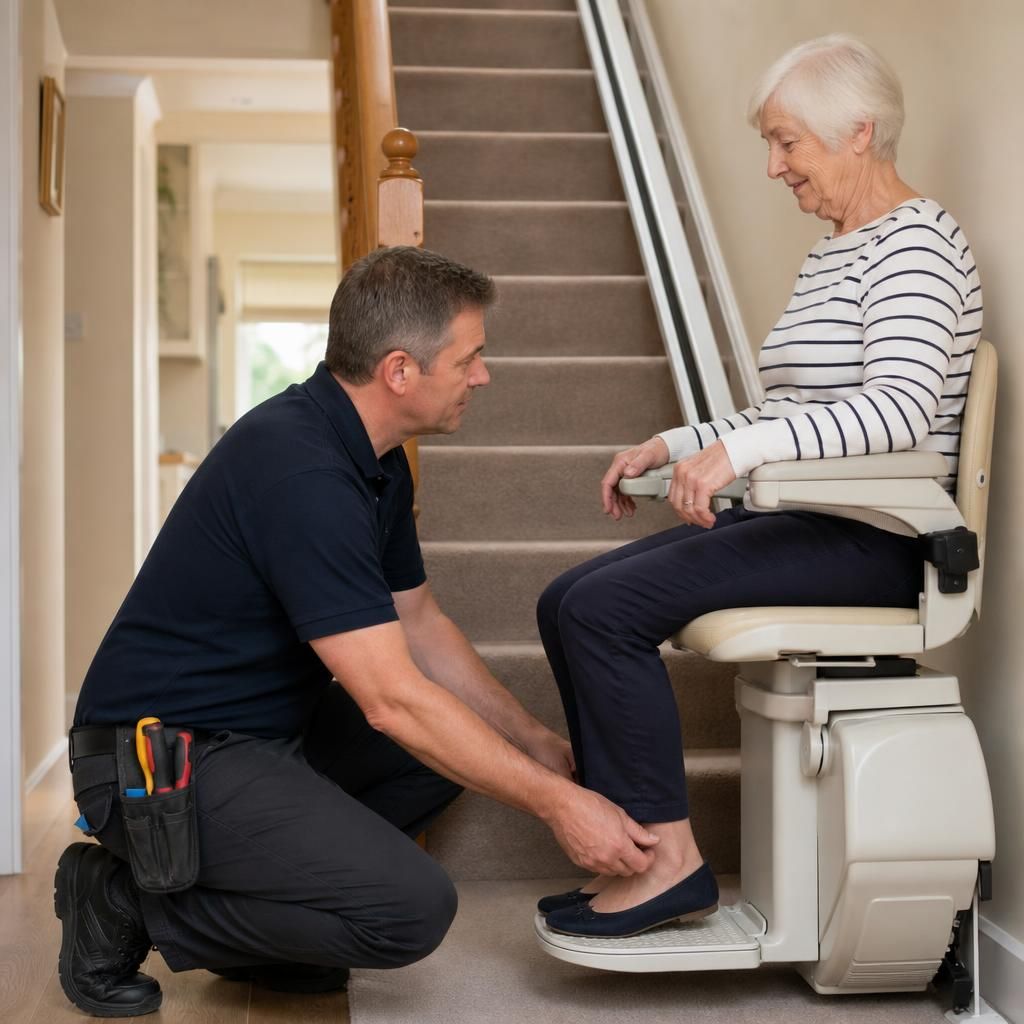
Arrange Your Reconditioned Stairlift Assessment
Arrange a home assessment to confirm that your reconditioned stairlift suits your staircase, the user and your access requirements. We’ll discuss the available options and provide a clear quotation covering fitting and aftercare.