
What are the key factors to consider when assessing the quality of a reconditioned stairlift before purchase?
Assess a reconditioned stairlift by checking its safety condition, battery and controls, service history, suitability for your staircase, installation quality, and the warranty and aftercare provided. A professional assessment should confirm that the stairlift is reliable, correctly fitted and appropriate for your mobility needs before you purchase.
The quality of a reconditioned stairlift is determined by its safety condition, reliability, suitability for the staircase, installation standard and the support provided after purchase—not simply by its age or appearance. Before buying, ask for a clear inspection and service history, test the lift under realistic conditions, confirm that the batteries and safety systems work correctly, and ensure the installation and warranty meet your needs.
Check the stairlift’s history and condition
Ask whether the stairlift has been professionally removed, inspected, cleaned and tested before being offered for sale. A reputable supplier should be able to explain its previous use where this information is available, identify the model and confirm which parts have been replaced or retained. Cosmetic wear is not necessarily a safety problem, but excessive damage, corrosion, cracked plastics, loose trim or signs of water ingress may indicate poor storage or rough handling.
Look for evidence that the lift has been assessed as a complete system rather than simply cleaned and resold. The carriage, rail, seat, armrests, footrest, controls and charging equipment should all be included and should operate together correctly. A missing manual, unidentified component or unclear model information makes it more difficult to obtain compatible parts and support in the future.
Examine the motor, drive system and movement
During a demonstration, the stairlift should start, stop and travel smoothly without juddering, excessive noise or unexplained pauses. Listen for grinding, clicking or straining from the motor and drive mechanism. The lift should maintain a consistent speed and should not appear to slip, hesitate or struggle on steeper sections of the staircase.
Test it in both directions and, where applicable, on bends, landings or changes in gradient. Movement that seems acceptable on a short straight section may reveal problems elsewhere on a curved rail. The carriage should remain stable throughout its travel, with no unusual rocking or looseness.
Pay particular attention to the batteries and charging system
Batteries are a service item and are among the components most likely to need replacement on a used stairlift. Ask when they were fitted and whether they have been tested under load, rather than relying only on the fact that the lift powers up. A stairlift with weak batteries may work briefly but fail to complete its normal journeys or stop when it is under greater demand.
Check that the lift charges correctly at its designated charging points and that the charger, power connection and indicator lights function as intended. If the stairlift has more than one charging position, test each one. The remote controls should call and send the lift reliably, and the controls on the armrest should respond without sticking or requiring excessive pressure.
Test every safety feature
A quality assessment must include the safety systems, not just the lift’s ability to travel. Depending on the model, check that:
- the seat belt or harness fastens securely and releases correctly;
- the swivel seat locks in its travel position and operates safely at the top of the stairs;
- the armrests, footrest and seat are secure and free from excessive movement;
- obstacle sensors stop or interrupt the lift when they detect an obstruction;
- the controls cannot be operated unintentionally;
- the emergency stop and other warning indicators work as described in the manual;
- the lift stops accurately at the intended landing positions; and
- any manual lowering, braking or emergency features are explained and tested appropriately.
Do not test safety sensors by placing a person or hand in a dangerous position. The installer or assessor should demonstrate the correct testing method and explain what to do if a fault occurs.
Confirm that it fits the staircase and the user
A reconditioned stairlift is only suitable if its rail and carriage are appropriate for the staircase and the person using it. A straight rail will not suit a staircase with bends, intermediate landings or changes of direction unless the design specifically accommodates them. For a curved stairlift, the rail must match the staircase’s individual measurements; a rail from another property is not automatically suitable simply because it appears similar.
A proper home assessment should consider the width and shape of the stairs, available space at the top and bottom, doorways, landings, radiator positions and any obstruction near the rail. It should also assess the user’s height, weight, balance, ability to transfer on and off the seat, and whether a powered swivel seat, hinged rail or other option is needed. Check that the footrest provides adequate support and that the user can operate the controls without twisting or stretching.
Ask the assessor to demonstrate where the stairlift will park and whether it will leave sufficient clear access for other people using the staircase. A technically successful installation can still be unsuitable if it blocks a doorway, leaves too little landing space or makes transfers difficult.
Inspect the rail and installation standard
The rail should be securely fixed, correctly aligned and free from damage, excessive corrosion or distortion. Fixings must be appropriate for the staircase and its construction, with no visible movement when the lift travels. The cable routing and charging points should be tidy and protected from damage, and the installation should not create avoidable trip hazards.
For a curved stairlift, check that joints, bends and parking sections are finished correctly and that the carriage travels smoothly through each section. For an outdoor model, inspect weather protection, seals, corrosion resistance and the condition of any outdoor charging equipment. Installation should be completed by a suitably trained professional who checks the finished system in the actual home rather than relying on a previous installation.
Ask for servicing, inspection and compliance records
Request written details of the checks carried out before sale, including any parts replaced, repairs completed and tests performed. The documentation should identify the stairlift and set out any limitations or recommended future servicing. If the supplier cannot explain what has been done to prepare the lift, treat that lack of information as a quality concern.
Ask how the stairlift has been assessed against the manufacturer’s instructions and applicable safety requirements. You should receive operating and safety information, details of the installer and a clear explanation of routine checks. Keep these documents, as they can be useful if the lift needs servicing or if you later move home.
Understand the warranty and aftercare
A warranty is an important indication of the supplier’s confidence in the stairlift, but read its terms carefully. Confirm what is covered, including the motor, batteries, charger, controls, rail and labour, and note any exclusions for wear items, accidental damage or misuse. Check how long cover lasts, whether call-outs and replacement parts are included, and who to contact if the lift stops working.
Ask about emergency response, planned servicing, battery replacement and support outside normal working hours. A clear aftercare process is particularly important for someone who relies on the stairlift every day. Establish whether the warranty applies only at the original address and what happens if the stairlift is moved, altered or sold on.
Compare the complete cost, not just the purchase price
Obtain a written quotation covering the stairlift, survey, delivery, installation, electrical work if required, removal of an existing lift, warranty and any optional features. A lower initial price may not represent good value if batteries need immediate replacement, the rail requires modification or installation and call-out charges are excluded.
Ask which parts are included as standard and whether the quoted model is being supplied with the correct seat, controls and safety equipment. If a lift needs substantial adaptation to fit the property, compare the overall cost and practical advantages with other suitable options rather than judging it as a standard reconditioned unit.
Use a practical pre-purchase checklist
- Has the stairlift been professionally inspected, serviced and tested?
- Are the model, age, previous use and replaced parts clearly explained?
- Do the motor, batteries, charger, controls and safety features work correctly?
- Has the staircase and the user’s mobility been assessed at home?
- Is the rail secure, correctly positioned and suitable for the staircase layout?
- Are operating instructions, service records and warranty terms supplied in writing?
- Are installation, servicing, repairs and emergency support clearly explained?
- Can the user try the stairlift and operate it safely before committing to the purchase?
If the supplier cannot provide a proper assessment, avoids demonstrating the safety systems or gives unclear answers about warranty and installation, delay the purchase until the information is available. A professional assessment should leave you satisfied that the reconditioned stairlift is safe, reliable, correctly fitted and appropriate for the user and the home.
A practical demonstration is one of the most reliable ways to assess a reconditioned stairlift before purchase. It shows whether the lift travels smoothly, reaches the correct stopping points and allows the intended user to operate the controls comfortably and safely.
The demonstration should take place on the staircase where the lift will be installed, rather than on a different showroom rail. Check that:
- the seat, swivel mechanism, belt, armrests and footrest are secure and easy to use;
- the user can transfer on and off the seat without excessive twisting or stretching;
- the lift starts, stops and changes direction smoothly;
- the controls respond consistently, including the remote controls; and
- the lift parks without blocking a doorway or leaving too little space on the landing.
Ask the installer to explain the obstacle sensors, emergency stop, charging points and procedure to follow if the stairlift stops. Do not test safety features by placing hands or feet near moving parts; the installer should demonstrate these safely and explain the correct checks.
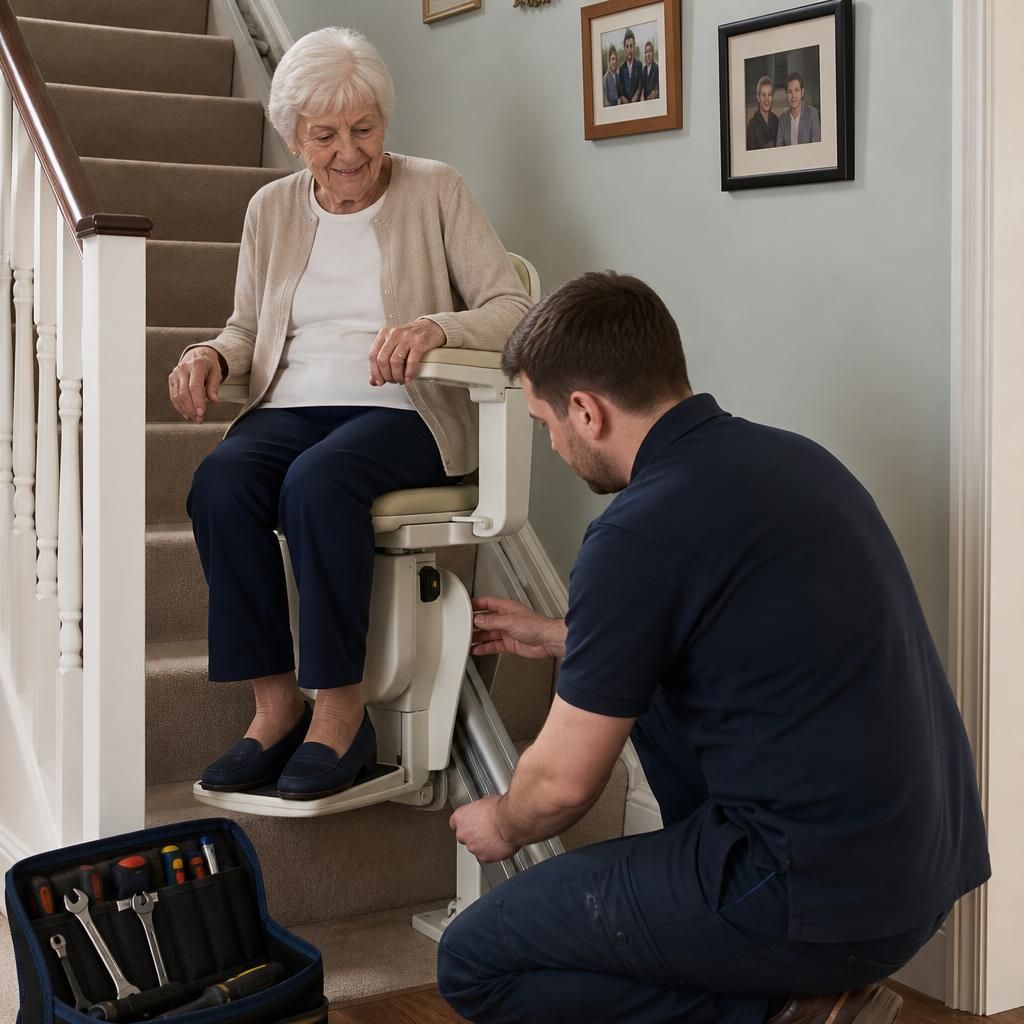
Arrange a Professional Reconditioned Stairlift Assessment
Arrange a professional reconditioned stairlift assessment to check the lift’s condition, safety features, staircase fit and suitability for the intended user. Independent Stairlifts can also explain the installation, warranty and aftercare included before you purchase.