
What are the environmental benefits of choosing a reconditioned stairlift over a new model?
Choosing a reconditioned stairlift can reduce environmental impact by extending the life of existing equipment, avoiding some of the raw materials, energy and manufacturing processes required for a new model. Professional inspection, replacement of worn parts and safe reuse also help keep usable components out of waste streams, although the overall benefit depends on the stairlift’s condition, refurbishment process and installation requirements.
A reconditioned stairlift can have a lower environmental impact than a new model because it keeps an existing lift, rail and other usable components in service for longer. This can reduce the need for new raw materials, manufacturing energy and packaging, while diverting equipment and parts from waste. The benefit is not automatic: it depends on the stairlift’s condition, the quality of its reconditioning, the parts replaced and how far it must be transported.
Choosing reconditioned equipment is an example of the circular economy. Rather than treating a stairlift as a disposable product at the end of its first installation, a suitable unit can be inspected, tested, repaired and installed in another home. Reuse usually preserves more of the product’s existing value than dismantling it for materials or sending it for disposal.
Reduced demand for raw materials
Manufacturing a stairlift requires materials such as steel, aluminium, copper, plastics, rubber and electronic components. These materials must be extracted, processed and formed before the lift can be assembled. Reconditioning a suitable stairlift reuses much of the existing structure, including the motor assembly, carriage, rail and control equipment where they remain safe and serviceable. This reduces the amount of new material needed for the replacement installation.
Some parts will normally be replaced as a matter of safety or reliability. Examples can include batteries, drive components, rollers, switches, covers, wiring or fixings, depending on the model and inspection findings. However, replacing selected worn parts is generally different from manufacturing an entirely new stairlift, because the main equipment may remain in use.
Lower manufacturing and processing requirements
A new stairlift involves a complete manufacturing process, from producing materials and components to assembling, testing and preparing the finished product. Reconditioning focuses on recovering the useful life of equipment that already exists. Cleaning, electrical checks, mechanical inspection and the replacement of worn components still require resources, but these activities can avoid some of the production stages associated with a new unit.
The environmental advantage is greatest when a reconditioned stairlift is technically suitable and can be prepared without extensive replacement of major components. A lift that needs substantial repair may provide less benefit than one that is already in good condition. Responsible assessment is therefore important: environmental considerations should never override the requirements for safe operation, reliability and suitability for the staircase.
Less waste and better use of components
Reconditioning can prevent usable equipment from entering the waste stream prematurely. Rails, seats, armrests, motors, carriages and control systems may all have further serviceable life, provided they are compatible with the proposed installation and pass appropriate checks. Recovering these components makes better use of the resources already invested in them.
When parts cannot be reused, they should be separated and handled responsibly. Batteries, electrical components and certain metals should not be placed in ordinary household waste. A professional provider should identify components that require appropriate recycling or disposal and should avoid installing parts that are excessively worn, damaged or no longer supported.
Less packaging and associated transport
A reconditioned stairlift may require less packaging than a completely new product, particularly where components are prepared locally for a specific installation. It may also avoid some of the transport associated with supplying newly manufactured equipment. These effects vary according to where the lift is sourced, where it is reconditioned and the distance to the customer’s home.
Transport still forms part of the environmental assessment. A suitable reconditioned lift sourced and installed efficiently may be preferable to an unsuitable unit that requires long-distance movement or extensive modification. Combining the assessment, preparation and installation where practical can help avoid unnecessary journeys.
Extending the life of the stairlift
Product life is an important part of environmental performance. The longer a safe, maintainable stairlift remains in use, the more effectively the original materials and manufacturing effort are used. Routine servicing, prompt repairs and correct operation can support that longer service life after installation.
For this reason, aftercare matters as much as the initial purchase decision. Keep the lift clean and free from obstructions, follow the operating guidance and report unusual noises, movement or charging problems promptly. A professional inspection can determine whether a repair is appropriate and whether replacement parts remain available.
Reconditioned does not mean simply second-hand
An environmentally responsible reconditioned stairlift should not be treated as an unchecked used product. It should be assessed for its mechanical and electrical condition, cleaned, tested and prepared for safe reuse. The installation must also be suitable for the staircase, including its width, layout, curvature, landing arrangements and any access requirements.
A good assessment considers the customer’s mobility needs as well as the equipment’s condition. For example, seat dimensions, swivel or powered functions, control positions, weight capacity, transfer requirements and battery performance may affect whether a particular reconditioned model is appropriate. Choosing a lift that is unsuitable could lead to early replacement, which would reduce the expected environmental benefit.
Environmental points to check before buying
- Ask what inspection and testing the stairlift has undergone before installation.
- Find out which parts have been replaced and whether replacement components are available for future repairs.
- Confirm that the rail and carriage are suitable for the exact staircase rather than assuming that a standard configuration will fit.
- Check how removed batteries, electrical parts and unusable components will be recycled or disposed of.
- Consider the likely service life, maintenance requirements and aftercare support, not only the initial reuse of the equipment.
- Make sure the warranty or guarantee provides appropriate protection if a fault develops after installation.
When a new stairlift may be the better environmental choice
A new model may be more appropriate where the staircase has unusual dimensions, where a particular set of functions is required or where a reconditioned unit would need extensive modification. A new lift may also offer updated technology, improved energy management or more readily available parts, although these advantages should be weighed against the materials and manufacturing involved in producing it.
The most sustainable choice is therefore not simply the oldest or cheapest stairlift available. It is a safe, durable and properly matched solution that is likely to remain useful for a long period and can be maintained rather than replaced prematurely. For many suitable homes, a professionally reconditioned stairlift achieves this by reusing valuable equipment while reducing demand for new resources and limiting avoidable waste.
The main environmental benefit of a reconditioned stairlift is that it extends the useful life of equipment already manufactured. Reusing the rail, carriage, motor and other serviceable components can reduce the need for new raw materials, manufacturing energy and packaging, while helping to prevent usable parts from becoming waste.
This benefit depends on professional assessment and preparation. Worn or safety-critical parts should be replaced, and batteries and electrical components should be recycled or disposed of responsibly. A reconditioned stairlift that is correctly matched to your staircase and maintained after installation is more likely to remain in service for longer, making better use of the resources already invested in it.
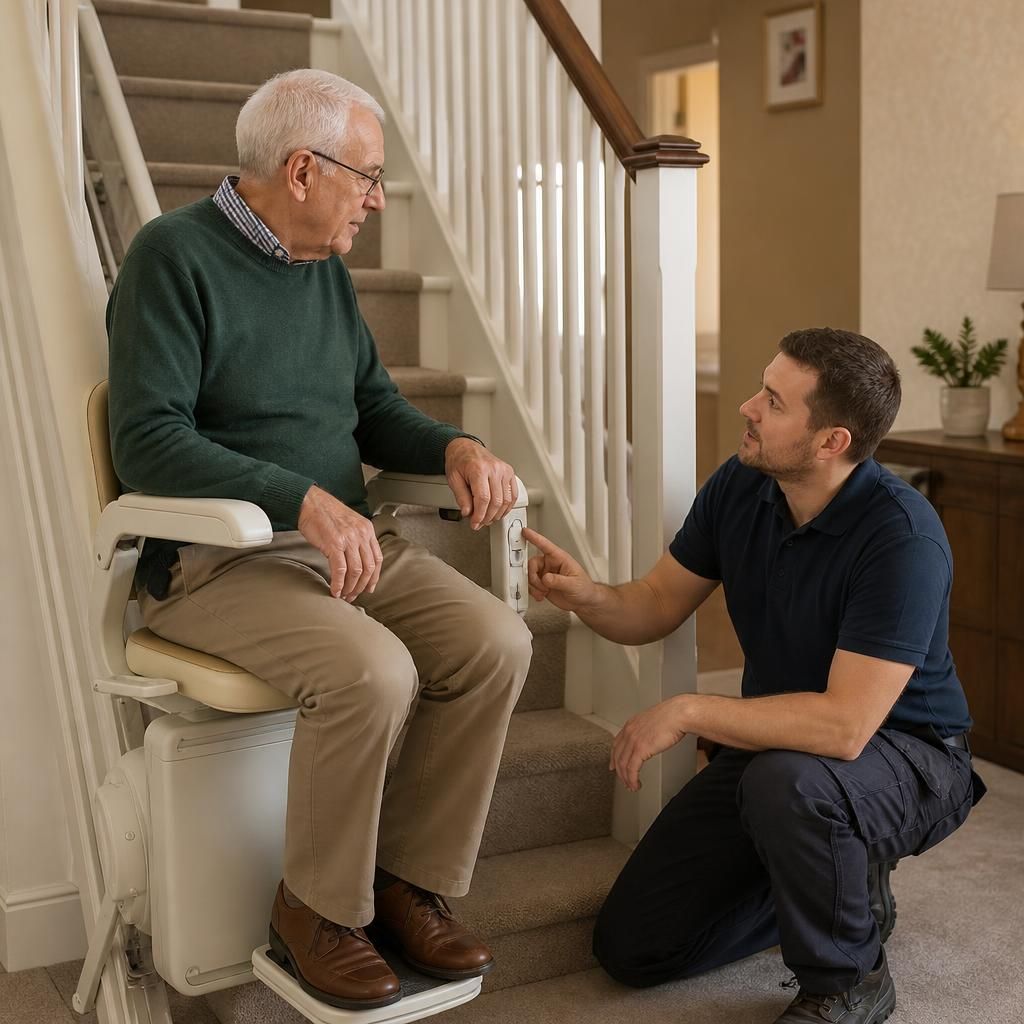
Discuss a suitable reconditioned stairlift for your home
Discuss a suitable reconditioned stairlift for your home with our team. We can assess your staircase, mobility requirements and the condition of available equipment to identify a safe, practical option.