
What are the criteria to determine if a reconditioned stairlift will fit the unique dimensions and curvature of my staircase?
A reconditioned stairlift will fit if its rail can be accurately matched to your staircase’s length, width, landings, bends, gradients and available clearance, while the seat, controls and safety features suit the user. A professional survey should measure the staircase and check the specific reconditioned model before installation, as curved lifts are usually tailored to the individual staircase rather than transferred without assessment.
A reconditioned stairlift will fit only when the rail, carriage, seat and safety features are compatible with both the staircase and the person using it. The assessment must cover the staircase’s length, width, gradient, bends, landings, available clearance and fixing points, as well as the user’s height, weight, mobility and transfer needs. A professional survey is therefore essential before a specific reconditioned model is approved for installation.
The staircase measurements that matter
- Overall length: The rail must follow the usable travel path from the intended boarding point to the destination. This includes any approach to the top or bottom landing where the user needs to get on or off safely.
- Width and clearance: The survey should establish the clear width of the stairs, including any handrails, dado rails, radiators, cupboards, doorways or other obstructions. There must be enough room for the stairlift and a safe route for other people using the stairs.
- Gradient: Changes in pitch, steep sections and transitions between flights can affect which carriage and rail system are suitable. A model designed for a conventional straight staircase may not be appropriate where the angle changes.
- Landings: The size and shape of the top and bottom landings determine where the lift can park and whether the user can turn or transfer safely. A short landing may require a different rail arrangement, a swivel seat or another exit option.
- Bends and curves: An internal or external curve, intermediate landing, spiral section or tight turn needs to be measured and mapped accurately. These features usually rule out a standard straight rail.
- Obstructions and access points: Doors, architraves, radiators, low ceilings and nearby furniture can affect the rail position and the space required for the seat, footrest and user’s knees.
Straight and curved staircases require different checks
A straight reconditioned stairlift is generally considered where the staircase has a consistent direction and gradient between the boarding and exit points. Even then, the available rail length, parking position, fixing locations and landing clearance must be checked. A used straight rail may sometimes be adjusted or cut to suit a particular installation, but this depends on its design and condition. It should never be assumed to fit solely because the staircase appears similar to the original installation.
Curved stairlifts are normally manufactured or configured for the specific staircase. The rail follows the individual bends, angles and landings, so a curved rail removed from another property will rarely transfer directly to a different staircase. Reuse may be possible in limited circumstances if the staircase geometry is sufficiently compatible and the manufacturer or installer confirms that the rail can be safely adapted. A physical inspection and accurate survey are required before treating a curved lift as suitable.
The user’s measurements are part of the fit
Physical installation is only one aspect of suitability. The seat must provide a stable and comfortable position, with controls that the user can operate reliably. The assessor should consider height, leg length, hip and shoulder width, weight capacity, ability to bend the knees, strength when transferring and whether the user can remain seated throughout the journey.
Particular attention is needed where the user has limited balance, restricted hip or knee movement, a larger frame or difficulty turning at the top or bottom of the stairs. A powered swivel seat, hinged or powered rail, retractable seat belt, different armrest arrangement or alternative parking position may be appropriate. These options can change the space required, so they must be assessed alongside the staircase rather than added after installation has been planned.
Important compatibility checks for a reconditioned model
- Confirm that the rail length and configuration match the measured staircase.
- Check that the carriage is compatible with the rail and that the drive system can operate safely on the staircase gradient.
- Check the seat dimensions, weight capacity, swivel mechanism, footrest and safety belt against the user’s requirements.
- Inspect the condition of the rail, rack, drive components, batteries, charging equipment, seat and safety sensors.
- Confirm that the controls can be positioned where the user can reach them and that remote controls will work from the intended parking points.
- Check whether the proposed installation needs a hinged rail, extra parking space, a powered swivel or other option to keep doorways and walkways clear.
- Establish that the electrical supply and charging points can be safely located and that the installation will not create a trip hazard.
A reconditioned stairlift should also be assessed as a complete system, rather than as a seat or rail in isolation. Components from different models are not automatically interchangeable, and a replacement part may affect compatibility, safety functions or servicing. The installer should identify the model, inspect its condition and confirm that the proposed configuration is appropriate before agreeing the installation.
What happens during a professional survey
- The assessor examines the full staircase, including the stairs, landings, surrounding walls, doors and possible obstructions.
- Measurements and photographs or digital data are taken to record the staircase’s shape, gradient, clearances and fixing points.
- The user’s mobility, transfer method, seating position and control requirements are discussed.
- Suitable straight or curved configurations are compared with the available reconditioned equipment.
- The proposed boarding and exit positions, parking arrangements, charging points and any required options are checked for safe day-to-day use.
- The installer confirms whether the available stairlift can be adapted, or explains if a different model or bespoke rail is needed.
Ask for the survey to distinguish between a stairlift that can be physically installed and one that is genuinely suitable for regular use. The final recommendation should explain any limitations, adaptations, clearance issues and aftercare arrangements. If the staircase has unusual curves, a split-level landing, restricted headroom or limited space at either end, do not rely on photographs or the dimensions of a previous stairlift; these details need to be checked on site.
In practical terms, a reconditioned stairlift is most likely to fit when the staircase is accurately surveyed, the rail geometry matches the route, the lift provides the required clearances and the seat and controls suit the user. Straight models may offer more opportunities for adaptation, while curved installations usually require a rail made or configured for the individual staircase. A trained installer can confirm compatibility before purchase and identify any changes needed for a safe, usable installation.
A reconditioned stairlift will fit a curved staircase only if its rail geometry matches the staircase’s bends, gradients, landings and parking areas. Unlike many straight rails, curved rails are usually made or configured for one particular staircase, so a rail removed from another home cannot be assumed to transfer safely.
A professional survey should check:
- the direction and tightness of each bend;
- changes in gradient and intermediate landings;
- available clearance for the seat, footrest and other stair users;
- boarding and exit positions at the top and bottom; and
- whether the existing rail can be safely adapted and supported by compatible components.
Photographs or measurements from a previous installation are not enough to confirm suitability. The installer should inspect the staircase, identify the complete reconditioned system and confirm that the rail, carriage, controls and safety features work together before purchase or installation is agreed.
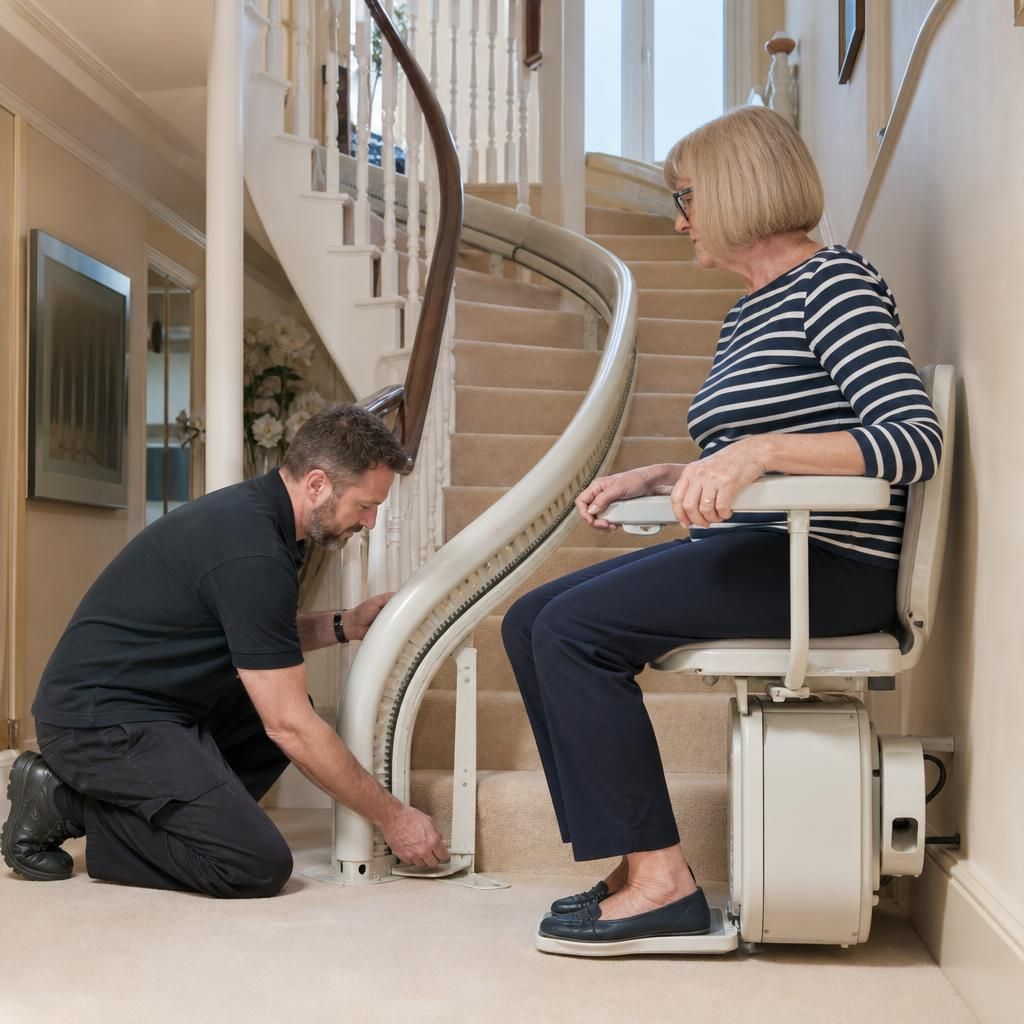
Book a Survey to Check Your Reconditioned Stairlift Fit
Book a professional survey to confirm whether your reconditioned stairlift’s rail, carriage and safety features suit your staircase and mobility needs. Independent Stairlifts can assess the measurements, curvature, clearances and installation requirements before you commit to a specific model.