
How can I ensure the reconditioned stairlift I purchase will fit my home needs?
Choose a reconditioned stairlift only after a professional assessment confirms that its rail, seat, controls and safety features suit your staircase, available space and mobility needs. An accurate survey should check the stairway’s shape and dimensions, access at the top and bottom, and whether the lift can be safely installed and supported in your home.
A reconditioned stairlift will meet your home needs only when its rail, seat, controls and safety features have been checked against both your staircase and the person using it. A professional home survey is therefore essential before purchase. The survey should assess the staircase’s shape and dimensions, access at the top and bottom, available space, electrical requirements and the user’s mobility, rather than relying on a model’s general specification.
Start with a detailed staircase assessment
Identify whether your stairs are straight, curved, split-level or include an intermediate landing. A straight stairlift may suit a single, uncomplicated flight, while a staircase with bends, a landing or changes in direction usually requires a rail made for that layout. Some reconditioned curved stairlifts can be adapted or matched to an existing rail, but compatibility must be confirmed at the survey. A previously used rail is not automatically suitable simply because it came from a similar-looking staircase.
The survey should record the dimensions and features that affect installation, including:
- the width and length of each flight;
- the angle and profile of the stairs;
- the position and size of landings;
- the space available at the top and bottom of the stairs;
- doorways, cupboards, radiators, bannisters and other obstructions;
- the position of nearby electrical sockets and the proposed charging points; and
- any unusual features, such as narrow steps, a half-landing, a spiral section or a staircase that changes width.
Measurements are particularly important at the top and bottom of the staircase. The lift may need to travel beyond the final step, turn on a landing or park in a position that keeps the route clear. A powered or manually operated swivel seat, folding footrest, hinged rail or alternative parking position may be considered where a standard arrangement would obstruct a doorway or reduce access.
Check the lift against the user, not just the stairs
The correct reconditioned stairlift must also suit the person who will use it. Consider their height, weight, balance, ability to transfer on and off the seat, leg position, grip strength, eyesight and ability to operate the controls. A seat that appears suitable in a brochure may be less practical if the user needs additional support, has difficulty bending their knees or cannot comfortably reach a control.
Discuss features such as a swivel seat, adjustable armrests, a powered footrest, a manual or powered swivel, a perch-style seat or a different seat width where appropriate. The user should be able to sit securely, place their feet safely on the footrest and operate the lift without unnecessary stretching. If more than one person will use the stairlift, the assessment should take each person’s requirements into account.
Weight capacity is another essential check. Confirm the manufacturer’s stated limit for the specific lift being offered, taking account of clothing, walking aids and anything the user may carry. Do not assume that every lift in the same product range has the same capacity or seat dimensions.
Confirm that the reconditioned equipment is suitable
Ask which parts are being supplied with the lift and which, if any, will be replaced or adapted for your home. A properly prepared reconditioned stairlift should be inspected, cleaned, safety-checked and tested before installation. The installer should be able to explain the condition of the battery, drive system, seat, controls, sensors, charging equipment and rail.
For a curved stairlift, establish whether the rail is being reused, modified or manufactured to match your staircase. The fit should be based on a survey of your home rather than on photographs or dimensions from the lift’s previous installation. For a straight stairlift, the rail length and parking position still need to be checked, particularly where the stairs are unusually long or space is restricted at either end.
It is also sensible to confirm the age and availability of replacement parts, batteries and remote controls. A lower purchase price may be less useful if essential components are difficult to source or if the equipment cannot be supported locally. Ask for the model details, the work included in the preparation, and any limitations that apply to the reconditioned unit.
Consider the installation environment
The stairlift must be fixed securely to the stairs or supporting structure in accordance with the installation requirements for that model. The survey should identify whether the staircase, treads and fixings are sound, and whether any repairs or alterations are needed before installation. The installer should also consider the position of charging points and whether cables can be routed safely without creating a trip hazard.
Check how the lift will affect everyday use of the stairs. When folded, the seat, arms and footrest should leave as much usable stair width as the installation allows. At landings and doorways, the parked lift should not create an avoidable obstruction. If other household members, carers or visitors use the stairs, their access should be included in the assessment.
Outdoor or exposed staircases require additional checks. The equipment must be intended for the environment, with suitable protection from weather and a safe electrical arrangement. A standard indoor reconditioned stairlift should not be installed outdoors merely because its rail appears to fit.
Use the survey to compare suitable options
Before agreeing to purchase, ask the surveyor to explain why the proposed model and configuration are suitable. You should receive clear information about:
- where the lift will park;
- how much stair and landing space will remain;
- which seat and control features are included;
- what happens if the power fails;
- how the batteries are charged and maintained;
- what warranty or guarantee applies to the reconditioned equipment;
- who to contact for servicing or a breakdown; and
- whether removal, relocation or alterations are included in the quoted work.
Where possible, try the proposed seat and controls before installation, particularly if the user has limited mobility or is uncertain about transferring. A demonstration can reveal whether the seat height, armrests, joystick or remote controls are practical. It is also useful to discuss whether the lift can be removed or relocated later, although a curved rail may not transfer to another staircase without modification.
Do not rely on photographs or a general measurement
Photographs can help with an initial discussion, but they cannot establish whether a stairlift is safe and practical for a particular home. Small differences in landing shape, bannister position, ceiling clearance or door location can affect the installation. A quote based only on a standard price or a brief description of the staircase may not identify these issues.
The safest approach is to arrange an in-home assessment, provide accurate information about the user’s mobility and ask for the proposed configuration in writing. If the survey identifies an unsuitable rail, restricted clearance or a mismatch between the equipment and the user, the right outcome may be a different reconditioned model or a new stairlift rather than forcing the available unit to fit.
In practical terms, choose the reconditioned stairlift only when the assessment confirms three things: it can be installed securely on your staircase, it leaves safe and usable access around the stairs, and the user can operate it comfortably and independently, or with the level of assistance they require. This approach ensures that the saving associated with reconditioned equipment does not come at the expense of fit, safety or ongoing support.
A professional home survey is the most reliable way to confirm that a reconditioned stairlift will fit your staircase and meet the user’s needs. The assessment should check the stairway’s shape, width, landings, clearances, obstructions, parking position and charging arrangements before a model is selected.
This is particularly important for curved stairlifts, as a rail from another property will not necessarily suit your staircase. The installer should also check that the seat, controls, footrest and weight capacity are appropriate for the user, and explain how much access will remain when the lift is parked or folded. Do not rely on photographs, a general measurement or a low price alone; the proposed configuration should be confirmed after an in-home assessment.
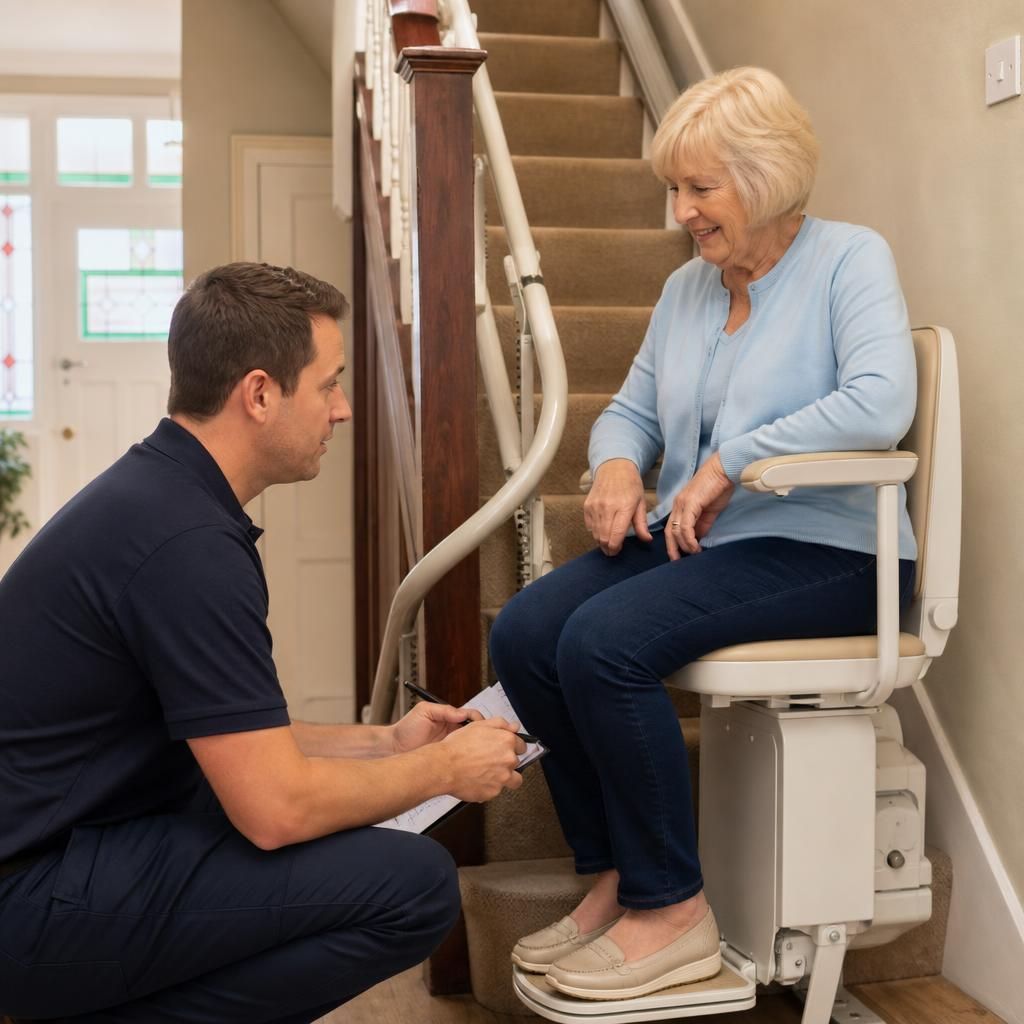
Arrange Your Reconditioned Stairlift Home Assessment
Arrange a professional home assessment to confirm that your reconditioned stairlift will fit your staircase, leave safe access and meet the user’s mobility needs. Contact Independent Stairlifts to discuss your requirements and the most suitable configuration.