
How are reconditioned stairlifts different from refurbished stairlifts?
The terms reconditioned and refurbished are often used interchangeably, but neither has a single industry-wide definition. In practice, a reconditioned stairlift should have been inspected, safety-checked, cleaned and repaired or replaced where necessary, while “refurbished” may refer more broadly to restoring its appearance or working condition, so always confirm the actual checks, parts replaced, warranty and aftercare included.
Reconditioned and refurbished stairlifts are not separated by a universally agreed industry definition. In practice, “reconditioned” usually describes a used stairlift that has been inspected, safety-checked, cleaned, tested and repaired or fitted with replacement parts where required. “Refurbished” can mean a similar process, but may also refer mainly to improving the stairlift’s appearance or restoring basic operation. The important distinction is not the label itself, but the work completed, the condition of the components, the installation standard and the support provided afterwards.
A stairlift may be described as reconditioned when it has been prepared for another installation after being removed from a previous home. Preparation should involve more than cleaning the seat and rail. The installer should assess the lift’s mechanical, electrical and safety systems, identify worn or damaged components, and confirm that the equipment is suitable for continued use.
A refurbished stairlift may also have undergone thorough inspection and repair. However, the term is sometimes used more loosely. It could mean that the unit has been cleaned, given replacement covers or had selected parts changed, without necessarily indicating the extent of the safety testing or preventative maintenance carried out. Some suppliers use “refurbished” and “reconditioned” to describe the same level of preparation, so you should ask for a precise explanation before comparing quotations.
The main differences to investigate are:
- Inspection: Find out whether the complete stairlift has been assessed, rather than only the visible or faulty parts.
- Safety testing: Ask which safety features have been checked, including the braking system, seat belt, sensors, controls, charging system and obstruction detection.
- Replacement parts: Confirm whether worn batteries, rollers, wiring, switches or other components are replaced as a matter of course or only when they have completely failed.
- Cosmetic work: Cleaning, repainting or replacing upholstery can improve appearance, but cosmetic restoration does not by itself demonstrate mechanical reliability.
- Testing after preparation: The lift should be tested under operating conditions and checked for smooth, controlled movement before installation.
- Installation: A used stairlift still needs to be correctly measured, fitted, commissioned and demonstrated in your home. Reusing an existing rail or adapting a previously installed unit is not automatically suitable for a different staircase.
- Warranty and aftercare: Check what is covered, how long cover lasts, whether labour and call-outs are included, and who will provide repairs if a fault develops.
Condition and age are also relevant, but they do not tell the whole story. A well-maintained older stairlift that has been properly inspected may be a more appropriate choice than a newer used unit with an incomplete service history. Conversely, a stairlift that looks almost new may still need batteries or other internal components replaced if it has been stored for a prolonged period. Battery condition is particularly important because batteries can deteriorate through age and lack of use, not only through frequent operation.
There can be a difference in the parts used during preparation. Ask whether replacement components are manufacturer-approved or compatible parts, and whether the installer can explain why a particular component has been changed. This does not mean every component must be new, but essential safety and reliability items should be suitable for the model and installed correctly.
A reconditioned or refurbished stairlift should also be assessed against your particular staircase and mobility needs. A straight lift may be transferable between homes only where the rail length, landing arrangement, access points and installation position are suitable. Curved stairlifts are generally made for a specific staircase, although some sections or components may be reusable. The seat, swivel mechanism, controls, footrest and weight capacity must also be appropriate for the person using the lift, including their ability to transfer safely on and off the seat.
Before agreeing to a purchase or installation, ask for the following information:
- The stairlift’s make, model and approximate age.
- Whether it was previously installed and, if so, whether its service or maintenance history is available.
- What inspection, cleaning, servicing and safety testing have been completed.
- Which parts have been replaced and whether the batteries are new or tested.
- Whether the quoted price includes a home assessment, installation, commissioning and user instruction.
- What the warranty covers, including parts, labour, batteries and engineer visits.
- Whether future servicing and emergency support are available in your area.
- Whether the supplier will remove or dispose of the stairlift if it is no longer required, and whether removal affects the warranty or any refund arrangement.
Be cautious of descriptions such as “as seen”, “fully working” or “refurbished” when they are not supported by a written condition report or clear warranty terms. “Fully working” may only describe the condition at the time of sale and may not confirm that the lift has been prepared for your staircase or checked by a competent installer.
For most customers, the safest way to compare a reconditioned and refurbished stairlift is to ignore the terminology initially and compare the specification and service package. Consider the condition of the lift, the suitability of the installation, the testing completed, the parts supplied, the warranty and the availability of aftercare. A properly reconditioned stairlift and a thoroughly refurbished stairlift may offer equivalent value; the difference lies in the evidence that the necessary work has actually been carried out.
A professional home assessment should confirm whether the proposed stairlift will fit the staircase, leave suitable access at the top and bottom, and work safely with the user’s mobility and transfer requirements. Ask the installer to explain any limitations before installation and keep the warranty and service documentation for future reference.
“Reconditioned” and “refurbished” are not standardised industry terms, so the label alone does not confirm the stairlift’s condition. A reconditioned model will generally have been inspected, safety-tested, cleaned and repaired for reuse, while refurbished may describe anything from a full technical overhaul to mainly cosmetic improvements.
Before comparing either option, ask for written details of the work completed. Confirm that the batteries, sensors, controls, braking system and obstruction detection have been checked, and find out which parts were replaced. The warranty should also state whether parts, labour and engineer call-outs are included. A properly tested and installed refurbished stairlift may be as suitable as a reconditioned one; the evidence of preparation matters more than the terminology.
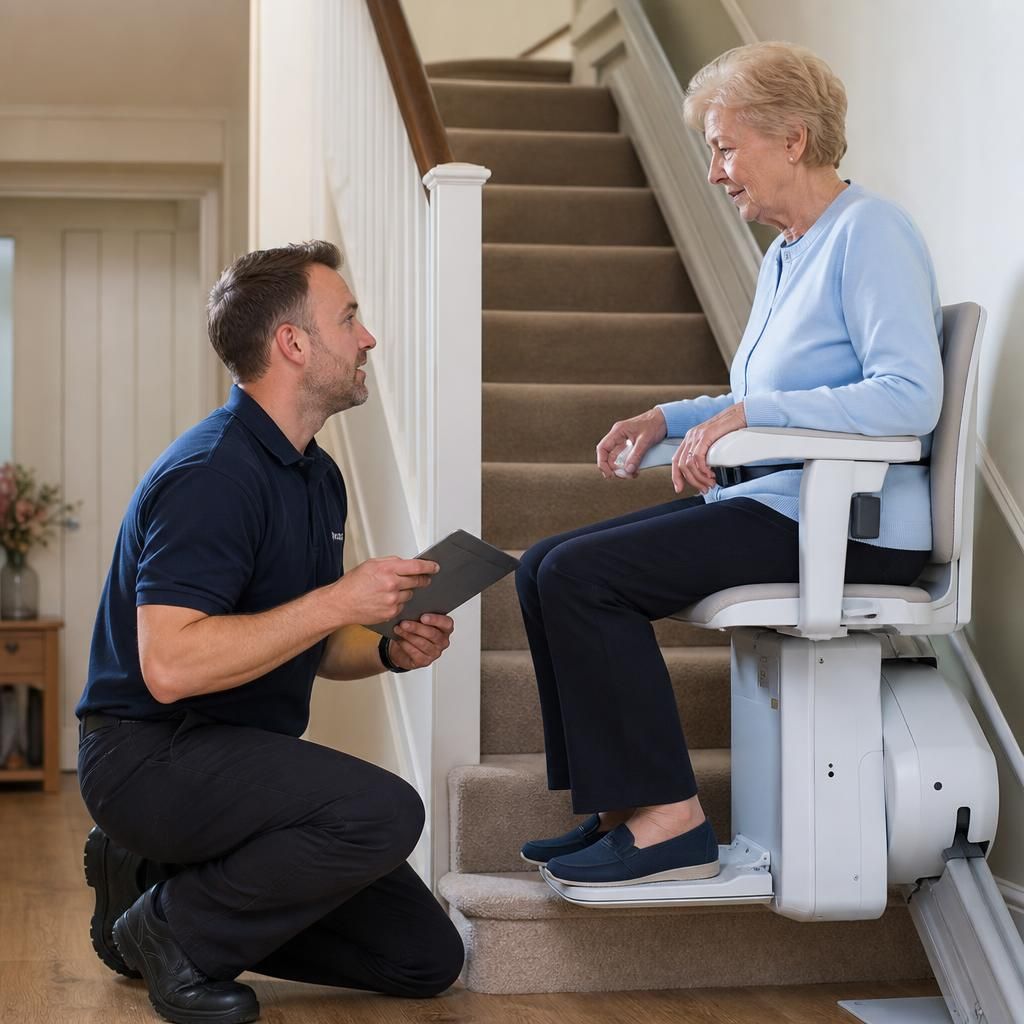
Discuss your reconditioned stairlift options
Discuss your reconditioned stairlift options with our team to compare suitable models, installation requirements, warranty cover and aftercare for your staircase. We can help arrange an assessment and explain which solution best meets your needs.