
Are there specific installation requirements or considerations for reconditioned stairlifts compared to new units?
Reconditioned stairlifts require the same safe installation standards as new units, including a suitable home survey, secure rail fitting, compatible electrical supply and thorough safety checks. The main additional consideration is confirming that the pre-owned lift, rail and components are in suitable condition and correctly matched to your staircase, which should be assessed and completed by a qualified installer.
Reconditioned stairlifts must meet the same safety and installation requirements as new units. The additional consideration is that the lift and, in some cases, the rail have already been used, so their condition, compatibility and suitability for your staircase must be checked carefully before installation. A qualified installer should complete a home survey, confirm that the equipment is correctly matched to the staircase and carry out full safety checks once it is fitted.
A home survey is essential
Installation should begin with an assessment of the staircase and the person who will use the stairlift. The surveyor will normally check:
- Whether the staircase is straight, curved, narrow, steep or interrupted by landings.
- The available width for safe passage alongside the stairlift.
- Clearance at the top and bottom of the stairs, including doors, hallways and landings.
- Potential obstructions such as radiators, handrails, windowsills, furniture and doorways.
- Whether the stairs, walls and floor can support the proposed installation securely.
- The user’s mobility, posture, transfer ability, weight requirements and preferred controls.
- Where the lift can be parked without obstructing an exit or creating a trip hazard.
Measurements are particularly important for a reconditioned unit. A straight stairlift may be suitable for more than one staircase if its rail length and design are compatible, but it is not automatically interchangeable between homes. Curved stairlift rails are usually made for a particular staircase, so a pre-owned curved unit may need to be adapted or may not be suitable at all. The installer should confirm this before any fitting is agreed.
Checking the reconditioned equipment
A reconditioned stairlift should be assessed before installation rather than treated as ready to fit simply because it has been previously used. The installer should inspect and test the lift, rail and associated components, including:
- The motor, drive mechanism, gears and braking system.
- The rail, brackets, joints and fixings for wear, damage, distortion or corrosion.
- The seat, swivel mechanism, armrests, footplate and safety sensors.
- The control switches, remote controls, charging points and display functions.
- The batteries, charger and electrical connections.
- Safety belts, obstruction sensors and any manual lowering or emergency functions.
Parts may be replaced where required, but the condition of the complete system matters. A good installation is not achieved by fitting a serviceable chair to an unsuitable, damaged or poorly matched rail. The installer should also confirm that the model’s controls and seating arrangement are appropriate for the user, particularly where a reconditioned lift has been configured for someone with different needs.
Rail fitting and structural considerations
The rail is normally fixed to the stair treads or another suitable structural surface using brackets. It should be aligned correctly, securely fastened and positioned to provide safe clearance from the stairs and surrounding fixtures. Existing holes or bracket positions from an earlier installation should not automatically be reused; their suitability depends on the new layout, the condition of the surface and the manufacturer’s installation requirements.
Curved installations require additional care because the rail must follow the staircase accurately. The installer may need to assess changes in direction, intermediate landings, narrow sections and the available parking positions. A rail that was designed for another staircase cannot generally be assumed to fit a different one without detailed measurements and, where appropriate, modification by a competent specialist.
Electrical supply and charging
Most modern stairlifts use rechargeable batteries and charge through contacts positioned at one or more parking points. The survey should establish that a suitable electrical socket and supply are available, that the charging position is practical and that the lift can remain charged when parked. The electrical connection should be installed and tested safely, with cables kept away from steps, moving parts and walking routes.
Older or reconditioned equipment may have batteries or charging components that require closer inspection. Batteries are consumable items and may need replacement if they do not hold charge correctly. A lift should not be put into regular use until the charger, batteries and charging contacts have been tested as part of the commissioning process.
Safety checks after installation
Once fitted, the stairlift should be operated through its full travel and checked under normal conditions. This includes testing the start and stop controls, safety belt, swivel seat, footplate, sensors, braking, remote controls, charging and any hinged or powered rail sections. The installer should check that the lift stops when it encounters an obstruction and that it parks securely at the agreed position.
The finished installation should also be checked for practical hazards. The lift must not block essential access, prevent a door from opening safely or leave the user unable to transfer on or off the seat. The installer should explain how to use the controls, charge the lift, respond to a fault and contact the appropriate aftercare service. Operating instructions and warranty information should be provided for the particular unit installed.
How installation differs from a new stairlift
The fitting process itself is broadly similar for a new and a reconditioned stairlift. Both require accurate measurements, secure rail installation, suitable electrical arrangements, commissioning and user instruction. The difference is the level of pre-installation verification. With a new unit, the equipment is supplied unused and configured as part of the order. With a reconditioned unit, the installer must additionally verify its service history where available, inspect previously used components, confirm that it has been correctly serviced and establish whether any parts need replacing.
Reconditioned equipment can also have cosmetic wear or minor marks that do not affect operation. These should be distinguished from functional defects such as excessive movement, unusual noise, unreliable controls, damaged safety components or poor battery performance. Ask for any known limitations to be explained before installation.
What to confirm before the appointment
- That a survey has confirmed the lift is suitable for the exact staircase, rather than only a similar-looking layout.
- Whether the rail is new, previously used or modified, and how its condition has been assessed.
- Which components have been serviced or replaced.
- That the seat, controls and weight capacity are appropriate for the intended user.
- Where the lift will park and whether it will affect doors, walkways or emergency access.
- What warranty, servicing and fault-support arrangements apply to this particular reconditioned unit.
- What will happen if the equipment is found to be unsuitable during the survey or installation.
In practical terms, a reconditioned stairlift should not be installed on the basis of price or appearance alone. The important requirements are a reliable assessment of the staircase, a properly inspected and compatible lift, secure fitting by a competent installer and documented safety testing before handover. These checks help ensure that a pre-owned unit provides safe, dependable access in your home.
Before a reconditioned stairlift is installed, a qualified installer must confirm that the lift and rail are suitable for the exact staircase. Previous use does not guarantee compatibility, particularly where a curved rail was made for a different home.
The survey should check the staircase dimensions, available clearance, parking positions, surrounding doors and fixtures, and the user’s transfer and seating requirements. The installer should also inspect the motor, rail, batteries, controls and safety features before fitting. Any worn or unsuitable components must be replaced, and the completed installation should be fully tested before handover.
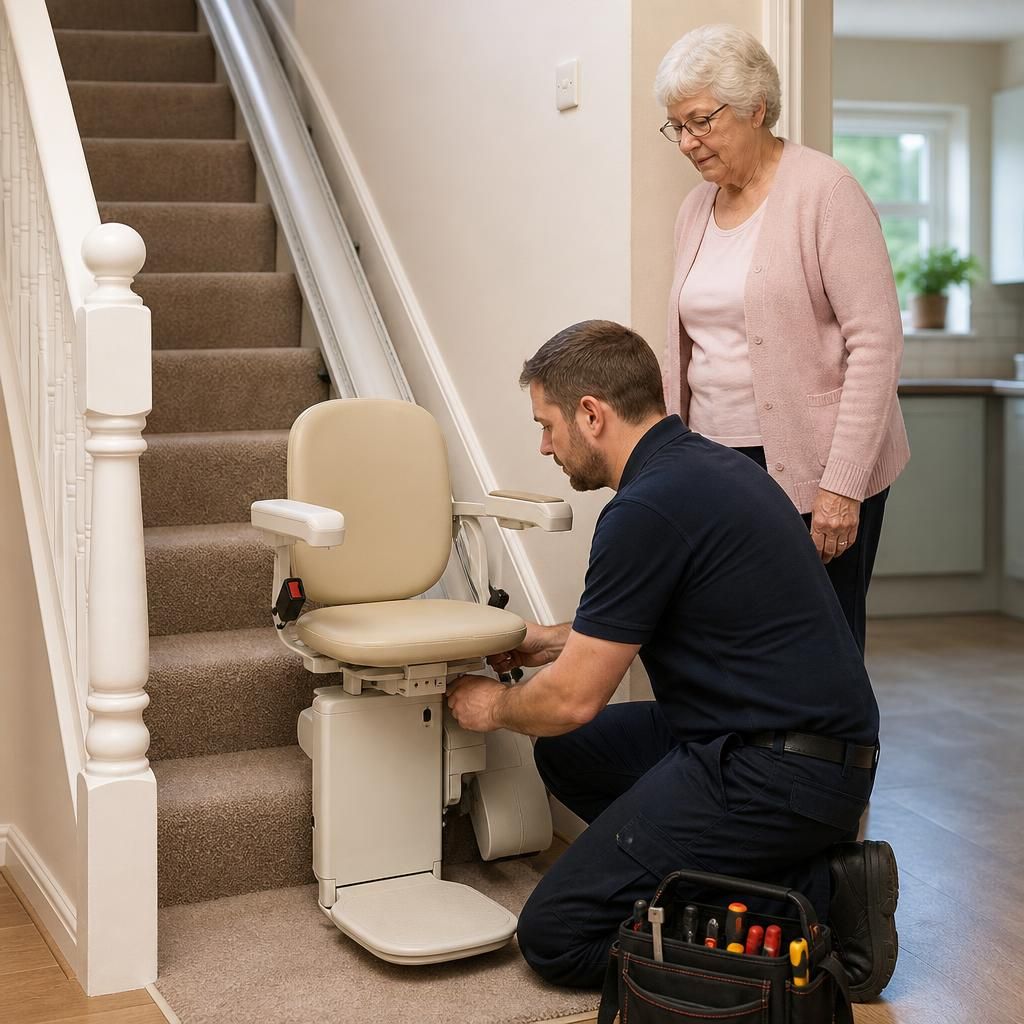
Arrange a suitability survey for your reconditioned stairlift
Arrange a suitability survey to confirm that your reconditioned stairlift, rail and charging position are compatible with your staircase and user requirements before installation.