
What are the key differences between reconditioned stairlift models, and how do they impact overall pricing and suitability for different homes?
Reconditioned stairlift models differ mainly by stair layout, intended location, seating and available features: straight models usually cost less, while curved and outdoor models require more specialised equipment and assessment. The right choice depends on your staircase, access needs, weight and comfort requirements, with condition, specification, installation complexity, warranty and aftercare all influencing the final price and suitability.
Reconditioned stairlift models vary primarily in their rail design, intended location, seating arrangement, lifting capacity and included features. A reconditioned straight stairlift is normally the most economical and easiest to install, whereas a curved or outdoor model usually costs more because it requires more specialised equipment, preparation and fitting. The most suitable option is determined by the staircase and the user’s mobility needs, not by price alone.
Straight reconditioned stairlifts are designed for staircases that run in one continuous direction without intermediate landings, bends or changes of angle. They are usually the simplest option to assess, adapt and install, so they tend to have the lowest overall price. A reconditioned straight model can be suitable for many conventional homes, particularly where the user needs safe access between two floors and does not require the lift to travel around a corner.
Suitability still depends on details such as the available staircase width, the position of doors and the amount of space at the top and bottom. A compact or folding seat may be important where the stairs are narrow or open into a hallway. The parking position also needs to be considered, as the stairlift should not obstruct a doorway, landing or access route when it is not in use.
Curved reconditioned stairlifts are made for staircases with bends, landings, changes in direction or multiple flights. Their rails are either specially made or selected and adapted to follow the staircase, which makes them more complex than a standard straight installation. This generally increases the price, particularly where the design requires more than one rail section, unusual parking arrangements or additional survey work.
A curved model can be the most suitable choice where a straight stairlift would stop at a landing and leave the user unable to continue independently. It may also provide a better use of space because the rail can be designed around the existing staircase rather than requiring separate lifts for different flights. The available reconditioned rail and its compatibility with the home are important: not every previously installed curved rail will suit another staircase.
Outdoor reconditioned stairlifts are built to withstand conditions that an indoor model is not designed to handle. They may include more durable finishes, weather-resistant components, protective covers and controls intended for external use. They are suitable for steps leading to a garden, entrance, patio or split-level outdoor area, provided the stair layout and installation position can accommodate the equipment.
Outdoor models generally cost more than indoor straight models because of their construction, environmental protection and installation requirements. The condition of the batteries, charging equipment, seat, controls and exposed fittings should be checked particularly carefully. Drainage, shelter, surface condition and access to a suitable power supply may also affect the installation and ongoing maintenance.
Seat and configuration differences can have a significant effect on both price and suitability. Common variations include:
- Standard seats: suitable for many users who can sit down and stand up with reasonable stability.
- Perching or semi-standing seats: useful where bending the knees or lowering into a conventional seat is difficult, or where the staircase is too narrow for a full-sized seat. They require the user to be able to maintain a supported sitting or standing position.
- Powered swivel seats: help turn the user towards the landing and can reduce twisting during transfers. They usually add to the cost and require enough space for safe movement at the top or bottom of the stairs.
- Powered or hinged rails: allow the rail to fold away where it would otherwise interfere with a doorway or walkway. They can make a particular home viable but add mechanical complexity and cost.
- Raised, lowered or adjustable seats: may improve transfer comfort for users with specific height, balance or joint-mobility requirements.
Weight capacity is another essential distinction between models. A reconditioned stairlift must be suitable for the user’s weight and body shape, with enough room for comfortable and stable positioning. A model that is technically able to operate on the staircase may still be unsuitable if the seat, armrests or footrest do not provide adequate support. The assessment should consider the user’s current needs as well as any likely change in mobility.
Features influence price in different ways. Powered movement, automatic swivelling, powered folding parts, larger seats, improved armrest controls, diagnostic functions and additional safety equipment can increase the purchase and installation cost. They may nevertheless represent better value where they solve a genuine access or transfer problem. Conversely, paying more for features that the user cannot operate or does not need will not necessarily make the stairlift more suitable.
Battery condition is particularly relevant when comparing reconditioned models. Most modern stairlifts use rechargeable batteries so that the lift can continue to operate during a power interruption. Batteries are wear components, so their age, charging performance and replacement history should be established where possible. A lower-priced model may require earlier battery replacement, while a model supplied with recently checked or replaced batteries may have a higher initial price but offer more predictable ownership costs.
Reconditioning standards also affect value. A properly reconditioned stairlift should be inspected, cleaned and tested, with safety-critical components checked before installation. The condition of the rail, drive system, seat, footrest, sensors, controls, batteries and charging points should be considered together. Cosmetic marks may have little effect on operation, whereas excessive wear in the drive mechanism, damaged controls or unreliable safety sensors can affect both suitability and future repair costs.
It is important to distinguish a professionally reconditioned stairlift from an unassessed second-hand unit. Reconditioning should involve more than removing a lift from one property and installing it in another. The equipment must be compatible with the new staircase, correctly configured for the user and tested after fitting. The available warranty and aftercare arrangements are also part of the overall value, rather than optional extras to consider only after installation.
Installation complexity is a major pricing factor. The final cost may be affected by the staircase design, the rail length or configuration, parking position, electrical access, fixing requirements and any need to work around doors, radiators or other obstructions. Curved and outdoor installations usually involve more planning than straightforward indoor installations. A remote survey may provide useful initial guidance, but an in-person assessment is often needed where the layout, transfers or user’s posture require closer examination.
A proper assessment should establish:
- Whether the staircase is straight, curved, split-level or external.
- How much usable width is available and whether other people need to pass safely.
- Where the user will get on and off the stairlift and whether there is enough room for a controlled transfer.
- Whether the user can operate the controls and remain safely positioned during travel.
- Whether a standard, perching, swivel or powered seat is appropriate.
- Whether the rail or seat would obstruct doors, corridors or emergency access.
- Whether the user’s weight, height, balance and leg movement are within the model’s safe operating requirements.
- Whether the batteries, charging points and other components are in suitable condition.
- What warranty, servicing and repair support are included after installation.
Pricing should therefore be compared as a complete installed package. The equipment price alone does not show whether one model offers better value. Ask whether the quoted amount includes the assessment, fitting, removal of an existing lift if necessary, testing, user instruction, warranty cover and aftercare. Clarify whether any likely adaptations, replacement batteries or unusual installation work are excluded. A cheaper model may become less economical if it needs extensive modification or has limited support, while a slightly more expensive model may be more appropriate because it is better matched to the staircase and user.
For many homes, a reconditioned straight stairlift provides the clearest balance between affordability and practical suitability. A curved model is more appropriate where the staircase changes direction or has several flights, and an outdoor model is necessary where the equipment will be exposed to the weather. Within each category, seating and control features should be selected according to the user’s ability to transfer, balance and operate the lift safely.
The most reliable way to choose between models is to arrange an assessment of both the staircase and the person using the stairlift. This allows the available reconditioned equipment to be matched to the rail layout, space restrictions, transfer points and required features. It also produces a more accurate installed price and helps avoid paying for a model that is inexpensive but unsuitable for the home.
The main difference between reconditioned stairlift models is the staircase they are designed to follow. A straight model usually has the lowest installed price because it uses a standard rail, while a curved model costs more because its rail must match the bends, landings or changes in direction within the home. An outdoor model may also cost more than an indoor equivalent because it requires components and finishes suited to exposure to weather.
Features can change the price and suitability within each model type. A compact or perching seat may be useful on a narrow staircase, while a powered swivel seat can make transfers safer and easier where turning at the landing is difficult. Hinged rails may be necessary if the stairlift would otherwise obstruct a doorway or walkway. These additions can increase the overall cost, but they may avoid access problems that make a basic model unsuitable.
When comparing prices, consider the complete installed package rather than the equipment alone. Check that the quotation covers assessment, fitting, testing, user instruction, warranty and aftercare. The condition of the batteries, controls, drive system and safety sensors should also be confirmed, as a lower purchase price may not represent good value if key components need early replacement.
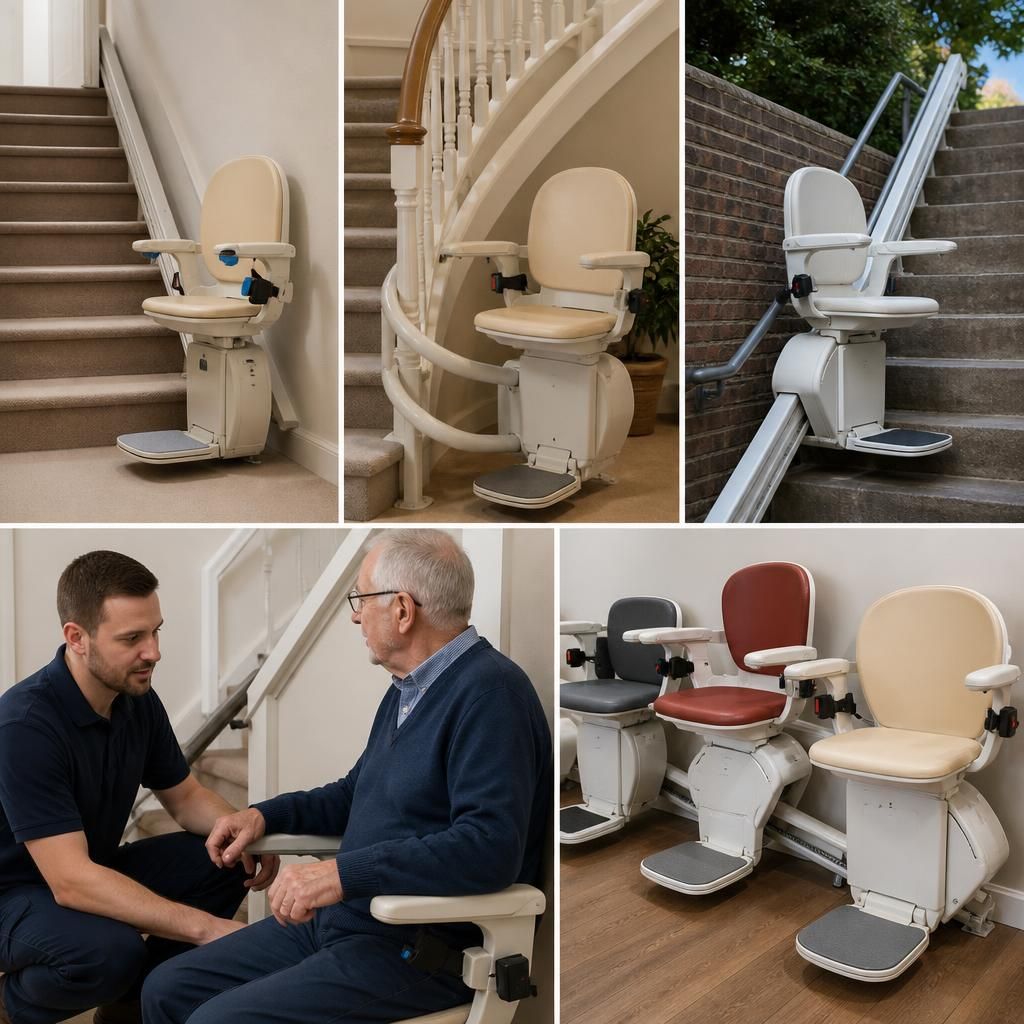
Arrange an assessment for a reconditioned stairlift
Arrange an assessment to compare suitable reconditioned stairlift models for your staircase, mobility needs and budget. We can confirm the installation requirements, available features and complete installed price before you decide.