
What should I consider when assessing the quality of a reconditioned curved stairlift?
Assess a reconditioned curved stairlift by checking the condition of its mechanical and electrical components, the quality of its refurbishment, and whether it has been professionally measured and installed for your staircase. Confirm that essential safety features work correctly and that the supplied warranty and aftercare provide suitable protection.
The quality of a reconditioned curved stairlift depends on more than the appearance of the seat or rail. Assess the condition and testing of the lift’s mechanical, electrical and safety components, the quality of the refurbishment, the accuracy of the survey and installation, and the protection provided by the warranty and aftercare service.
A curved stairlift is made for a particular staircase, so the quality of the installation is just as important as the condition of the stairlift itself. Before committing, ask for a clear explanation of what has been refurbished, what has been replaced, how the lift will be adapted to your stairs and what support is included after installation.
Check the refurbishment process
A reconditioned stairlift should have undergone a controlled inspection and refurbishment process rather than simply being cleaned and resold. Ask whether the lift has been:
- Inspected for wear, damage and corrosion.
- Professionally cleaned and sanitised, including the seat, armrests, footplate and controls.
- Tested under load and through its full operating range.
- Checked for unusual noise, vibration, hesitation or irregular movement.
- Fitted with replacement parts where the original components are worn or unsuitable.
- Checked against the manufacturer’s safety and operating requirements.
Cosmetic condition is relevant, but minor marks do not necessarily indicate poor quality. Conversely, a clean-looking lift may still have worn drive components, batteries or safety switches. The supplier should be able to describe the work completed and distinguish between parts that were inspected, serviced, repaired and replaced.
Examine the main mechanical components
The carriage must travel smoothly and remain stable as it follows the curved rail. During a demonstration, listen for grinding, knocking or excessive motor noise. The lift should start and stop in a controlled way, without sudden jolts, and should not rock excessively when the user is seated.
Important areas to check include the drive system, rollers, gears, bearings, seat swivel mechanism, armrests and footplate. The footplate should be secure and should not flex abnormally under normal use. Seat swivelling and locking should be positive and easy to operate. If the lift has a powered swivel seat or powered folding footplate, confirm that these features work consistently and that the controls are accessible to the intended user.
Ask whether replacement parts are readily available for the particular model. A reconditioned lift may provide good value, but its long-term practicality can be affected if essential components are obsolete or difficult to source.
Verify the electrical and battery condition
Battery performance is central to reliable operation, particularly if the stairlift is needed during a power cut. The batteries should hold charge properly, and the lift should return to its charging point as intended. Check that the charger, charging contacts and power supply are secure and that there are no warning lights or fault messages.
A responsible assessment should include the condition of the batteries, not just whether the lift operates during a short demonstration. Ask whether the batteries have been tested and whether they are being replaced as part of the refurbishment. Find out how the lift behaves if it is stopped away from a charging point and whether the user can easily identify a low-battery warning.
Controls should be responsive and clearly marked. Test the handset, directional controls and any controls on the arms of the chair. If more than one person will use the lift, consider whether the handset positions and operating method are suitable for everyone.
Confirm that all safety features work
Safety features should be demonstrated rather than assumed. Depending on the model, these may include sensors on the footplate, carriage or arms that stop the lift if an obstruction is detected; a seat belt; swivel-seat interlocks; overspeed protection; limit switches; and emergency stop controls.
Check that:
- The seat belt fastens securely and can be released by the user.
- The lift will not travel when the seat is not correctly positioned, where an interlock is fitted.
- Obstruction sensors stop the lift promptly and reset correctly.
- The carriage stops accurately at the top and bottom of the rail.
- The emergency controls and manual lowering or rescue procedure are explained.
- The user receives clear instructions for reporting a fault.
Do not attempt to defeat a sensor or test a safety system in a way that could create a hazard. The installer should carry out formal checks and explain the results in practical terms.
Assess the rail and the staircase survey
For a curved stairlift, the rail is usually bespoke. Its quality is determined by the accuracy of the survey, the suitability of the design and the security of its fixings. The surveyor should assess the full staircase, including landings, bends, narrow sections, doorways, radiator positions and any areas where other people need to pass.
Ask how the rail will affect access at the top and bottom of the stairs and whether the design includes features such as a parking position, manual or powered hinge, short-start rail or folding section where appropriate. The chair should leave sufficient usable space for the rider to sit down and stand up safely, while the folded lift should not create an unnecessary obstruction.
Fixings must be suitable for the construction and condition of the stairs. Older properties may have uneven walls, unusual newel posts, decorative finishes or altered floor levels. These issues do not automatically prevent installation, but they should be identified during the survey and included in the proposed design. Avoid accepting a quotation based solely on photographs or a generalised assumption that every curved staircase is the same.
Review the installation quality
A good installation should leave the rail secure, the carriage correctly aligned and the controls convenient to use. The installer should protect the surrounding flooring and décor where reasonably necessary, keep the route safe during the work and remove packaging and waste afterwards.
At handover, ask the installer to demonstrate the complete journey, including starting, stopping, parking, charging and transferring on and off the seat. Check that the lift clears walls, banisters, doors and other obstructions throughout its travel. The seat should be positioned at a comfortable height for the user, and the seat belt, armrests and controls should be adjusted or explained properly.
You should also receive operating instructions, details of the model fitted, warranty terms and information about servicing or fault reporting. Keep these documents where they can be found easily by the user or their family.
Read the warranty and aftercare terms carefully
The warranty should state what is covered, how long cover lasts, whether parts and labour are included, and whether there are exclusions for batteries, accidental damage or misuse. It should also explain the process for arranging a repair and whether support is available outside normal working hours.
Ask who will provide aftercare and whether the installer has access to parts and engineers familiar with the particular lift. A warranty has greater practical value when the terms are clear and a straightforward repair process is available. Confirm whether a service or inspection is recommended and what ongoing costs may apply.
Look for evidence of testing and traceability
The supplier should be able to identify the stairlift model and explain its condition without making unsupported claims about its history. Ask for a written record of the inspection, refurbishment and installation checks where one is available. It is also reasonable to ask whether the lift has been modified, whether any important components are not original and whether the supplied controls and charger are correct for the model.
Be cautious if the seller cannot explain what work has been carried out, pressures you to decide without a proper survey, or is vague about warranty exclusions and future repairs. A transparent assessment should cover both the advantages and limitations of the reconditioned lift.
Match the lift to the user
Finally, quality is partly a matter of suitability. The user should be able to sit securely, operate the controls, use the seat belt and transfer safely at both ends of the staircase. Consider posture, balance, joint movement, weight capacity, vision, dexterity and whether another person may need to assist.
Before installation, use the assessment to compare the condition of the lift with the staircase design, the user’s abilities and the level of support required. A reconditioned curved stairlift can be a dependable option when it has been properly inspected, fitted to the individual staircase and supported by clear documentation, appropriate warranty cover and competent aftercare.
The most reliable way to assess a reconditioned curved stairlift is to look for evidence of professional testing, not just a clean appearance. The supplier should explain which components were inspected, serviced or replaced, and demonstrate that the lift operates smoothly through the full route of your staircase.
- Check for controlled starts and stops, with no grinding, jolting or excessive movement.
- Ask whether the batteries, charger, drive system, rollers and safety sensors have been tested.
- Confirm that the seat belt, swivel mechanism, footplate and obstruction sensors work correctly.
- Request clear warranty, installation and fault-reporting information.
A curved stairlift must also be measured and installed for the individual staircase. At handover, the installer should demonstrate travelling, parking, charging and safe transfers, while confirming that the rail clears walls, banisters and other obstructions.
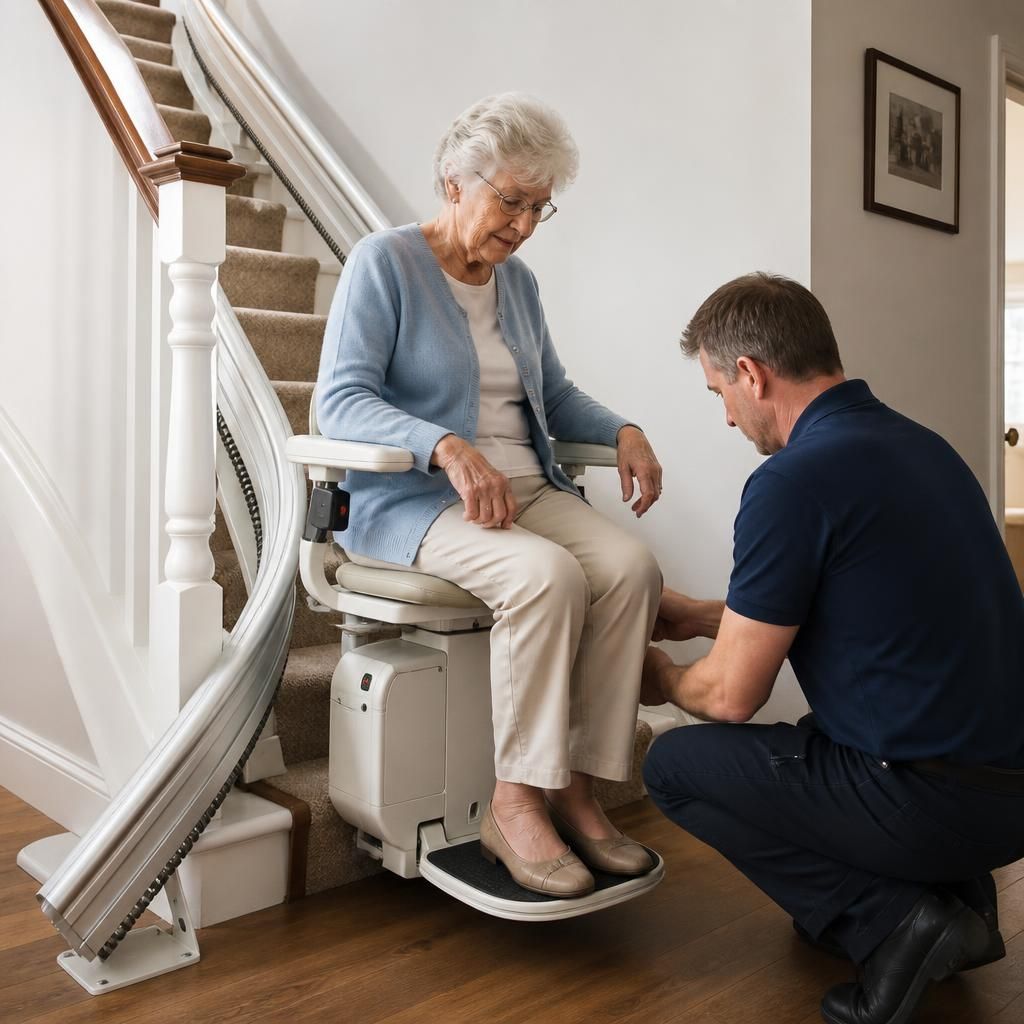
Arrange a professional assessment of your reconditioned curved stairlift
Arrange a professional assessment of your reconditioned curved stairlift to confirm its condition, safety features and suitability for your staircase. Independent Stairlifts can review the installation and explain any recommended aftercare or warranty cover.