
What refurbishment processes ensure the safety and reliability of reconditioned curved stairlifts?
Reconditioned curved stairlifts are made safe through a structured inspection, thorough cleaning, replacement of worn or unsuitable components, and testing of the drive system, controls, sensors, seat and safety features. They are then correctly fitted to the individual staircase and checked by a qualified installer before handover, with ongoing servicing and warranty support helping maintain reliable performance.
Reconditioned curved stairlifts are made safe and reliable through a controlled process of assessment, dismantling, cleaning, component replacement, reassembly, testing and professional installation. The lift should only be supplied when its condition, specification and operating performance are suitable for the user and the individual staircase.
Initial assessment and identification
The refurbishment process begins with an inspection of the stairlift’s history and overall condition. The drive unit, seat, controls, batteries, charging equipment and curved rail are assessed for wear, damage, corrosion and compatibility. Any available service records can help identify previous faults or parts that may require particular attention.
A curved stairlift is not simply a standard lift fitted to a staircase. Its rail has been made for a specific layout, so the rail and drive system must be checked together. A suitable reconditioned rail may be reused, adapted where appropriate, or replaced with a correctly manufactured rail if its condition or configuration is unsuitable.
Cleaning and dismantling
The lift is normally dismantled sufficiently to allow concealed areas and individual components to be examined. Dirt, dust and residue are removed from the seat, chassis, rail and accessible mechanical parts. Cleaning is more than cosmetic: it allows wear, cracks, loose fixings and contamination around moving parts to be identified properly.
Components that are removed are inspected before being cleaned or refurbished. Parts showing excessive wear, damage or unreliable operation should not be returned to service simply because they can still be made to work temporarily.
Inspection and replacement of components
Particular attention is given to components that affect safety, movement or stopping. Depending on the model and inspection findings, this may include:
- drive wheels, gears, rollers and other transmission parts;
- the motor, brake and mechanisms that control movement;
- batteries, charging contacts and the charger;
- seat swivelling, locking and folding mechanisms;
- the footrest, armrests and seat belt;
- joysticks, remote controls, wiring and electrical connections;
- safety edges, obstruction sensors and limit switches; and
- rail fixings, joints and structural areas subject to load or repeated movement.
Replacement parts should be suitable for the particular stairlift model and installed in accordance with the manufacturer’s requirements. Not every component will need replacing, but any part that could compromise safe operation should be repaired or renewed rather than overlooked.
Testing the drive and safety systems
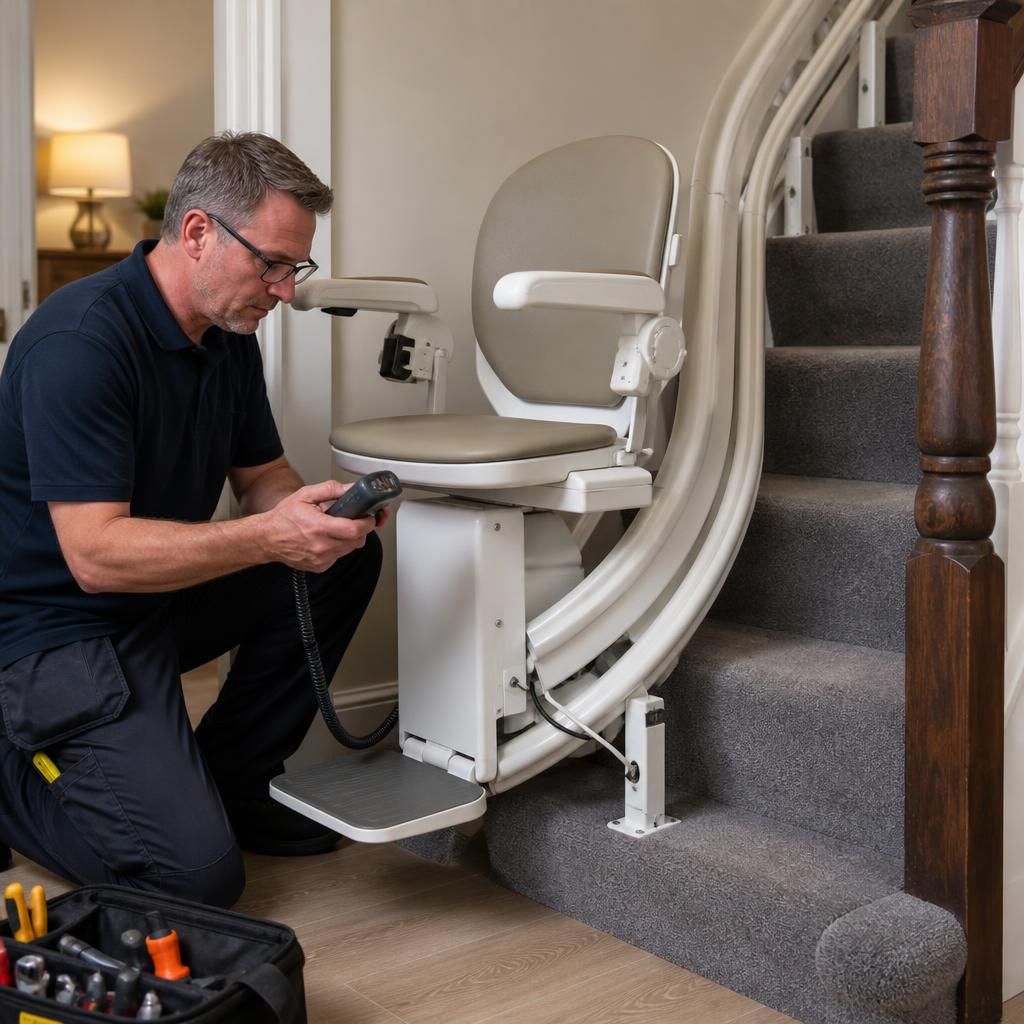
After reassembly, the stairlift is tested under operating conditions. This includes checking smooth travel, starting and stopping, changes in direction, movement around bends, charging and response to the hand control or remote control. The brake should hold the lift securely when it stops, while the controls should respond consistently without sticking or intermittent operation.
Safety systems are tested separately as well as during normal travel. Obstruction sensors should stop or interrupt movement when they detect an obstruction, and the seat, swivel lock, footrest and seat belt should operate as intended. Emergency or manual lowering arrangements, where fitted, should also be checked and explained to the user.
Electrical connections and charging points are inspected for damage, poor contacts and signs of overheating. Batteries are assessed for their ability to hold charge and support normal operation. A lift that travels correctly but does not charge reliably is not ready for dependable daily use.
Rail inspection and preparation
The curved rail must be checked for its shape, joints, fixings, alignment and clearance from the stairs, walls and handrails. Its condition is especially important because the rail supports the lift throughout its route. Any alteration or preparation must preserve the correct travel path and allow the carriage to move smoothly through curves, landings and transitions.
Before installation, the proposed layout should be compared with the customer’s current staircase and access needs. Changes to the staircase, flooring, handrails or surrounding furniture can affect whether a previously used configuration remains suitable.
Professional installation and commissioning
Installation is part of the safety process, not a separate finishing step. The installer secures the rail correctly, positions charging points where required and checks clearances at every part of the route. The seat height, swivel position and controls should be set up so the customer can use the lift without unnecessary stretching, twisting or reaching.
Once fitted, the lift is operated repeatedly along the full staircase. The installer checks the fixings, travel path, charging position, stopping points and safety features, then resolves any issues before handover. The customer should receive practical guidance on normal use, charging, cleaning, emergency procedures and reporting faults.
Records, warranty and ongoing care
A reliable refurbishment process should leave a clear record of the inspection, work completed, parts replaced and tests carried out. The supplied warranty should explain what is covered, how faults are reported and whether servicing or exclusions apply. Keeping these details makes it easier to arrange support and identify recurring issues.
Regular servicing remains important because batteries, rollers, brakes, sensors and electrical connections continue to wear during use. Customers should report unusual noises, jerky travel, reduced battery performance, failure to charge, loose components or unexpected stopping rather than continuing to use the lift without advice.
In practice, the quality of a reconditioned curved stairlift depends on the condition of its original components, the suitability of the rail and the thoroughness of the testing and installation. A proper refurbishment does not treat a used lift as ready for immediate resale; it verifies that the complete system is appropriate for the staircase and safe for the person who will use it.
Safety testing confirms that a reconditioned curved stairlift operates reliably after cleaning, repairs and reassembly. The installer checks the complete route, including smooth movement through bends, controlled starting and stopping, secure braking, charging and consistent response from the controls.
Safety features are tested separately and during normal travel. Obstruction sensors should interrupt movement when they detect an object, while the seat swivel lock, footrest, seat belt and limit switches must work correctly. Any jerky movement, unreliable charging, unusual noise or intermittent control response should be investigated before the stairlift is handed over.
Arrange your reconditioned curved stairlift assessment
Arrange an assessment of your staircase and mobility requirements to confirm whether a reconditioned curved stairlift is suitable. We can explain the refurbishment work, installation requirements, warranty and ongoing support available for your lift.