
What post-purchase support and warranties are available for reconditioned curved stairlifts?
Reconditioned curved stairlifts are typically supplied with a limited warranty covering specified parts and labour, together with post-purchase support such as installation guidance, servicing and repairs. The exact warranty period, exclusions and support arrangements depend on the stairlift’s condition, model and written quotation, so Independent Stairlifts will confirm these details before installation.
Post-purchase support for a reconditioned curved stairlift normally includes installation, operating guidance, fault assistance and servicing, while the warranty covers agreed parts and labour for a stated period. The precise cover depends on the stairlift model, its condition, the work completed during refurbishment and the terms set out in your written quotation, so check these documents rather than relying on a standard assumption.
What the warranty may cover
A warranty for a reconditioned curved stairlift may cover repairs needed because of faults in specified mechanical, electrical or control components. Where labour is included, this can cover the engineer’s work required to diagnose and rectify an eligible fault. The rail, carriage, motor, controls, charging equipment and safety systems may be treated differently, so the warranty should identify what is included and whether different parts have different periods of cover.
Some components are classed as consumable or wear items and may have limited cover or be excluded. Batteries, for example, gradually lose capacity through normal use and may be covered only where they fail prematurely or are found to be defective. Damage caused by misuse, accidental impact, water ingress, unauthorised alterations or unsuitable maintenance is also commonly excluded. A warranty will not usually cover unrelated changes to the property or problems caused by conditions outside the stairlift’s intended operating environment.
Installation and handover support
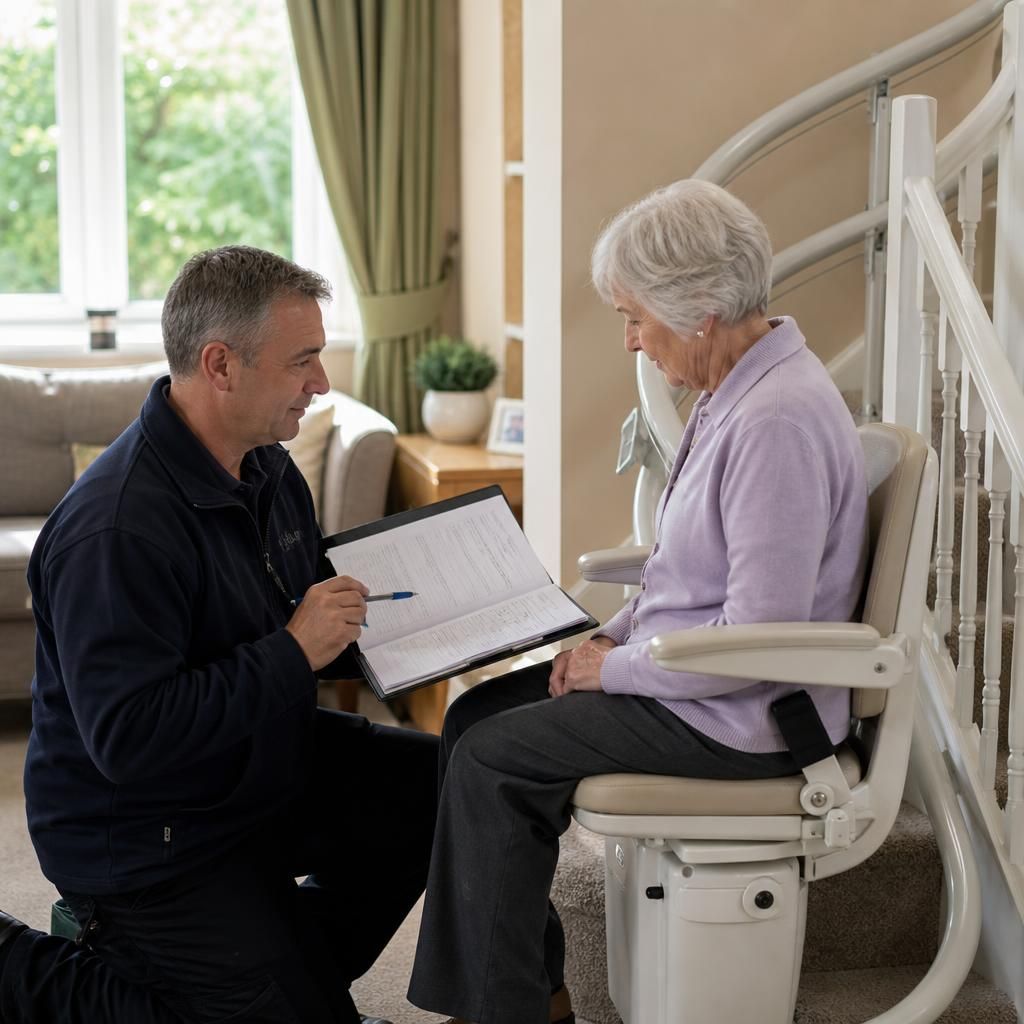
Installation is an important part of post-purchase support for a curved stairlift because the rail is made or adapted for the staircase and must be aligned correctly. The installation team should check the travel path, charging points, safety sensors, seat operation, controls and any swivel or folding features. They should also demonstrate normal operation, charging, safe transfers and the procedure to follow if the stairlift stops.
Keep the handover information in an accessible place. This should include the user instructions, warranty terms, service details and any information about the stairlift’s model or serial number. If more than one person uses the lift, each user should understand the controls and the basic safety instructions. Ask for clarification at handover if the stairlift behaves differently from the demonstration or if a control, sensor or charging point is unclear.
Help with faults and breakdowns
Post-purchase assistance normally starts with telephone guidance to establish what has happened. Simple issues, such as a key switch being off, an obstruction near a sensor or the lift not being correctly parked on a charging point, may be resolved without an engineer visit. Do not bypass a safety feature, remove covers or attempt electrical repairs yourself.
If the fault cannot be resolved safely, an engineer may need to inspect the stairlift. The warranty terms should explain how to report a fault, the contact arrangements, the hours of support and whether visits outside normal service hours are available. They should also state whether call-out charges, travel costs or repairs for excluded faults are payable. If the stairlift is your main means of accessing another floor, raise this when reporting the problem so the urgency can be assessed appropriately.
Servicing and ongoing maintenance
Regular servicing is separate from a warranty, although it can help identify wear before it causes a breakdown. A service may include checks of the rail and fixings, drive system, batteries and charging contacts, safety sensors, seat mechanisms, belts or harnesses, controls and emergency stop functions. The engineer may also check that the stairlift remains suitable for the way it is being used.
Follow the maintenance recommendations supplied with your stairlift. Keep the rail and charging areas clear, report unusual noises or movement, and tell the service team if the lift stops short, travels unevenly, loses charge quickly or repeatedly displays a fault. Continued use of a stairlift showing a safety-related fault should be avoided until it has been assessed.
What to confirm in your documents
- The start date and duration of the warranty, and whether it begins at installation or delivery.
- Which parts, labour and call-out costs are included.
- Whether batteries and other wear items are covered, and under what conditions.
- How to report a fault and which contact details should be used.
- Whether servicing is recommended, included or charged separately.
- Any exclusions relating to misuse, accidental damage, moisture, alterations or lack of maintenance.
- Whether the warranty remains valid if the property changes hands or the stairlift is used by a different person.
- Whether a future relocation, removal or alteration of the stairlift is covered.
A curved stairlift is usually tailored to a particular staircase, so moving it to another property is not normally a simple transfer. The rail may not suit the new layout, and any relocation should be assessed and carried out by a suitably qualified stairlift engineer. Moving or modifying the equipment without approval could affect the warranty and may create a safety risk.
Warranty terms are in addition to, not a replacement for, your legal rights as a consumer. If you believe the stairlift or installation does not meet the agreed specification, report the issue promptly and keep records of the fault, dates of contact and any advice received. Independent Stairlifts can confirm the support route, warranty scope and servicing options that apply to your particular reconditioned curved stairlift before or after installation.
The written warranty confirms what post-purchase support is available for your reconditioned curved stairlift. Check whether it covers parts, labour and engineer call-outs, and note any separate terms for batteries, controls, charging equipment and other wear items.
Keep the warranty, installation record and user instructions together. They should also explain how to report a fault, which contact details to use, the support hours and whether servicing is included or arranged separately. If the stairlift develops a fault, contact the support team before attempting any adjustment or repair, as unauthorised work may affect the warranty and could compromise safety.
Confirm your reconditioned curved stairlift support and warranty
Contact Independent Stairlifts to confirm the warranty terms, servicing arrangements and fault-support process for your reconditioned curved stairlift. Keep your quotation and installation documents available so we can answer questions about your specific model.