
What factors should be considered when deciding between reconditioned and new curved stairlifts?
Choosing between a reconditioned and new curved stairlift depends on your budget, required features, staircase design, installation timescale and the warranty and aftercare provided. A reconditioned model may offer good value where a suitable unit is available, while a new stairlift generally provides the widest choice of options and the latest specification.
The choice between a reconditioned and a new curved stairlift should be based on the suitability of the rail for your staircase, the condition and specification of the equipment, the total installed cost, and the warranty and aftercare included. A reconditioned stairlift can provide good value when a suitable system is available and has been professionally inspected, refurbished and fitted. A new stairlift is usually preferable when you need a particular seat, control arrangement, finish or configuration, or when your staircase requires a newly manufactured rail.
Staircase design and rail suitability
Curved stairlifts are made for the individual staircase rather than selected solely by model. The rail must follow the bends, landings, changes in gradient and available clearance accurately. This applies to both new and reconditioned systems. In many reconditioned installations, the stairlift carriage may have been used previously but the rail is newly manufactured for the current home. In other cases, a suitable existing rail may be available, but it must still be checked against the staircase and adapted or replaced where necessary.
An assessment should consider the width of the stairs, the position of doors and radiators, headroom, the space available at the top and bottom, and whether other people need to use the stairs while the lift is parked. A curved stairlift may need to stop on a different part of the landing from a previous installation. Do not assume that a reconditioned unit will fit simply because the staircase looks similar to another one.
Overall cost rather than purchase price
Reconditioned equipment often has a lower initial cost, but the final price depends on the rail design, installation work, seat specification, electrical requirements and any alterations needed in the property. A new stairlift may cost more initially while offering a wider choice of features and a more predictable specification.
Ask for a clear quotation that explains what is included. This should cover the survey, manufacture or modification of the rail, delivery, installation, testing, demonstration and any applicable warranty. It is also sensible to ask whether removal of an old stairlift, extra charging points or future servicing would be charged separately. Comparing the complete installed solution gives a more useful result than comparing the advertised price of the equipment alone.
Condition, refurbishment and component quality
“Reconditioned” should mean more than equipment that has simply been removed from another property and cleaned. The stairlift should be assessed by a competent technician, with safety-critical parts inspected and replaced where required. Typical checks include the drive system, batteries, charging equipment, sensors, switches, seat mechanism, armrests, footrest, safety belt and controls. The rail and fixings should also be examined for damage, wear or corrosion.
Ask what refurbishment has been carried out and whether replacement parts are available for the specific model. Some cosmetic marks may remain on a reconditioned stairlift and do not necessarily affect operation, but damage to structural or safety-related components should be addressed before installation. A new stairlift gives greater certainty about its previous use and condition, although it still requires correct fitting, testing and servicing.
Features and personal requirements
New models generally provide the broadest choice of options. Depending on the model, these may include different seat dimensions, powered swivel or folding functions, powered footrests, alternative controls, diagnostic functions and upholstery or finish choices. A reconditioned stairlift may have fewer options because the available equipment is determined by what is in stock and what can be safely fitted to the staircase.
Features should be selected for a practical reason rather than appearance. Consider whether the user can transfer safely to the seat, operate the controls, use the safety belt and reach the armrest controls. A powered swivel seat or powered footrest may be useful where movement is restricted, but it also introduces additional components that need to be maintained. The most suitable option is the one that matches the user’s mobility, posture, balance and ability to operate the lift independently.
Availability and installation timescale
A reconditioned curved stairlift may be available sooner when a compatible carriage is in stock, but the rail still normally needs to be surveyed and made or modified for the property. Availability can therefore vary according to the staircase and the required specification. A new system may involve a longer manufacturing lead time, particularly where the staircase has several bends or requires a less common layout.
If the stairlift is needed urgently, explain the timescale at the assessment stage. The installer can then establish whether a suitable reconditioned option is available or whether a new system is the more practical route. Do not compromise on the survey, installation or safety testing simply to achieve an earlier fitting date.
Warranty, servicing and aftercare
Warranty terms can differ between new and reconditioned stairlifts and may cover parts, labour, call-outs or specific components for different periods. Read the terms carefully and check whether batteries, accidental damage, misuse or faults caused by unauthorised work are excluded. A warranty is most useful when you understand how to report a fault and what support is available outside normal working hours.
For either option, ask who will provide servicing and repairs, whether genuine or compatible replacement parts remain available, and whether the installer will continue to support the model. Reconditioned equipment can be a sound choice when it has a clear service history and reliable aftercare. A new model may offer longer-term support for its particular specification, but this should still be confirmed rather than assumed.
Expected use and future needs
Think about how frequently the stairlift will be used and whether the user’s mobility is likely to change. Occasional use may make a well-refurbished system attractive, while frequent daily use may place greater importance on the latest specification, battery performance, seat comfort and ease of operation. The assessment should also consider whether another person may use the stairlift in future.
Check the manufacturer’s guidance and the installer’s advice on expected service life, battery replacement and routine maintenance. A reconditioned stairlift is not automatically less reliable than a new one, but its remaining life depends on its age, previous use, refurbishment standard and ongoing care. Any uncertainty about the equipment’s history should be reflected in the warranty and the written quotation.
Safety and installation quality
Both types of stairlift must be installed, tested and demonstrated by a competent installer. The completed installation should allow the user to board and leave the seat safely, keep the stairway and landings as clear as possible, and stop correctly at each programmed position. Safety sensors, the seat belt, swivel lock and emergency controls should be checked before the lift is handed over.
Older or historic properties may need additional care because of uneven walls, unusual stair construction, restricted fixing points or listed-building considerations. The installer should identify these issues during the survey and explain any proposed fixing method or remedial work. Do not choose a reconditioned or new stairlift until you are satisfied that the installation method is appropriate for the building.
How to make the decision
- Arrange a detailed assessment of the staircase and the user’s mobility needs.
- Confirm whether the proposed rail is new, previously used, modified or manufactured specifically for the property.
- Compare the complete installed cost, including any additional work and future servicing.
- Check the equipment’s refurbishment records, safety checks, component availability and warranty.
- Compare the available features with what the user can operate safely and comfortably.
- Confirm the installation timescale, handover process and who to contact if a fault develops.
In practical terms, a reconditioned curved stairlift is often suitable when value is important, the available specification meets the user’s needs and the equipment is properly refurbished with dependable support. A new curved stairlift is generally the better choice when the staircase is particularly complex, a specific configuration is required, or you want the widest choice of features and a new-equipment warranty. A professional assessment should establish which option is safe, compatible and appropriate for the home rather than basing the decision on price alone.
A reconditioned curved stairlift does not necessarily use a previously fitted rail. In many installations, the carriage is professionally refurbished while a new rail is manufactured to follow the customer’s staircase precisely.
This means the decision should be based on the condition and specification of the carriage, the suitability of the rail, and the quality of the installation—not simply on whether the stairlift is described as reconditioned or new. Ask what has been reused, what has been replaced, and how the completed system will be tested before handover.
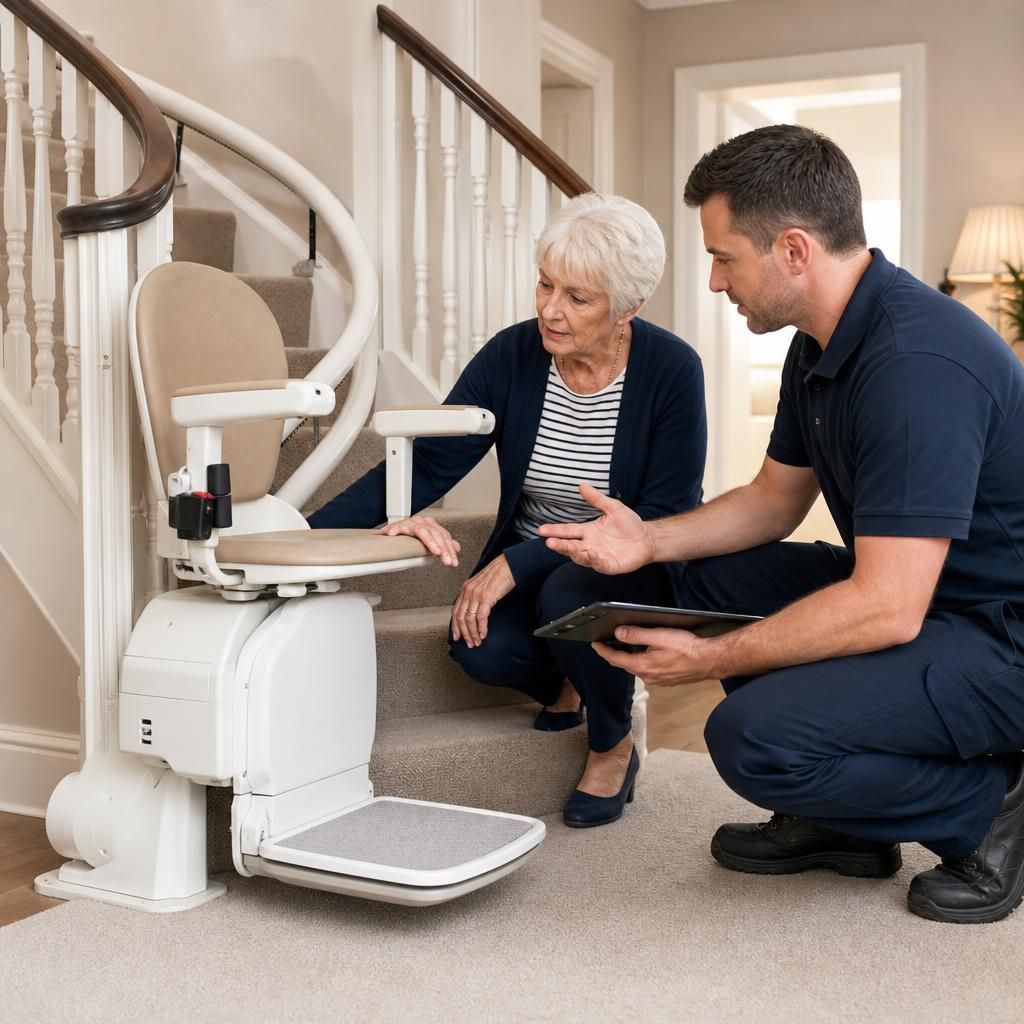
Arrange your curved stairlift assessment
Arrange a professional curved stairlift assessment to compare suitable reconditioned and new options for your staircase, mobility needs and budget.