
How does the quality of components in reconditioned curved stairlifts compare to new models?
Reconditioned curved stairlifts can provide comparable safety and reliable performance to new models when their components have been professionally inspected, tested and replaced where necessary. However, new models contain unused components and offer the latest specification, while reconditioned lifts may show cosmetic wear or retain older design features.
The quality of a reconditioned curved stairlift can be comparable to that of a new model where it has been professionally assessed, refurbished and tested. The main difference is that a new stairlift is supplied with unused components and the latest available specification, whereas a reconditioned lift may include carefully inspected used parts, replacement components and older design features. Its condition depends more on the quality of the refurbishment and installation than on the fact that it has been previously used.
Curved stairlifts require particular care because the rail is made to follow the individual staircase. The lift must travel smoothly through bends, landings and changes in gradient, while maintaining safe clearances. A professional assessment should therefore consider both the condition of the lift itself and whether its rail, drive system and safety features are suitable for your staircase.
How the main components compare
- Rail: A reconditioned curved stairlift may use an existing rail that has been checked for damage, wear, secure fixing points and accurate alignment. In some installations, a rail may be adapted or a new rail section may be required to suit the staircase. The important issue is that the finished rail is correctly measured, securely installed and tested throughout its full travel.
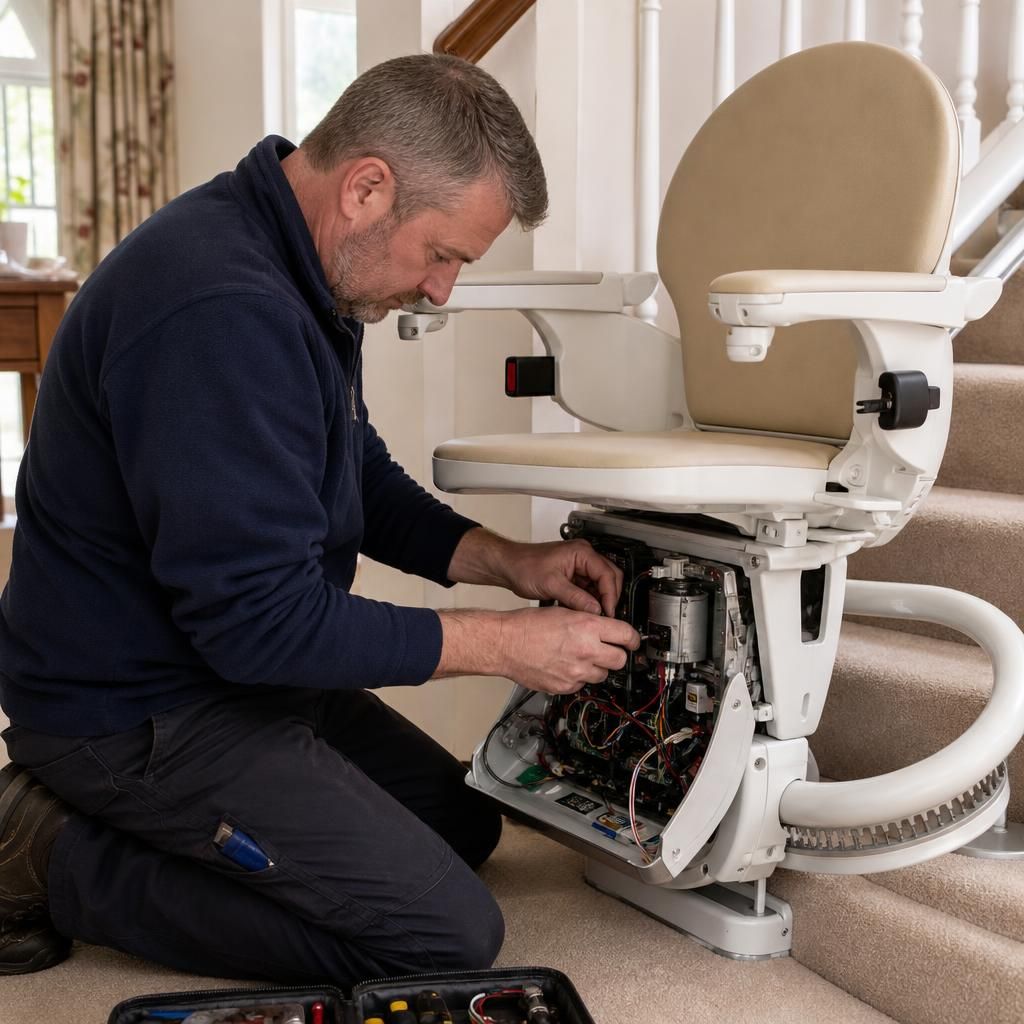
- Drive motor and gearbox: These components are inspected for unusual noise, hesitation, excessive wear and consistent operation. Bearings, drive surfaces and other wearing parts may be cleaned, adjusted or replaced. A new model will normally have a completely unused drive system, but a properly serviced motor and gearbox can continue to provide dependable operation.
- Batteries and charging equipment: Batteries are consumable items and should not be accepted solely because the lift runs during a demonstration. They should hold an appropriate charge, allow the lift to complete its intended journeys and work correctly with the charging points. Batteries showing poor capacity or age-related deterioration should be replaced. Chargers and charging contacts should also be checked for damage and reliable connection.
- Seat, arms and footrest: These parts are assessed for secure movement, locking, stability and general wear. Upholstery or covers may show cosmetic signs of previous use, but structural damage, excessive movement or faulty swivel and folding mechanisms should be addressed before installation.
- Controls and switches: The handset, arm controls, direction controls, key switches and stop controls should respond consistently. Any damaged casing, sticking button or intermittent operation needs investigation rather than being treated as a cosmetic issue.
- Safety sensors and edges: Safety switches, obstruction sensors, seat and swivel interlocks, braking functions and other protective features must be tested. The lift should stop or respond as intended when a relevant safety feature is activated. These checks are essential on both reconditioned and new stairlifts.
- Wiring and electrical connections: Wiring should be inspected for damage, loose connections, deterioration and signs of overheating. Connections must be protected and routed so that they cannot be caught or damaged during normal use.
What “reconditioned” should mean
A reconditioned stairlift should have undergone more than cleaning and a basic operational check. The refurbishment process should establish the lift’s condition, identify worn or unreliable components, replace parts where necessary and confirm that the complete system operates safely. It should include a full travel test on the intended staircase, not just a test on a workshop floor or a short section of rail.
The assessment should also distinguish between cosmetic wear and functional wear. Minor marks on a cover may have no effect on performance, while a worn drive component, weak battery or unreliable safety switch can affect safe operation. Ask what has been inspected, which parts have been replaced, whether the lift has been tested under load and what records or warranty cover will be provided.
Where new models have an advantage
New curved stairlifts offer unused components, current design features and the manufacturer’s latest available controls and accessories. They may also provide a wider choice of finishes, seat configurations or powered options, depending on the model. A new lift can be the more suitable choice where you require a particular specification, want the latest technology or expect to keep the installation for a long period without accepting cosmetic wear.
New does not remove the need for a proper survey or installation check. A new stairlift can still be unsuitable if the rail is poorly measured, the seating position is wrong or the installation does not account for doorways, narrow landings and household circulation. Component age is only one part of overall quality.
Where a reconditioned model can provide good value
A reconditioned curved stairlift can be appropriate when the available configuration meets your mobility needs and the unit has been selected, refurbished and installed for your staircase. The design may be older, but that does not automatically make it unsafe or unreliable. Established components can be serviceable when they have been maintained correctly and replacement parts remain available.
There may be cosmetic differences from a new model, including light marks or a more limited choice of upholstery and accessories. You should also establish whether the warranty covers parts, labour and call-outs, how long it lasts, and whether any exclusions apply to batteries or other wearing components. A clear warranty and accessible aftercare are useful indications that the condition of the lift has been assessed responsibly.
Questions to ask before choosing
- Which components have been inspected, serviced or replaced?
- How have the batteries been tested, and are replacement batteries included if required?
- Has the complete lift been tested on my staircase after installation?
- Are the safety sensors, braking system, interlocks and stop controls working correctly?
- Will replacement parts and technical support remain available for this model?
- What is covered by the warranty, and who should I contact if the lift develops a fault?
- Are any cosmetic marks, previous repairs or limitations recorded in the quotation?
The most useful comparison is therefore not simply “used versus new”. Compare the actual condition of the motor, batteries, controls, safety systems and rail; the suitability of the configuration; the quality of installation; and the support available afterwards. A professionally reconditioned curved stairlift can provide safe, consistent performance, while a new model offers the certainty of unused components and the latest specification. A detailed survey and transparent refurbishment report will show which option is appropriate for your staircase and day-to-day requirements.
The quality of a reconditioned curved stairlift depends on the condition of its working components and the standard of refurbishment, rather than simply whether it has been used before. A professional assessment should identify worn parts, test the complete system and replace components that could affect safe, reliable operation.
Particular attention should be given to the drive motor, gearbox, batteries, controls, safety sensors, braking system and electrical connections. Batteries are consumable components and may need replacing even when the stairlift operates during a brief demonstration. The rail should also be checked for secure fixings, accurate alignment and smooth travel through every bend and landing.
Cosmetic marks on upholstery or covers may be acceptable, but functional wear should not be overlooked. Before installation, ask which parts were inspected or replaced, whether the stairlift was tested throughout its full journey and what warranty and aftercare are included.
Arrange a professional assessment of your curved stairlift options
Arrange a professional assessment to compare reconditioned and new curved stairlift options for your staircase. We can review the required specification, component condition, installation requirements and available warranty cover.