
How can I ensure a reconditioned curved stairlift fits my specific staircase dimensions?
Arrange a professional staircase survey before choosing the lift, so the installer can measure each flight, curve, landing, obstruction and required clearance around the seat and rail. The reconditioned lift should then be matched with a suitably refurbished or newly adapted rail and checked against the recorded measurements before installation, rather than selected by staircase type or dimensions alone.
A reconditioned curved stairlift will fit your staircase only when its rail, seat position and clearances are matched to the measured layout of your individual stairs. Curved staircases cannot usually be fitted using standard dimensions alone, so arrange a professional survey before selecting a lift. The surveyor should record the full staircase profile and identify whether an existing refurbished rail can be adapted, or whether a rail made for your staircase is required.
During the survey, the installer should assess:
- the width, depth and pitch of each step;
- the direction and tightness of every bend;
- intermediate landings, half-landings and changes in stair direction;
- available headroom, particularly near the top and bottom of the stairs;
- doorways, radiators, cupboards, bannisters and other obstructions;
- where the lift can park without blocking a hallway, doorway or landing;
- the space needed to sit down, stand up and transfer safely at each end; and
- the strength and condition of the stairs or wall where the rail will be fixed.
Measurements should be taken throughout the staircase rather than at a single point. A curved rail follows the actual line of the stairs, including changes in gradient and direction. Small differences in a bend, landing or obstruction can affect the rail route, the seat position and the clearance between the passenger, the stairs and surrounding fixtures.
It is also important to distinguish between the stairlift unit and its rail. A reconditioned motor, seat and carriage may be suitable for reuse, but a rail from another installation is unlikely to match your staircase without modification. Depending on the design, the installer may reuse a suitable rail, adapt part of an existing rail or specify a newly manufactured rail with refurbished lift components. The proposed arrangement should be based on the survey, not simply on the fact that the lift was previously installed on a staircase described as curved.
Ask for the survey findings to be explained clearly before agreeing to the installation. The quotation or specification should confirm the proposed rail route, parking position, seat configuration and any options needed for your staircase. These might include a swivel seat, powered swivel or folding seat, hinged rail, short or extended parking section, or a different seat height. Such features are not merely cosmetic: they can improve access where a doorway, narrow landing or limited headroom affects how you approach the lift.
Check how the installer will verify the fit before work is completed. A competent installation should include:
- checking the staircase measurements against the design or template used to prepare the rail;
- fixing the rail securely while maintaining the required clearances;
- testing the lift at slow and normal operating speeds through every bend and landing;
- checking that the seat, footrest and armrests do not strike walls, bannisters, doors or other objects;
- confirming that the user can board and leave the seat safely at both ends; and
- demonstrating the controls, safety sensors, swivel mechanism, charging points and emergency procedures.
If the property is older or has unusual construction, the survey should also consider uneven steps, non-standard walls, fragile finishes and restricted fixing points. The installer may need to use alternative brackets or carefully positioned supports, provided the finished installation remains secure and complies with the manufacturer’s instructions and relevant safety requirements. Any proposed changes to bannisters, doorways or other features should be discussed with you before installation.
Before accepting a reconditioned curved stairlift, confirm what happens if the fit differs from the survey. Ask whether the rail is being refurbished specifically for your staircase, which components have been inspected or replaced, and what warranty and aftercare apply to the installation. You should also receive operating and safety instructions, maintenance information and a clear contact route for reporting faults.
The most reliable way to ensure a suitable fit is therefore to have the staircase surveyed in person, use the recorded measurements to design or select the rail, and have the completed installation tested in your home. A reconditioned stairlift can be a practical option on a complex staircase, but its suitability depends on accurate assessment and professional adaptation rather than on the age or general description of the equipment.
A professional staircase survey is the most reliable way to confirm that a reconditioned curved stairlift will fit your home. The installer should measure the full route, including bends, landings, available headroom, obstructions and the space needed to board and leave the seat safely.
These measurements are used to assess whether a suitable refurbished rail can be adapted or whether a new rail is needed for your staircase. The lift should not be selected solely because it was previously fitted to another curved staircase, as small differences in layout can affect clearances and parking positions.
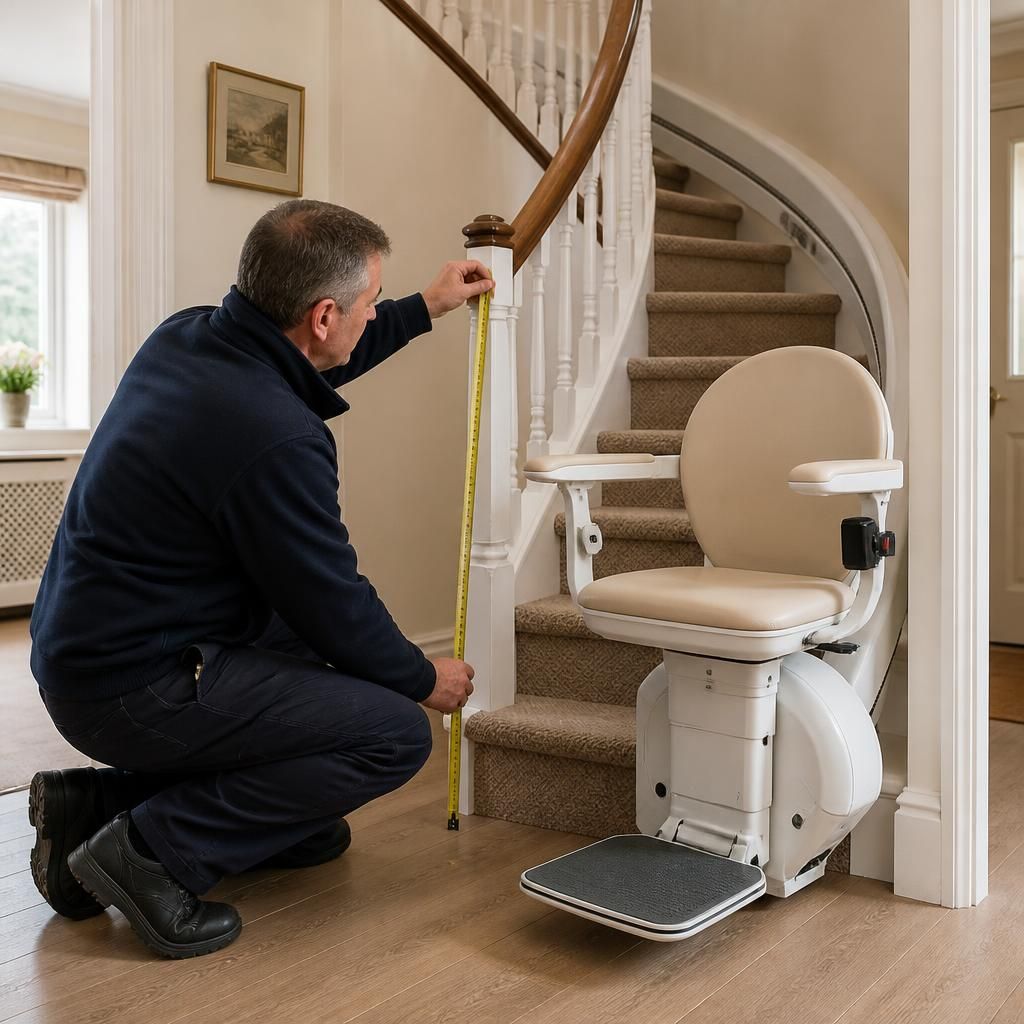
Arrange your professional staircase survey
Arrange a professional staircase survey so we can assess your bends, landings, clearances and parking requirements before confirming the reconditioned curved stairlift and rail.