
Are there any specific installation considerations for reconditioned curved stairlifts in older or historic homes?
Yes. Installing a reconditioned curved stairlift in an older or historic home requires careful assessment of the staircase, walls, flooring, electrical supply and any heritage features, so the lift can be fitted securely without unnecessary alteration to the property. A professional survey should confirm the rail design, fixing points, access around landings and any conservation requirements before installation.
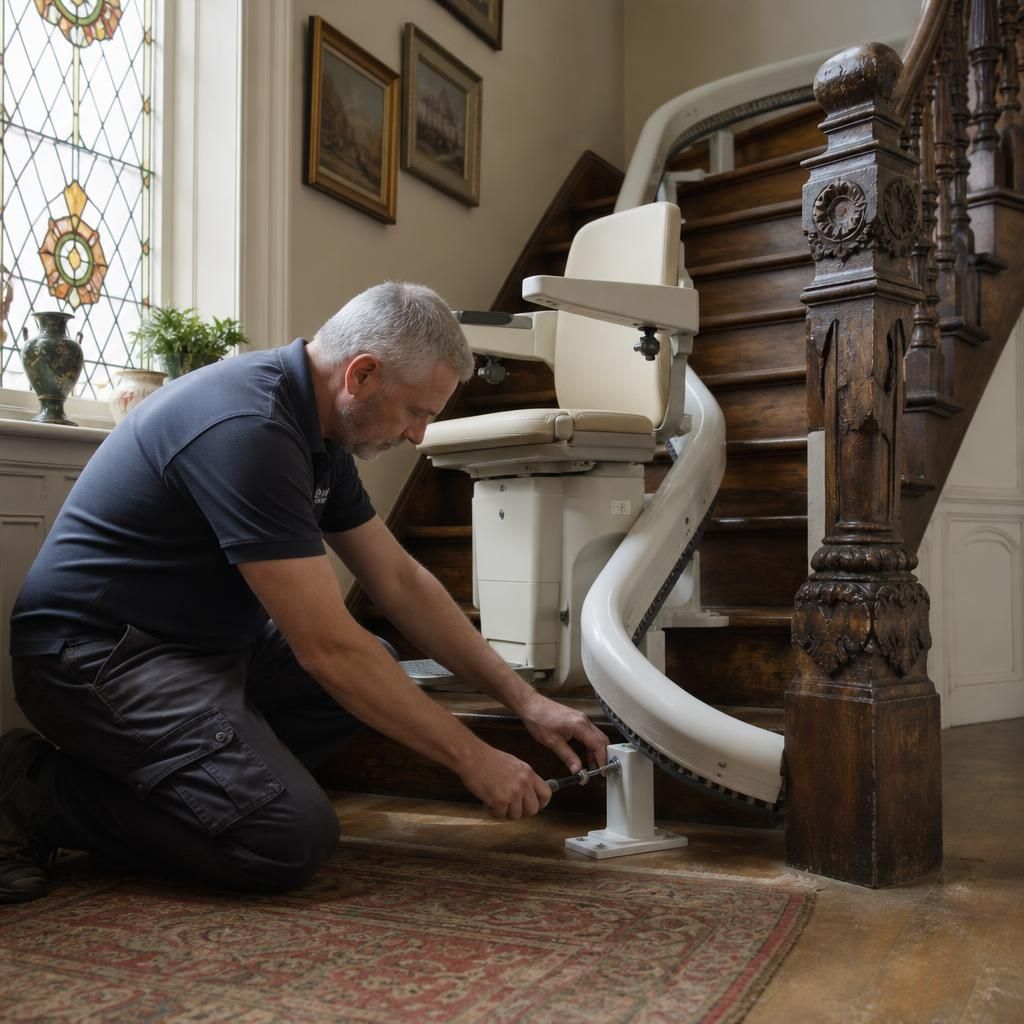
Yes. A reconditioned curved stairlift can often be installed in an older or historic home, but it requires a more detailed survey than a standard straight installation. The installer must assess the staircase structure, fixing points, flooring, electrical supply, landing space and any protected architectural features before confirming the rail design and installation method.
Assessing the staircase and structure
Older staircases may have irregular dimensions, uneven treads, narrow sections, unusual turns or changes in gradient. Timber stairs can also have movement, wear or concealed alterations from previous building work. A proper survey should record the full shape of the staircase rather than relying on standard measurements. This allows the reconditioned rail, or any replacement rail sections, to be checked against the actual staircase.
The surveyor should also establish where the rail can be fixed securely. Curved stairlift rails are normally attached to the stair treads or suitable structural points, rather than relying solely on plaster, panelling or decorative wall surfaces. If the stair construction is unusual, the fixing method may need to be adapted so that it provides adequate support without damaging significant features.
Protecting heritage and period features
Historic homes may contain listed features, original panelling, ornate balustrades, exposed brickwork, decorative plaster, stonework or valuable flooring. These should be identified before work begins. The proposed fixing positions and rail route can then be reviewed to avoid unnecessary disturbance.
If the property is listed or located in a conservation area, planning or conservation requirements may apply. These requirements vary according to the property and the proposed work. The homeowner should check with the local authority, conservation officer or relevant property professional where appropriate. An installer can explain the practical installation requirements, but should not assume that permission is unnecessary simply because the stairlift is a mobility aid.
Installation should be planned to minimise alteration. This may include using existing suitable fixing points, avoiding decorative woodwork and selecting a parking position that does not obstruct an important landing feature. Any proposed changes should be agreed before installation, particularly where removing or drilling into original materials could affect the character of the building.
Checking flooring, treads and landings
Uneven, worn or delicate flooring can affect access to the stairlift and the stability of the installation area. Loose boards, damaged stair nosings and uneven coverings should be reported during the survey. Thick carpets, rugs and carpet grippers may also need to be secured or adjusted so they do not interfere with the rail, footrest or moving parts.
Landing space is especially important in older homes, where corridors and doorways may be compact. The survey should consider where the user will get on and off, whether the seat can swivel safely, and whether the parked stairlift will restrict a doorway, escape route or other essential access. A powered or manually operated swivel seat may be appropriate where the top or bottom of the stairs is confined, but its suitability depends on the individual user and the layout.
Reviewing the electrical supply
A reconditioned curved stairlift needs a suitable electrical supply and charging arrangement. In older properties, the wiring may have been altered over time or may not include a convenient socket near the proposed charging point. The electrical system should be checked by a suitably qualified person where necessary, and any new connection should comply with current safety requirements.
The charging point should be positioned so that the stairlift can charge reliably without creating a trip hazard or requiring an unsuitable extension lead. If the home has vulnerable wiring, limited sockets or an unusual consumer unit, these issues should be resolved before installation rather than treated as an afterthought.
Confirming the reconditioned equipment is suitable
Reconditioned does not mean that a standard rail can be made to fit every staircase. The rail must be compatible with the measured route, and the stairlift’s carriage, seat, controls and safety features must be suitable for the user and the environment. Components should be inspected, serviced and tested before fitting, with worn or unsuitable parts replaced as required.
Where a previously used curved rail is being considered, its original staircase profile may not match the new property. A bespoke curved rail is generally produced or adapted for the specific staircase, while the stairlift equipment itself may be reconditioned. The installer should explain clearly which parts are being reused, which are new or replaced, and how the final system has been checked.
Planning safe access during installation
Older homes may have restricted access, delicate surfaces or limited room for tools and materials. The installation team should plan how equipment will be brought into the property and how floors, walls and furnishings will be protected. The work area should be kept clear, particularly where the resident has limited mobility or where other people need to use the stairs.
After fitting, the installer should test the stairlift throughout its route, including bends, transitions, charging points and parking positions. Safety features such as the seat belt, sensors, swivel mechanism, controls and obstruction detection should be demonstrated to the user and any regular carer. The user should also be shown how to operate the stairlift safely if the power supply is interrupted, in line with the model’s instructions.
Questions to resolve before agreeing the installation
- Where will the rail be fixed, and are the proposed fixing points structurally suitable?
- Will any original woodwork, panelling, plaster, stone or flooring need to be altered?
- Does the property require permission or consultation because of its listed or historic status?
- Where will the stairlift park, and will it affect a doorway, landing or escape route?
- Is the electrical supply suitable for the charging arrangement?
- Which components are reconditioned, which have been replaced and what testing has been completed?
- What warranty, servicing and breakdown support will apply after installation?
A detailed survey and written installation plan are particularly important in an older or historic property. They help balance secure fitting and everyday usability with the need to protect the building’s existing features. If the staircase, structure or heritage status presents an unusual challenge, the installation should be reviewed with the appropriate building or conservation professional before work starts.
In an older or historic home, the rail fixing points must be planned carefully so the reconditioned curved stairlift is secure without unnecessarily disturbing original woodwork, panelling, plaster, stonework or flooring. The installer should assess the staircase structure and agree the proposed fixing positions before work begins.
If the property is listed or in a conservation area, check whether consent or advice from the local authority is needed. A detailed survey also helps identify a suitable parking position that preserves access to landings, doorways and escape routes.
Arrange a detailed survey for your historic home
Arrange a detailed survey for your historic home to assess the staircase structure, heritage features, fixing points, landing space and electrical supply before installation. This confirms the most suitable reconditioned curved stairlift and helps minimise unnecessary alterations to the property.