
What specific refurbishment processes are undertaken to ensure the reliability of reconditioned stairlifts in Manchester?
Reconditioned stairlifts for Manchester homes are carefully inspected, cleaned and function-tested, with worn or defective components replaced before installation. The refurbishment also includes checks of the drive system, batteries, controls, safety sensors, seat and track, followed by installation testing to confirm safe, reliable operation on the customer’s staircase.
Reliable reconditioned stairlifts are produced through a controlled refurbishment process rather than simply being cleaned and resold. Each lift is assessed for condition and suitability, dismantled as necessary, cleaned, inspected, tested and fitted with replacement parts where wear or damage is found. The completed stairlift is then installed and checked on the customer’s staircase to confirm safe, smooth operation.
The refurbishment process normally includes the following stages:
- Initial condition assessment: The stairlift is examined to identify its model, operating history where available, general condition and compatibility with the intended staircase. The assessment covers the rail, carriage, seat, motor, controls, batteries, charging equipment and safety systems. Units or components that cannot meet the required condition are not suitable for reconditioning.
- Strip-down and cleaning: Removable components are taken off where appropriate so that dirt, dust and residue can be removed from areas that are difficult to inspect when the lift is assembled. The rail, carriage, seat, armrests, footrest and control surfaces are cleaned, while moving and electrical parts are handled in accordance with the manufacturer’s instructions.
- Inspection of the drive system: The motor, gearbox, drive mechanism and related fixings are checked for abnormal noise, play, leaks, damage or signs of excessive wear. The lift must accelerate, travel and stop in a controlled manner. Parts showing unacceptable wear are repaired or replaced rather than left in service.
- Examination of the track: The rail is checked for damage, distortion, secure fixings and smooth carriage travel. On curved staircases, the bends, joints and transitions receive particular attention because accurate alignment is essential for consistent movement. The track is also assessed against the measurements taken at the new installation.
- Battery and charging checks: Batteries are inspected and tested for their ability to hold charge and provide dependable power during normal use. Charging points, wiring, fuses and indicators are checked as well. Batteries that no longer perform reliably are replaced, since poor battery condition can lead to reduced travel, failure to charge or unexpected stoppage.
- Safety-system testing: Safety edges, obstruction sensors, limit switches, braking functions and other protective controls are tested to make sure the stairlift responds correctly if an obstruction is encountered or a travel limit is reached. The seat belt, swivel seat, armrests, footrest and any interlocks are also checked for secure operation.
- Controls and user interfaces: The handset, arm controls, direction switches, emergency stop functions and diagnostic indicators are tested. Controls should respond consistently and be positioned so that the intended user can operate them safely. Remote controls are paired and checked where the model uses them.
- Replacement of worn components: Reconditioning may involve replacing batteries, covers, switches, rollers, belts, wiring, fasteners or other components, depending on the inspection findings. Replacement parts must be appropriate for the stairlift and installed correctly; cosmetic cleaning alone is not a substitute for mechanical and electrical checks.
After refurbishment, the stairlift is operated repeatedly in a controlled test environment. This allows the technician to check starting and stopping, travel speed, noise, charging, sensor response and the behaviour of the lift under normal operating conditions. Any fault identified during testing is investigated before the unit is considered ready for installation.
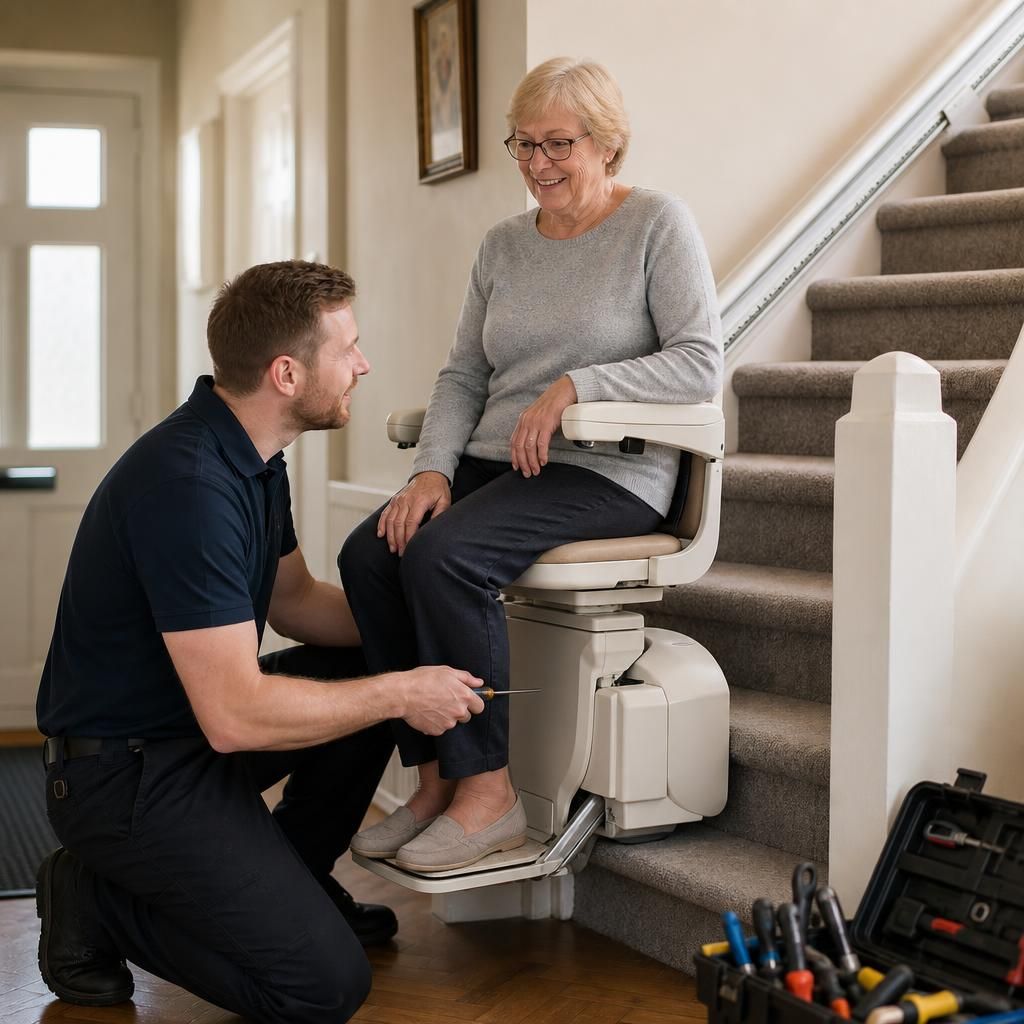
Installation provides a further reliability check because the stairlift must work with the actual staircase, not just on a workshop test setup. The rail is positioned securely, clearances are checked and the lift is run through its full route. On a narrow, curved or multi-storey staircase, particular attention is given to bends, landings, parking positions and access at the top and bottom of the stairs.
Once fitted, the installer checks the fixing points, charging position, seat and footrest movement, belt, controls, sensors and emergency functions again. The customer is shown how to use the stairlift, charge it correctly, use the swivel or folding features safely and report a fault. Operating guidance and details of the available warranty or aftercare arrangements should also be provided.
These checks help identify defects before the stairlift is handed over, but regular use and maintenance remain important. Keeping the track clear, leaving the lift on its charging point when required by the model and reporting unusual sounds, reduced battery performance or inconsistent movement promptly can help prevent avoidable breakdowns. A proper assessment in the Manchester property is therefore essential: it confirms both that the reconditioned unit has passed its refurbishment checks and that it is suitable for the particular staircase and user.
Installation testing is a crucial part of refurbishing a stairlift because it confirms that the reconditioned unit works safely on the customer’s actual staircase, not just in a workshop. After the rail has been secured, the installer checks the full travel route, including bends, landings, parking positions and clearances at the top and bottom of the stairs.
The stairlift is operated repeatedly to assess smooth starting and stopping, travel speed, noise, battery charging, control response and sensor operation. The seat belt, swivel seat, footrest, armrests, emergency stop and obstruction sensors are checked again once fitted. Any issue found during these checks must be investigated and corrected before handover.
This final assessment also confirms that the controls and charging position are practical for the user. The installer explains safe operation, charging requirements and the signs of a developing fault, such as unusual noise, inconsistent movement or reduced battery performance.
Arrange your Manchester stairlift assessment
Arrange your Manchester stairlift assessment so we can check your staircase, discuss your requirements and identify a suitable reconditioned stairlift. The assessment also confirms the installation and aftercare arrangements before you proceed.