
What is the process for refurbishing a reconditioned stairlift in Manchester?
A reconditioned stairlift is professionally inspected, cleaned, serviced and safety-tested before being matched to your Manchester home. Worn or faulty components are replaced, the lift is configured for the staircase, and a trained installer checks its operation after fitting.
A reconditioned stairlift is refurbished through a controlled process of inspection, cleaning, servicing, component replacement and safety testing before it is offered for installation in a Manchester home. The lift is then assessed against the staircase, adjusted or reconfigured where possible, installed by a trained technician and tested again in the property.
Initial assessment and suitability checks
The process starts with confirming that the stairlift is suitable for the intended user and staircase. The type of stairlift, seat position, controls, weight capacity, parking location and access requirements are considered alongside the layout of the home. For a curved or multi-storey staircase, the rail and carriage must be checked against the required route rather than assumed to fit because a similar lift has been used elsewhere.
A survey of the stairs also identifies practical issues such as narrow sections, bends, intermediate landings, doorways and available parking space. This helps determine whether an existing rail can be reused, altered or replaced with a suitably configured rail.
Removal and identification of the equipment
When a previously installed stairlift enters the refurbishment process, it is removed carefully and its main parts are identified and recorded. The carriage, seat, controls, batteries, charging equipment, rail and safety components are examined individually. Parts that are missing, damaged, excessively worn or unsuitable for further use are not simply put back into service.
The condition of the equipment is considered together with its age, operating history where available and compatibility with the proposed installation. A reconditioned lift should not be described as fully refurbished merely because it has been cleaned or removed from another property.
Cleaning and detailed inspection
Surfaces, upholstery, armrests, footrests, controls and accessible mechanical areas are cleaned using methods appropriate to the materials. The rail and carriage are checked for contamination, wear and damage that could affect smooth movement. The inspection also covers wiring, connectors, switches, sensors, charging contacts and protective covers.
Particular attention is given to components that affect safe travel and stopping. These can include the seat swivel mechanism, armrest and seat belt, footrest, obstruction sensors, limit switches, brakes and controls. Any item that does not meet the required condition is repaired or replaced before the lift proceeds to installation.
Servicing and replacement of worn parts
The carriage and drive system are serviced in line with the equipment’s design and the technician’s findings. Batteries are assessed because their condition affects starting, travelling and whether the lift can operate away from a charging point. Charging equipment and contacts are also checked rather than treating battery replacement as the only possible remedy.
Other work may include replacing worn rollers, switches, covers, wiring or fasteners, and correcting faults in the control system. The exact work varies between stairlifts. A straight lift that has had limited use may require different attention from a curved lift that has been dismantled and reconfigured for another staircase.
Configuration for the Manchester property
Once the equipment has passed its workshop checks, it is prepared for the intended home. A straight stairlift may be set up with the appropriate rail length and parking arrangement. A curved stairlift requires more detailed matching of the rail, bends, landings and entry or exit position. Where the staircase has unusual dimensions, the installer confirms that the proposed configuration allows safe clearance and practical use.
The lift is also configured for the user. Seat height, swivel direction, controls and transfer position can be important, particularly where the staircase is narrow or the user has limited strength or balance. These points should be confirmed during the assessment rather than left until the installation day.
Pre-installation safety testing
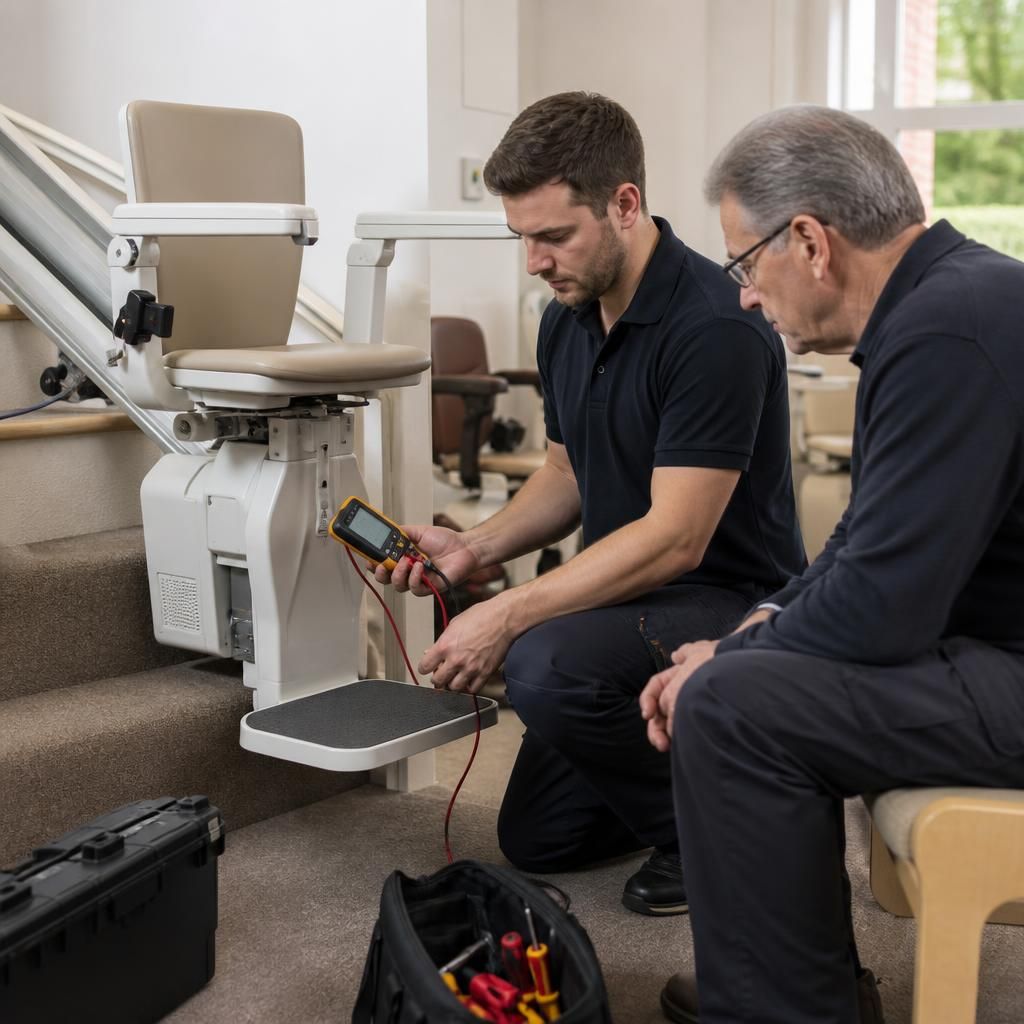
Before fitting, the refurbished stairlift is operated and checked for correct response from the controls, charging system and safety devices. The technician verifies that the lift starts, travels and stops as expected, and that protective features respond appropriately when tested. The seat, footrest, belt, armrests and swivel mechanism are checked for secure operation.
Testing is not limited to whether the carriage moves. Unusual noise, hesitation, poor charging, inconsistent stopping or movement in a safety sensor can indicate a fault requiring further investigation. The lift should only be installed once the relevant checks have been completed and any identified defects addressed.
Professional installation
At the Manchester property, the installer positions and secures the rail or other mounting arrangement without obstructing normal use of the stairs more than necessary. The carriage, seat, controls and charging points are fitted, and the system is connected and adjusted for the staircase. For a curved installation, the rail alignment and transitions between sections are checked particularly carefully.
The installer then runs the stairlift repeatedly through its route. This confirms that it clears walls, steps, doors and landings, reaches its charging and parking positions, and operates correctly with the actual staircase and household layout. Minor adjustments may be made to improve clearance, alignment or the user’s transfer position.
Final handover and advice
After installation, the user or their representative is shown how to operate the controls, use the seat belt and swivel seat, charge the lift and respond to basic safety features. Safe parking, keeping the stairs clear and reporting unusual sounds or changes in performance are also explained. The relevant paperwork, warranty information and details of aftercare should be provided as part of the handover.
A reconditioned stairlift still contains mechanical, electrical and battery-powered components that require sensible use and maintenance. It should not be modified by the customer, and faults should be reported rather than ignored. If the lift is being installed for someone with changing mobility needs, the installer can also confirm whether the selected controls and transfer arrangement remain appropriate.
The result should be a stairlift that has been assessed as suitable, refurbished using serviceable components, safety-tested and checked in the actual Manchester home. The precise refurbishment work depends on the model and condition of the equipment, so it is reasonable to ask what has been inspected, which parts have been replaced, what testing was completed and what warranty and aftercare are included.
The safety-testing stage confirms that a refurbished stairlift is ready for use before it is installed in your Manchester home. The technician checks the controls, drive system, charging equipment, seat belt, swivel seat, footrest, brakes and obstruction sensors rather than relying only on the lift moving normally.
The stairlift is operated repeatedly to identify hesitation, unusual noise, inconsistent stopping or charging faults. Any worn or defective component found during these checks should be repaired or replaced before installation. After fitting, the installer tests the complete route again to confirm that the lift clears the stairs, walls, landings and doorways and reaches its parking positions safely.
At handover, you should be shown how to use the controls, seat belt, swivel mechanism and charging point, as well as what to do if the lift behaves unusually. Ask for confirmation of the refurbishment work completed, the safety checks carried out and the warranty or aftercare provided.
Arrange a professional stairlift refurbishment assessment in Manchester
Arrange a professional stairlift refurbishment assessment in Manchester to confirm the equipment, staircase and user requirements are suitable. Contact Independent Stairlifts for expert advice on the refurbishment, installation, warranty and aftercare arrangements.