
What are the standard safety features to look for when selecting a reconditioned stairlift in Manchester?
When selecting a reconditioned stairlift in Manchester, check that it has a tested safety belt, obstruction sensors, a swivel seat with a secure locking mechanism, a reliable braking system, and battery backup for use during a power cut. The lift should also receive a full safety inspection and professional installation, with controls and settings suited to the user and the staircase.
The standard safety features to look for in a reconditioned stairlift in Manchester are a tested seat belt, obstruction sensors, a swivel seat that locks securely, dependable braking, safe controls and battery backup. These features should be checked as part of a documented safety inspection before installation, then tested again on your staircase by a qualified installer. Reconditioning should restore the lift to a safe, reliable working condition; it should not mean accepting worn, missing or untested safety equipment.
Ask for an assessment that considers both the stairlift and the person using it. A lift may operate correctly but still be unsuitable if the user cannot reach the controls, release the belt, transfer safely to the seat or operate the swivel mechanism. The installer should explain how each safety feature works and demonstrate it before handover.
Seat belt and restraint
A seat belt should be present, clean, undamaged and easy for the user to fasten and release. It must hold the user securely without causing difficulty during transfer. Check that the buckle locks positively, the belt retracts or adjusts correctly and there are no signs of fraying, splitting or contamination. Where a particular user needs additional support, discuss whether the available restraint arrangement is suitable before choosing the lift.
The belt is only effective when used correctly. The installer should show the user how to sit fully back in the seat, fasten the restraint and keep arms and clothing within the chair while it is moving.
Obstruction sensors
Sensors around the footrest and other vulnerable parts of the carriage should stop the stairlift if it meets an object on the stairs. This is important in homes where shoes, toys, pets or other household items may be left on the staircase. During the demonstration, the installer should explain where the sensors are located and how the lift behaves when they are activated.
Sensors do not remove the need to keep the stairs clear. They are a protective feature, not a replacement for checking the route before travel. If the stairlift stops because an obstruction has been detected, the user should follow the operating instructions rather than attempting to bypass or tamper with the sensor.
Swivel seat and locking mechanism
A swivel seat allows the user to turn towards the landing before standing up, reducing the need to twist on the stairs. The seat should lock firmly in the travel position and, where applicable, in the position used for getting on and off. It should not rotate unexpectedly while the lift is moving.
Check that the release handle is within easy reach and that the user has enough room at the top and bottom of the staircase to transfer safely. On a curved staircase, the final parking position and the direction of the swivel can be particularly important. The assessment should account for the user’s balance, strength and preferred side of transfer.
Braking and controlled movement
The stairlift should start and stop smoothly, maintain controlled movement and stop securely when the controls are released. Its braking system, drive mechanism and safety switches should be inspected during refurbishment and tested during installation. Unusual juddering, slipping, delayed stopping or inconsistent movement should be treated as reasons to stop using the lift until it has been examined.
There should also be a clear emergency stop or stop control that the user or carer can operate if necessary. The installer should explain what happens after an emergency stop and how to reset the lift safely.
Battery backup and charging
Most modern stairlifts use rechargeable batteries so they can continue to operate for a limited period during a mains power failure. A reconditioned lift should have batteries that have been tested and are capable of holding an appropriate charge. The charging points should be secure and positioned so the lift can charge at its designated parking location.
Ask how the lift indicates a low battery and what to do if it stops away from a charging point. Battery performance can deteriorate with age, so the condition and replacement arrangements should be included in the aftercare information. A battery backup is not intended to provide unlimited operation during a power cut.
Controls, key switches and interlocks
Controls should be straightforward to use and positioned where the user can reach them without leaning dangerously. A handheld control can be useful when more than one person uses the staircase, while a key switch or similar isolation control can help prevent unintended operation. Any remote controls should be clearly labelled and tested.
Safety interlocks should prevent the lift from operating when the seat, armrests or other required components are not in the correct position. On some models, the lift will not travel unless the seat is facing forwards and locked. These protections should be checked during the demonstration rather than assumed to work because the lift is moving normally.
Footrest and armrest protection
The footrest should provide stable support and should not be loose, cracked or excessively worn. Some stairlifts have sensors that stop the lift if the footrest contacts an obstruction. Armrests should lock securely and provide suitable support when the user is seated or transferring.
Check the clearance between the footrest, the stairs and nearby walls. This is especially important on narrow staircases or where the stairs turn. The installer may need to adjust the seat, controls or parking position so the user can travel without clothing, feet or mobility aids coming into contact with the staircase.
Safety at the top and bottom of the stairs
The lift should park in a position that leaves a safe area for getting on and off. At the top landing, the user should be able to swivel and stand without being forced towards an edge, doorway or obstruction. At the bottom, there should be sufficient space to dismount without blocking a corridor or colliding with furniture.
Where the staircase opens directly into a living area or walkway, consider whether a powered or manual swivel, a hinged rail or another configuration is needed to protect access routes. The correct solution depends on the layout, so this should be assessed in the home rather than selected from a general specification.
What should be checked on a reconditioned lift?
- The seat, belt, armrests, footrest and casing should be inspected for damage, excessive wear and secure operation.
- The rail, carriage, drive system, brakes and charging equipment should be examined and tested.
- Obstruction sensors, limit switches, interlocks, emergency controls and audible or visual warnings should be tested.
- The batteries should be assessed, with any charging or replacement concerns explained clearly.
- The lift should be run on the actual staircase to check smooth movement, clearances, parking positions and safe transfers.
- Instructions should be provided for normal use, charging, cleaning, emergency stopping and reporting a fault.
Ask what refurbishment work has been completed and whether the inspection record identifies any parts that were replaced, adjusted or retained after testing. A reputable assessment should distinguish between cosmetic cleaning and safety-critical work. If a component is worn or its condition cannot be confirmed, it should be replaced or the suitability of the lift should be reconsidered.
Installation and ongoing safety
Professional fitting is part of the safety system. The rail must be secured correctly, the lift aligned with the staircase and the final positions set to suit the user and the available space. After fitting, the installer should carry out functional checks and show the user how to operate the lift safely.
Keep the operating instructions and service information accessible. Arrange servicing or inspection when advised, and contact Independent Stairlifts promptly if the lift develops unusual noise, jerky movement, a battery warning, a loose component or a fault with the belt, sensors or controls. Do not continue using a lift that does not stop correctly or whose safety equipment appears damaged.
When comparing reconditioned stairlifts in Manchester, look beyond the purchase price and ask for evidence of inspection, suitable safety features, professional installation and clear aftercare arrangements. The right lift is one whose safety systems have been tested, whose controls match the user’s abilities and whose design suits the particular staircase.
A reconditioned stairlift should have every safety-critical component inspected and tested before it is installed in your Manchester home. This includes the seat belt, obstruction sensors, swivel-seat lock, braking system, controls, interlocks and battery.
Ask for a clear explanation of what was checked, which parts were replaced or adjusted, and how the lift performed on your staircase. The installer should then demonstrate the safety features, controls, charging procedure and emergency stop before handover. A lift that works correctly but does not suit the user’s transfer needs, reach or balance is not a safe choice.
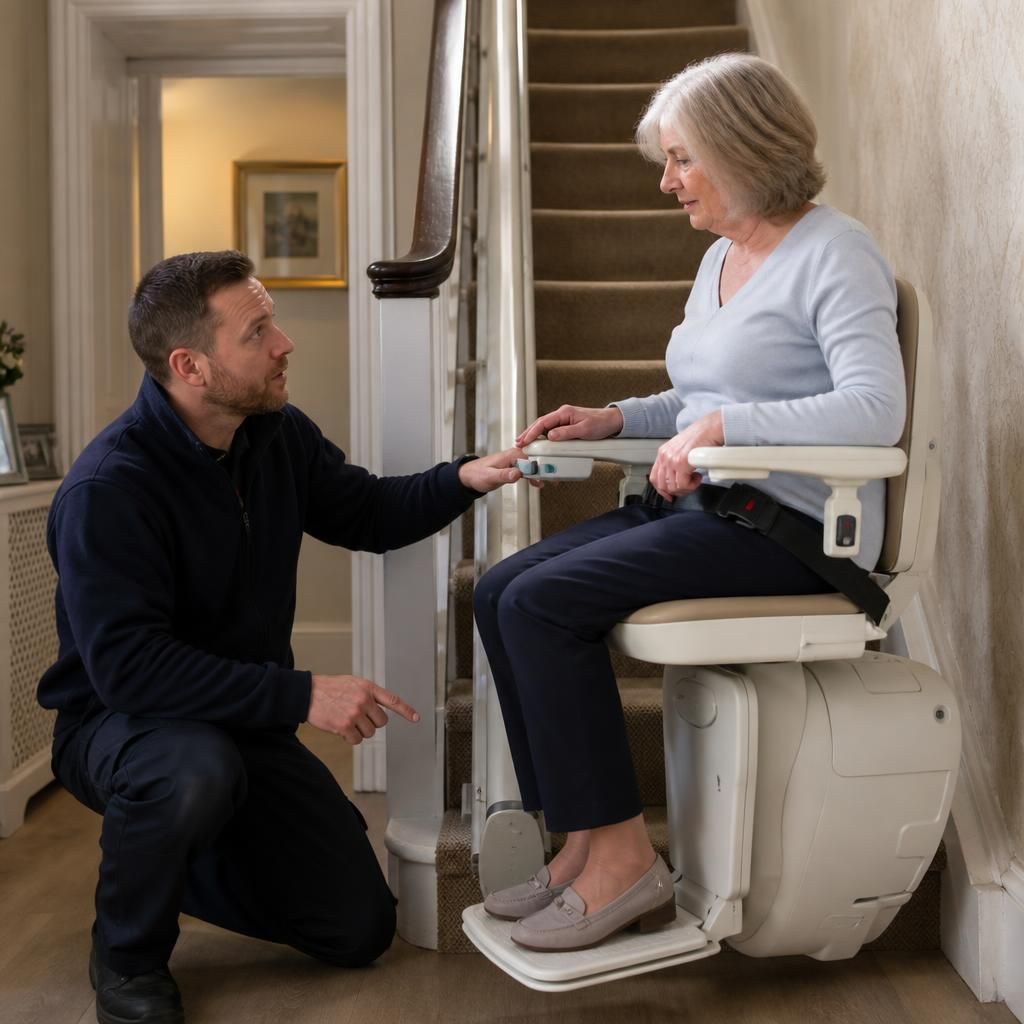
Arrange a safety assessment for your reconditioned stairlift
Arrange a home safety assessment with Independent Stairlifts to check that your reconditioned stairlift’s safety features, controls and parking positions suit both the user and your Manchester staircase. We can explain the inspection findings and demonstrate safe operation before installation.