
What are the key benefits of choosing a reconditioned stairlift over a new one for Manchester homes?
A reconditioned stairlift can provide safe, reliable access at a lower cost than a new model, making it a practical option for many Manchester homes. Once professionally inspected, refurbished and fitted to your staircase, it can offer the essential safety features, tailored installation and aftercare you need without paying for a brand-new unit.
A professionally reconditioned stairlift can give a Manchester home safe, dependable access at a lower purchase price than a new model. The main benefits are reduced cost, shorter availability in some cases, less waste and access to proven equipment, provided the stairlift has been correctly refurbished, matched to the staircase and installed by a qualified technician.
Lower overall purchase cost
The most immediate advantage is the lower price compared with an equivalent new stairlift. This can make a practical difference when you need to improve access quickly, are working within a set budget or want to preserve funds for other home adaptations and care needs. A reconditioned option may provide the essential functions required for safe movement between floors without paying for features that are not necessary for your circumstances.
The final cost still depends on the type of staircase and the equipment required. A straight stairlift is generally simpler to prepare and install than a curved model, while a narrow staircase, multiple landings or unusual changes in direction may require additional assessment. The most useful comparison is therefore between like-for-like quotations, including fitting, safety checks, warranty cover and aftercare rather than comparing the equipment price alone.
Reliable access using established equipment
Reconditioned stairlifts are not simply used units installed without preparation. Suitable equipment should be removed, assessed, cleaned, tested and refurbished before it is offered for reuse. Worn parts are replaced where necessary, batteries and charging systems are checked, and the lift is tested to confirm that its controls, safety sensors, seat and travel mechanisms operate correctly.
Because the equipment has already been used, its operation and common service requirements are well understood by experienced installers. This does not make every second-hand stairlift suitable, however. Reliability depends on the quality of the refurbishment, the condition of the individual unit and whether it is appropriate for the intended staircase and user. A proper assessment is essential.
Essential safety features can still be included
A reconditioned stairlift should provide the safety features appropriate to its design and condition. These may include a secure seat belt, swivel or powered swivel seating, obstruction sensors, braking systems, safety arms, diagnostic controls and battery backup. The exact specification varies between models, so the assessment should consider the user’s balance, strength, mobility and ability to operate the controls.
Installation is also part of safety. The stairlift needs to be securely fixed, positioned to allow safe transfers at the top and bottom of the stairs, and set up so that the controls and seat movements are manageable. On homes in Manchester with narrow hallways, limited landing space or more than one flight, careful planning helps prevent the lift from obstructing doors, walkways or other household users.
More choice for different Manchester homes
Reconditioned stairlifts can be suitable for a broad range of domestic layouts. Straight models may work for a single uninterrupted flight, while curved systems can be configured around bends, intermediate landings and changes in direction. Outdoor or weather-resistant solutions may be considered where steps lead to a garden, entrance or different level outside the property.
A reconditioned option can be particularly useful where a standard new model is not the best match for the staircase or where a specialist configuration would otherwise be more expensive. The available equipment must still be compatible with the rail layout, stair width, landing space and the user’s preferred transfer position. A home assessment will identify these points before a recommendation is made.
Potentially quicker access
Where suitable refurbished equipment is already available, it may be possible to arrange installation without waiting for a new unit to be manufactured or specially configured. The timescale depends on the stairlift type, the condition of the equipment, the complexity of the installation and the availability of any replacement parts.
Speed should not come at the expense of inspection or fitting quality. The stairlift should be checked before installation and tested again once it has been fitted. You should also receive an explanation of the controls, charging routine, emergency lowering procedure and what to do if the lift stops working.
A more resource-efficient option
Reusing a stairlift extends the working life of equipment and reduces the need to manufacture, transport and dispose of another complete unit. This can be a sensible choice where the existing equipment can be safely restored and remains appropriate for the user and property. Environmental considerations should support, rather than replace, the practical requirements of safety, suitability and dependable aftercare.
What to check before choosing reconditioned
- Whether the assessment covers the staircase, landing areas, access points and the user’s mobility needs.
- Which parts have been inspected, serviced or replaced during refurbishment.
- Whether the quoted price includes delivery, professional fitting, testing and user instruction.
- What warranty is provided, what it covers and how faults are reported.
- Whether batteries, chargers, remote controls and other essential accessories are included.
- How servicing, repairs and replacement parts will be handled after installation.
- Whether the proposed model can be adapted if the user’s mobility or support needs change.
A new stairlift may be preferable where you need a particular specification, a fully customised finish or the longest available choice of options. A reconditioned stairlift is often the better-value route when a suitable model can meet the user’s needs and is backed by proper refurbishment, expert fitting and clear aftercare. For a Manchester home, the right decision should be based on the staircase, the person using the lift and the complete support package, not on the equipment’s age alone.
The main benefit of a reconditioned stairlift for a Manchester home is that it can provide dependable access between floors at a lower cost than an equivalent new model. The saving comes from reusing suitable equipment, not from removing essential safety checks or professional installation.
Before fitting, the stairlift should be assessed, cleaned, serviced and tested. Key components such as the batteries, charging system, seat, controls, sensors and braking mechanism should be checked, with worn parts replaced where necessary. The lift must also be matched to the staircase and the user’s mobility needs.
When comparing options, look beyond the equipment price. Ask whether the quotation includes fitting, safety testing, user instruction, warranty cover and aftercare. A properly refurbished stairlift with clear support can offer practical value while helping the user move around the home more safely and independently.
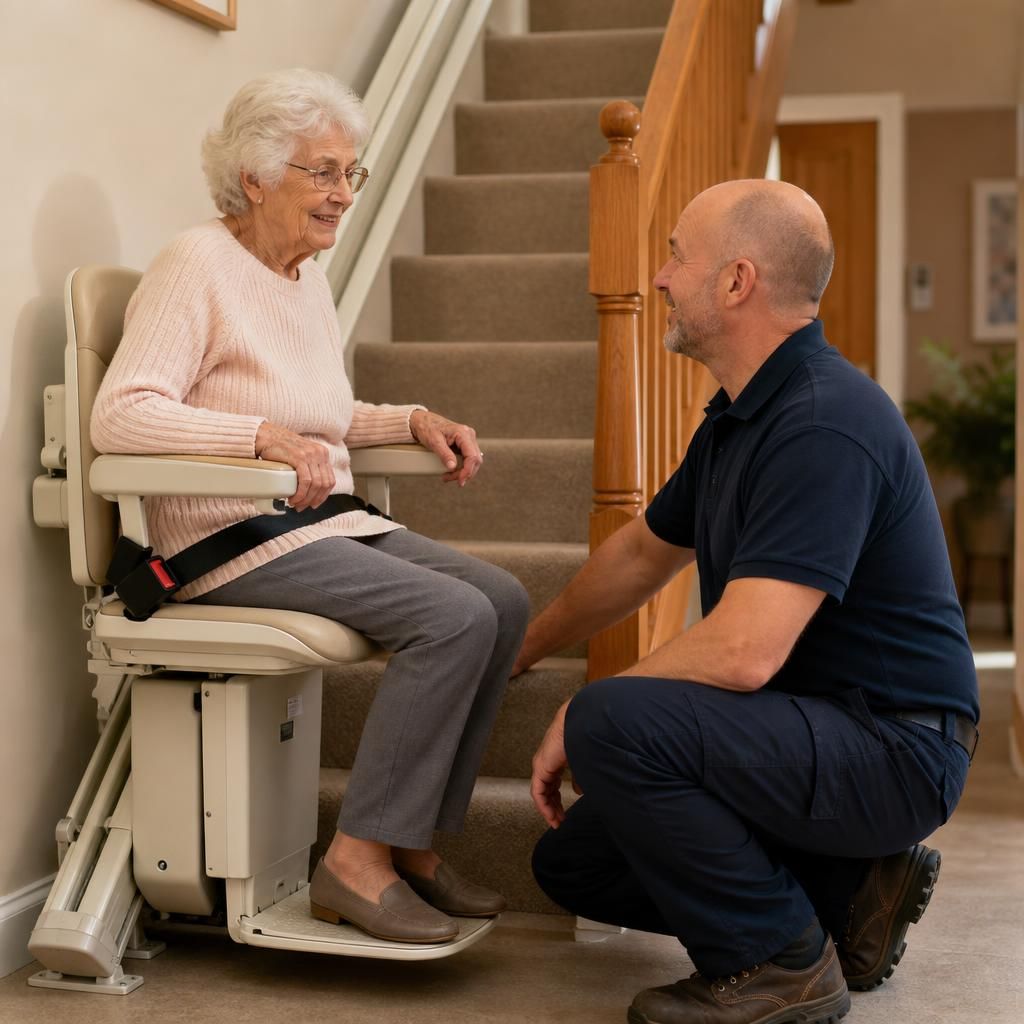
Arrange your Manchester reconditioned stairlift assessment
Arrange a home assessment for a reconditioned stairlift in Manchester to discuss your staircase, mobility needs and suitable available models. Contact Independent Stairlifts for a clear quotation covering fitting, warranty and aftercare.