
How do reconditioned stairlifts in Manchester accommodate different stair configurations, such as narrow or multi-storey setups?
Reconditioned stairlifts in Manchester can be adapted to many layouts, including narrow, curved and multi-storey staircases, following an assessment of the stairs, landings and access requirements. Straight stairs may use a refurbished standard unit, while curved or multi-storey arrangements may require a reconditioned curved lift, separate lifts for each flight or a suitable alternative where space is limited.
Reconditioned stairlifts in Manchester can accommodate many different stair configurations, including narrow, curved, split-level and multi-storey layouts, provided the equipment is matched to the staircase and assessed for safe installation. Straight staircases may suit a refurbished standard stairlift, while curved or complex arrangements normally require a reconditioned curved model with a rail designed for the individual staircase. Where one lift cannot serve every section, separate lifts or another accessibility solution may be more suitable.
Narrow staircases
A narrow staircase is assessed for more than the width of the steps. The installer also considers the available clearance at the top and bottom, the position of handrails, radiators, doors and nearby furniture, and whether other people will still be able to use the stairs safely. A compact stairlift, slimline seat or lift with a folding footrest may help preserve usable space when the staircase is restricted.
The stairlift must still provide a stable seating position and enough room for the user to mount and dismount safely. In some homes, the rail can be positioned to keep the chair closer to the stair treads when folded, although this depends on the staircase and the model available. If the stairs are exceptionally tight or the user needs to travel with bulky equipment, a stairlift may not be the appropriate option without further adaptations.
Curved and turning stairs
Curved stairs, quarter-turn stairs and staircases with intermediate landings require a rail that follows the individual path of the staircase. A suitable reconditioned curved stairlift may be available, but its existing rail cannot normally be assumed to fit a different home. The route, bends, gradients, landing dimensions and parking position must be checked before a recommendation is made.
During the assessment, the installer will consider where the chair should park, whether it needs to stop beyond the top or bottom step, and how the user will transfer on and off the seat. Powered swivel seats, hinged rails or alternative parking positions may be considered where they improve access or prevent the rail from obstructing a doorway. These features are dependent on the stairlift and the layout rather than being included automatically with every reconditioned model.
Multi-storey and split-level homes
For a staircase serving more than one floor, the most suitable arrangement depends on whether the flights are continuous, separated by a landing or positioned in different directions. A single curved stairlift may be able to follow a continuous route where the rail can be safely designed for it. In other properties, separate stairlifts for separate flights can be more practical. The user may transfer between the lifts at a landing, provided there is sufficient space and the transfer can be made safely.
Separate lifts may also be considered where the upper and lower flights have different shapes or where a single rail would obstruct a landing, doorway or access route. Each lift needs its own safe parking position and charging arrangement. The assessment should therefore cover every floor the user needs to reach, not just the main staircase.
Landings, doors and shared access
Landings are important in both narrow and multi-storey installations. The installer checks that the chair can reach the required floor without blocking a door, hallway or escape route. A rail may need to finish in a different position from the top or bottom step, or a hinged section may be needed where the rail would otherwise cross an opening. Doors should not open into the chair’s travel path, and the lift must not create an avoidable hazard for people walking through the area.
In homes where the staircase is shared with other occupants, the folded stairlift should leave as much usable passage as the layout allows. The user should also be able to approach the seat, operate the controls and transfer without leaning across the stairs. These practical points can affect the recommended model as much as the shape of the staircase.
How a reconditioned lift is matched to the staircase
- Survey of the route: The staircase, landings, bends, access points and parking areas are measured and inspected. The assessor also considers the user’s height, weight, mobility, transfer ability and preferred floors.
- Selection of the configuration: A suitable refurbished straight or curved unit is identified, together with compatible controls, seat options and safety features. A pre-owned curved rail is only suitable if its route matches the property or can be appropriately adapted or replaced.
- Checks before fitting: The stairlift and its components should be examined, serviced and tested before installation. Any work required to the rail, batteries, drive system, controls or safety equipment should be established before the fitting is agreed.
- Installation and testing: The lift is secured to the stairs or another approved structure according to the installation requirements. It is then tested along the full route, including stopping points, sensors, swivel mechanisms, charging and the intended parking positions.
- User instruction: The user is shown how to operate the controls, fasten the seat belt, use the swivel or folding mechanisms where fitted, respond to an obstruction and leave the lift safely if it stops.
Reconditioning does not make every stairlift suitable for every staircase. A refurbished straight model is generally intended for a straight flight, whereas a curved installation needs a compatible rail and a properly assessed route. The condition of the staircase, the fixing points, electrical supply, battery performance and availability of replacement parts should also be considered.
If the stairs are unusually narrow, steep, interrupted by several landings or difficult to access, ask for a full home assessment rather than selecting a model from its appearance alone. The assessment can compare a single curved lift, separate lifts, a different seat configuration or an alternative mobility aid. This ensures that the chosen reconditioned stairlift accommodates the building while remaining practical and safe for the person who will use it.
A detailed home assessment determines how a reconditioned stairlift will work with your staircase. For narrow stairs, the installer checks step width, handrails, doorways, landings and the space needed to mount and leave the seat safely. A compact seat, folding footrest or alternative parking position may help preserve access, but only where the layout and user’s needs allow.
In multi-storey homes, the assessment covers every flight and landing. A single reconditioned curved stairlift may follow a continuous route, while separate lifts may be more practical where flights change direction or are divided by landings. Each arrangement must provide safe transfers, clear access and suitable parking and charging points.
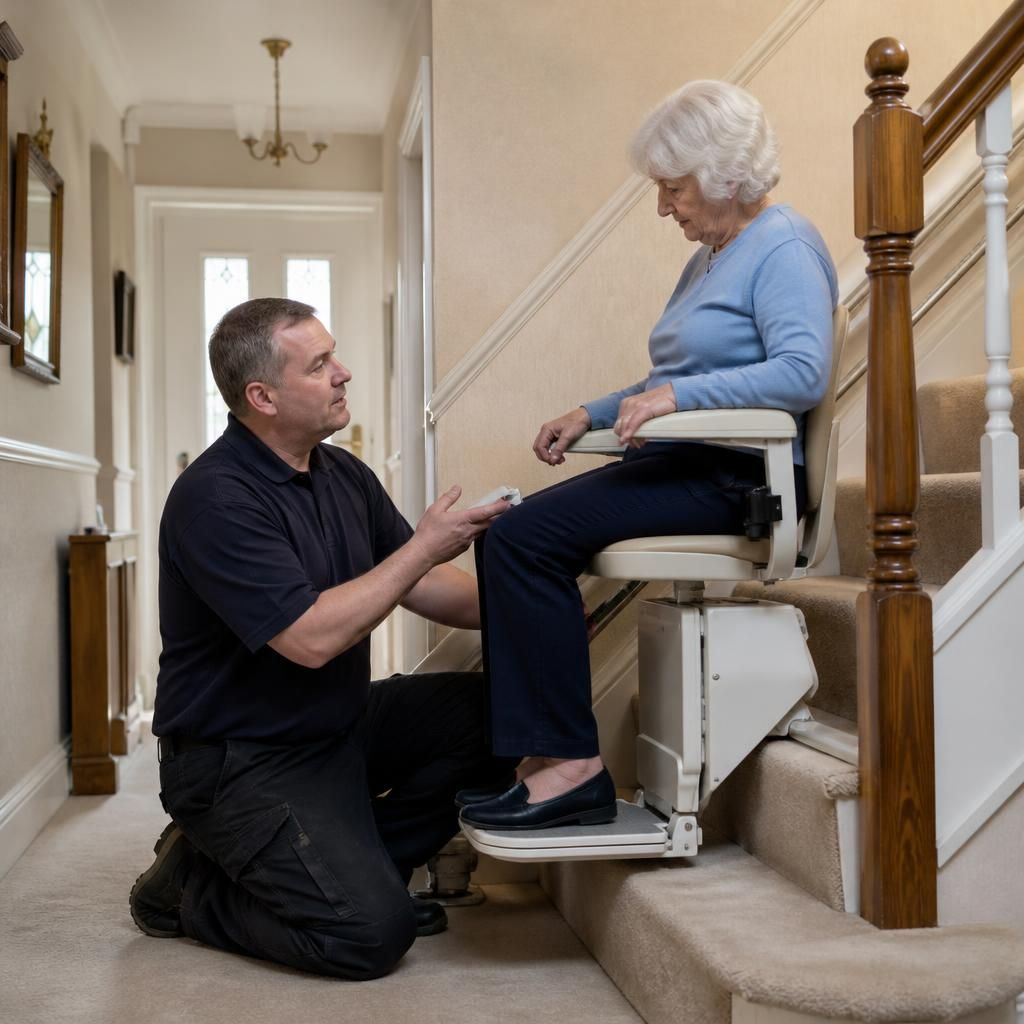
Arrange a Home Assessment for Your Manchester Staircase
Arrange a home assessment for your Manchester staircase so we can check its width, landings, turns and access points, then advise whether a reconditioned straight, curved or multi-lift arrangement is suitable.