
How do reconditioned stairlifts compare in terms of installation time and ease versus new models in Manchester?
Reconditioned stairlifts in Manchester are often quicker and simpler to install than new models because the main lift components have already been manufactured and tested. However, installation time still depends on your staircase, the chosen equipment and any adjustments needed to ensure a safe, precise fit.
Reconditioned stairlifts in Manchester are often quicker to install than new models, particularly when a suitable straight-rail unit is already available and the staircase needs no modification. The lift components have already been manufactured, so preparation can be simpler. However, the installation itself still requires the same careful survey, fitting, safety checks and user demonstration as a new stairlift. A reconditioned model is not automatically easier or faster to install, especially on a curved, narrow or multi-storey staircase.
What affects the installation time? The main factors are the shape of the staircase, the type of stairlift selected, whether a suitable unit is in stock, and whether any existing equipment must be removed. A straight staircase usually allows a straightforward rail installation. A curved staircase requires a rail made to follow the individual bends, landings and changes in direction. If a suitable reconditioned curved rail is not available, the rail may need to be prepared or manufactured for the property, reducing or removing the time advantage over a new system.
The condition and layout of the home can also affect the work. The installer may need to consider the position of the charging points, access to the stairs, doorways, handrails, radiators and nearby electrical supplies. On a narrow staircase, the lift must be positioned so that it leaves safe clearance for other users. Where the staircase serves several floors or includes intermediate landings, the installation requires more planning than a simple straight flight.
Why a reconditioned stairlift can be quicker
- The main components have already been produced and may be ready for allocation.
- A standard straight-rail model can often be matched to the staircase without designing a new rail.
- The lift has already been through an earlier manufacturing process, so the installation team is fitting an established system rather than assembling a completely new unit.
- Where the existing staircase measurements and the available equipment are a good match, fewer adaptations may be needed before fitting.
These advantages depend on the particular model. A reconditioned stairlift still needs to be checked, prepared and configured for its new home. The installer must confirm that the seat, controls, sensors, charging system and safety mechanisms operate correctly before the lift is handed over. The rail and carriage also need to be secured accurately; speed should never take priority over a precise and safe installation.
How installation compares with a new stairlift
A new stairlift may take longer to supply when it is being made or configured specifically for the staircase, particularly if it is a curved model. On the other hand, a new standard straight stairlift that is available locally may be just as quick to fit as a reconditioned one. New equipment may also offer a wider choice of current finishes, controls and optional features, while a reconditioned model is selected from the suitable equipment available at the time.
For curved staircases, the comparison is more dependent on the rail than on whether the carriage is new or reconditioned. A pre-existing curved rail can only be reused if its dimensions and shape are appropriate for the new staircase. Rails are not universally interchangeable between homes. In some cases, a reconditioned carriage can be paired with a newly prepared rail, but this should be confirmed during the assessment rather than assumed.
What happens during a reconditioned installation?
- The staircase and the person’s mobility requirements are assessed, including seating position, transfer points and the controls that will be easiest to use.
- The available stairlift is checked for compatibility with the staircase and the intended installation position.
- The equipment is inspected and prepared in line with the agreed specification. Worn or unsuitable components should be addressed before installation.
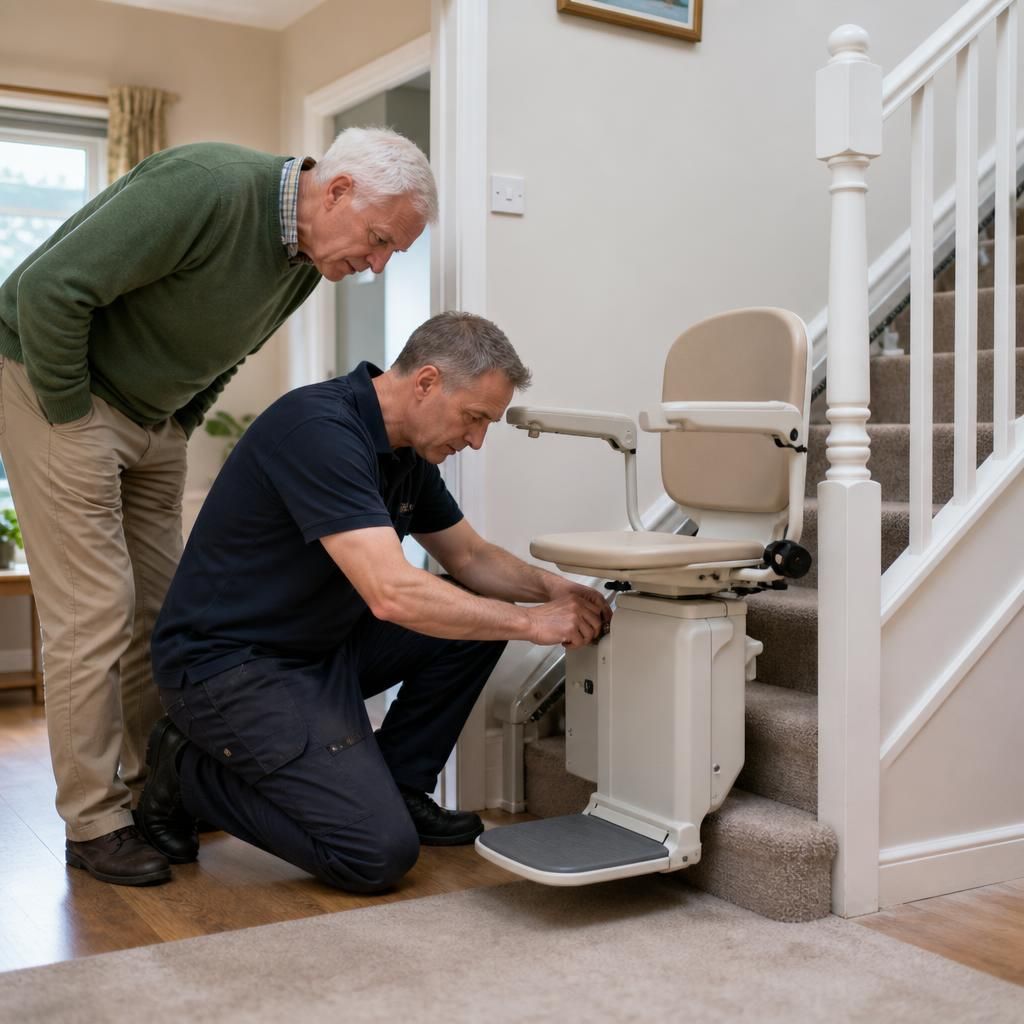
- The rail, charging points and lift are installed securely, with attention to clearance at the top and bottom of the stairs.
- The installer tests the operating controls, seat position, safety sensors, brakes, charging system and any relevant swivel or folding functions.
- The user is shown how to operate, charge and stop the stairlift safely, including what to do if the lift stops away from its charging point.
If an old stairlift is being replaced, allowing time for its safe removal may be necessary. The installer may also need to make good or explain any fixing points left by the previous equipment, although the extent of this work depends on the property and the replacement arrangement.
How to help the fitting go smoothly
- Keep the staircase and the access route clear before the installation visit.
- Tell the adviser about doors, radiators, handrails, mobility issues and any difficulty transferring on or off the seat.
- Explain whether other household members need to use the stairs while the lift is fitted.
- Make sure the agreed model and any optional features are confirmed before the fitting date.
- Ask whether the installation includes removal of existing equipment, electrical work, demonstration and aftercare arrangements.
The most reliable way to compare installation times is therefore to compare like for like: a reconditioned straight stairlift with a new straight model, or a reconditioned curved solution with a new curved solution. For a Manchester home with a standard staircase and a suitable unit available, reconditioned equipment may provide the quicker route to installation. For a complex staircase, the assessment and precise fitting requirements are more important than the age of the lift. A proper survey will establish the realistic timescale and confirm whether the proposed reconditioned stairlift can be installed safely and comfortably in your home.
A reconditioned stairlift is usually easiest and quickest to install when a suitable, fully tested model already matches the staircase. This is most common with standard straight stairs, where an available rail can often be fitted without being specially made for the property.
Curved and multi-storey staircases require more careful matching. The rail must follow the exact bends, landings and changes in direction, so a suitable reconditioned rail may not be available. In that situation, preparing a compatible rail can make the timescale similar to that of a new stairlift. A home assessment in Manchester confirms the fit, access requirements and realistic installation date before work is arranged.
Arrange Your Manchester Stairlift Assessment
Arrange your Manchester stairlift assessment to confirm whether a suitable reconditioned model can be fitted and to receive a realistic installation timescale. Our adviser can assess your staircase, access requirements and preferred equipment before fitting is arranged.