
What steps are involved in the professional assessment and installation of a used stairlift?
A professional used stairlift assessment involves surveying your staircase, checking the lift’s condition and compatibility, and confirming the safest configuration for your home. Installation then includes secure fitting, safety testing, and a demonstration so you can use the stairlift confidently.
A professional assessment and installation of a used stairlift normally involves a home survey, a detailed check of the stairlift and its compatibility, safe fitting by a qualified installer, and a final demonstration. The process is not simply a matter of attaching a second-hand lift to the staircase: the equipment, rail, controls, charging points and user requirements must all be checked before installation is approved.
1. Discussing the user’s needs
The assessment begins with a discussion about who will use the stairlift and how it needs to support them. The assessor may ask about mobility, balance, transfers, pain, strength, vision and whether the user needs assistance getting on or off the seat. They will also consider whether the lift needs to be used by one person or several people in the household.
This information helps determine the most suitable configuration. For example, a swivel seat may make transfers safer at the top of the stairs, while adjustable armrests or a powered footrest may be useful where movement is restricted. Controls, seat width, weight capacity and the position of the user’s stronger side can also affect the recommendation.
2. Surveying the staircase and surrounding space
The installer measures and examines the staircase rather than relying on general descriptions or photographs. They assess its length, width, gradient, number of flights, landings, bends and available clearance. They also look at the shape and strength of the stair treads, the position of handrails, nearby doors, radiators and walls, and the space available at the top and bottom.
A straight used stairlift may be suitable for a straight flight, but the rail still needs to be the correct length and configuration. A curved stairlift usually requires a rail made for the particular staircase, so the condition and suitability of the existing rail are especially important. Where the staircase has narrow sections, intermediate landings or unusual curves, the survey will identify whether the lift can be installed without creating an obstruction.
The assessor will also consider how the user approaches and leaves the stairlift. A safe installation must provide adequate room to sit down, stand up and use the controls without placing the user close to a hazard such as an open doorway or a change in floor level.
3. Checking the used stairlift and its documentation
The equipment is inspected to establish whether it is suitable for reuse. This may include checking the motor, gearbox, batteries, charging system, seat, swivel mechanism, armrests, footrest, safety sensors, controls and remote call/send units. The rail, brackets and fixings are checked for damage, wear, corrosion or signs of alteration.
A professional assessment should also establish the lift’s history where that information is available. The installer may review service records, previous faults, battery replacement information and any manufacturer or servicing documentation. A used stairlift should not be treated as suitable merely because it powers on. Its safety systems and mechanical components need to operate correctly under test conditions.
Some parts may be replaced or refurbished before fitting. Batteries and consumable items, for example, may need attention if they no longer hold charge reliably. If the equipment is not compatible with the staircase or cannot be brought to a safe, serviceable condition, a responsible installer should explain this before work proceeds.
4. Confirming compatibility and agreeing the installation
Once the staircase, user requirements and equipment have been assessed, the installer confirms the proposed arrangement. This should cover the position of the rail, charging points, seat orientation, controls, parking position and any access considerations. If adaptations are needed, such as repositioning a handrail or protecting a doorway, these should be discussed in advance.
The quotation or agreement should make clear what is included, such as delivery, fitting, testing, removal of unsuitable equipment and user instruction. It should also explain the warranty, servicing arrangements and what happens if a fault develops. With a curved stairlift, it is particularly important to confirm whether the existing rail is being reused, modified or replaced, as this can affect both suitability and cost.
5. Preparing the staircase
Before fitting begins, the installer confirms that the staircase and landing are clear enough to work safely. Furniture or ornaments may need to be moved, and the route for bringing the equipment into the property should be considered. The installer should protect surrounding surfaces as appropriate and identify the location of the electrical supply and charging points.
Most stairlifts are secured to the stair treads rather than the wall. The fixing positions must be selected carefully so that the rail is stable and does not interfere unnecessarily with the user’s access or the structure of the staircase. Any required electrical work should be completed in accordance with applicable safety requirements.
6. Installing and adjusting the stairlift
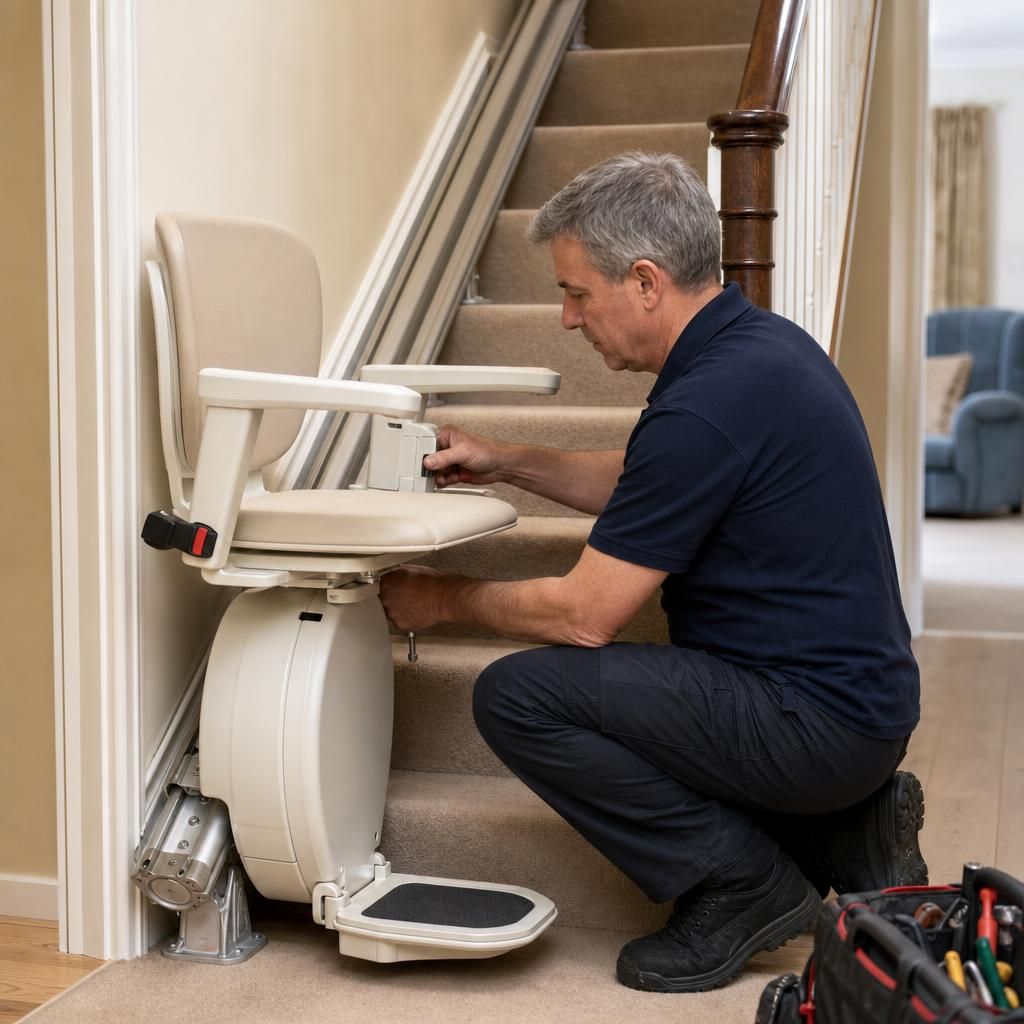
The rail is assembled or positioned according to the survey, then secured firmly to the stairs. The carriage, seat and other components are fitted and adjusted so that the lift travels smoothly and remains clear of walls, doors and other obstructions. On a curved installation, the rail alignment and stopping positions require particular attention because the stairlift must negotiate each change of direction safely.
The installer adjusts features such as seat height, swivel operation, armrest position, footrest clearance and control layout where the model allows. They also check that the user can reach the controls and that the stairlift is comfortable to enter and leave at both ends of the journey.
7. Carrying out safety and operational tests
After fitting, the stairlift is tested through its full travel. The installer checks starting and stopping, speed control, charging, battery operation, seat locking, swivel mechanisms, footrest operation and the response of safety edges or obstruction sensors. They also check that the lift stops correctly if a safety control is activated and that the remote controls communicate properly with the unit.
Fixings, clearances and the stability of the rail are checked again after the equipment has been operated. Any unusual noise, hesitation, movement or warning indication should be investigated before the stairlift is handed over. The lift should not be accepted for normal use until the installer is satisfied that it operates safely and consistently.
8. Demonstrating the stairlift and providing aftercare information
The installer demonstrates the complete operating sequence, including how to park and charge the lift, use the seat swivel, fasten any safety belt, operate the controls and use the remote call/send units. The user should be shown how to stop the stairlift in an emergency and what to do if it does not move, does not charge or displays a fault warning.
Instruction should be practical and adapted to the user’s abilities. If a family member or carer helps with transfers or day-to-day use, they should also understand the controls and basic safety precautions. The installer should leave information about servicing, warranty cover, emergency support and safe cleaning, and should explain when the stairlift should be inspected or serviced.
What to check before signing off the installation
- The stairlift travels the full staircase smoothly and stops at the correct positions.
- The seat, armrests, footrest, belt and swivel mechanism work as demonstrated.
- The controls and remote units are easy for the user to operate.
- The batteries charge correctly and the charging position is clear.
- Safety sensors and emergency controls have been tested.
- The rail and brackets are secure, with no avoidable obstruction to the stairs.
- You have received clear warranty, servicing and fault-reporting information.
A professional assessment protects against the main risks associated with buying a used stairlift: unsuitable equipment, poor fit, hidden wear and unsafe installation. If the survey identifies a problem, ask for an explanation and a written alternative rather than proceeding with a lift that does not meet the user’s needs or the staircase’s requirements.
A professional used stairlift assessment confirms that the equipment is safe, suitable for the staircase and appropriate for the person using it. Before installation, the assessor checks the rail, carriage, seat, controls, batteries, safety sensors and available space at the top and bottom of the stairs.
After fitting, the installer should run the stairlift through its full journey and demonstrate its operation. Before signing off the installation, check that:
- the stairlift travels smoothly and stops correctly;
- the seat, belt, swivel, armrests and footrest work as expected;
- the controls and remote units are easy to use;
- the batteries charge correctly;
- the rail and brackets are secure and do not create an avoidable obstruction; and
- you have received clear warranty, servicing and fault-reporting information.
Arrange Your Used Stairlift Assessment
Arrange a professional used stairlift assessment to confirm that the equipment is safe, compatible with your staircase and suitable for the person using it. The assessment will also clarify the installation requirements, warranty and ongoing servicing arrangements.