
What are the key considerations when assessing the safety features of a used stairlift?
When assessing a used stairlift, check the seat belt, safety sensors, braking system, swivel-seat lock, controls, footrest, battery and track for secure, reliable operation. A qualified engineer should test these features, confirm the stairlift is correctly installed for your staircase and provide evidence of servicing and electrical safety checks before you buy.
A safe used stairlift should have fully functioning occupant restraints, safety sensors, controls, braking and swivel-seat mechanisms, with a sound battery, carriage and track. It should also be professionally assessed and installed for the specific staircase, with service records, operating instructions and evidence that electrical and safety checks have been completed. Do not rely on appearance or a short demonstration alone: safety-critical components need to be tested under operating conditions by a qualified stairlift engineer.
When assessing a used stairlift, check the following features and supporting information before agreeing to buy:
- Seat belt or harness: Check that the belt is present, undamaged and easy to fasten and release. The buckle should lock securely, and the belt should remain firmly attached to the seat during movement. If the stairlift has a harness rather than a standard lap belt, make sure it is correctly adjusted for the user and that replacement parts are available if required.
- Safety sensors: Sensors around the footrest, carriage and other exposed areas should stop the stairlift if they detect an obstruction. Ask the engineer to demonstrate this safely rather than attempting to place hands or objects in the mechanism yourself. Sensors that have been disconnected, damaged or bypassed are a serious concern.
- Braking and stopping: The stairlift should start smoothly, travel at a controlled speed and stop accurately at the top and bottom of the track. It should not judder, roll backwards, overrun the landing or make unusual mechanical noises. The braking system must be assessed as part of a professional inspection, as its condition cannot be confirmed by looking at the lift.
- Swivel seat and locking mechanism: A swivel seat helps the user get on and off away from the edge of the stairs. Check that it rotates smoothly, locks firmly in the intended position and cannot swivel unintentionally while travelling. Fold-up arms, the seat and the swivel release should all work without excessive looseness.
- Controls and remote controls: The armrest control should respond consistently and be suitable for the user to operate. If the stairlift has remote controls, test them from both ends of the track and check that they cannot cause confusion or unintended movement. Controls should be clearly marked, with any emergency stop or isolation control identified and explained.
- Footrest and obstruction protection: The footrest should be secure, stable and free from cracks or excessive movement. Its sensors should stop the lift if the footrest meets an obstruction. Check that the user’s feet will be supported comfortably and that the footrest does not create a trip hazard when the seat is folded.
- Battery condition and charging: Used stairlifts normally rely on rechargeable batteries so they can complete a journey during a mains power interruption. Check that the lift charges correctly at its charging points, remains powered when parked and does not display battery or charging warnings. Batteries are consumable items, so ask about their age and replacement history. A lift that only works when connected to the mains, or frequently runs out of charge, should not be accepted without investigation.
- Track, carriage and fixings: Inspect the rail for damage, distortion, loose fixings or signs of inappropriate alteration. The carriage should run steadily without excessive vibration, scraping or unusual noise. A track from another staircase or a poorly adapted rail may not provide a safe fit, even if the stairlift itself appears to operate normally.
- Installation and staircase suitability: The stairlift must be measured and installed for the actual staircase, including its width, bends, landings, doorways and available space at the top and bottom. Check that the lift does not obstruct access, leave insufficient clearance or create a risk for other people using the stairs. A professional assessment is particularly important for curved, narrow, split-level or outdoor staircases.
- Safety switches and electrical condition: Ask the engineer to check the isolation switch, charging equipment, wiring, plugs and connections. There should be no exposed wires, scorch marks, makeshift repairs or damaged casing. Electrical safety checks and any required servicing should be documented rather than assumed from the fact that the lift powers up.
Also check the condition of the armrests, seat upholstery, footrest edges and casing. Cosmetic wear does not necessarily make a stairlift unsafe, but cracks, sharp edges, loose covers or missing parts can indicate damage or poor maintenance. Confirm that all safety-related covers and guards are fitted and that replacement components can still be sourced.
Ask to see the available service history, installation details and user instructions. Records should identify maintenance or repairs and, where possible, explain when batteries or other commonly replaced parts were fitted. The seller should be able to explain the lift’s controls, charging routine, emergency lowering or manual movement procedure, and what to do if the stairlift stops on the stairs. Keep the operating instructions with the lift after installation.
Before purchase, request a written assessment that records the model, condition, required work and any limitations. Clarify who is responsible for removing the stairlift, adapting the track, installing it in the new property and carrying out follow-up servicing. A warranty should state which parts and labour are covered, how long cover lasts and whether call-outs or batteries are excluded.
Do not buy a used stairlift that has missing safety equipment, unexplained faults, damaged wiring, unreliable stopping, ineffective sensors or a track that has not been confirmed as suitable. A qualified engineer should complete the final inspection and installation, test the safety systems after fitting and demonstrate the lift to the user. This is the most reliable way to confirm that a pre-owned stairlift is safe for the individual and the staircase where it will be used.
A professional safety assessment is essential when buying a used stairlift because appearance and a short demonstration cannot confirm the condition of its safety-critical parts. A qualified engineer should test the seat belt, sensors, braking, swivel-seat lock, controls, battery, carriage and charging system under normal operating conditions.
The assessment should also confirm that the track and installation are suitable for the actual staircase. Ask for a written record of any faults, repairs or limitations, together with the service history and details of warranty cover. Do not proceed if safety equipment is missing, sensors have been bypassed, stopping is unreliable or the wiring and track show signs of damage.
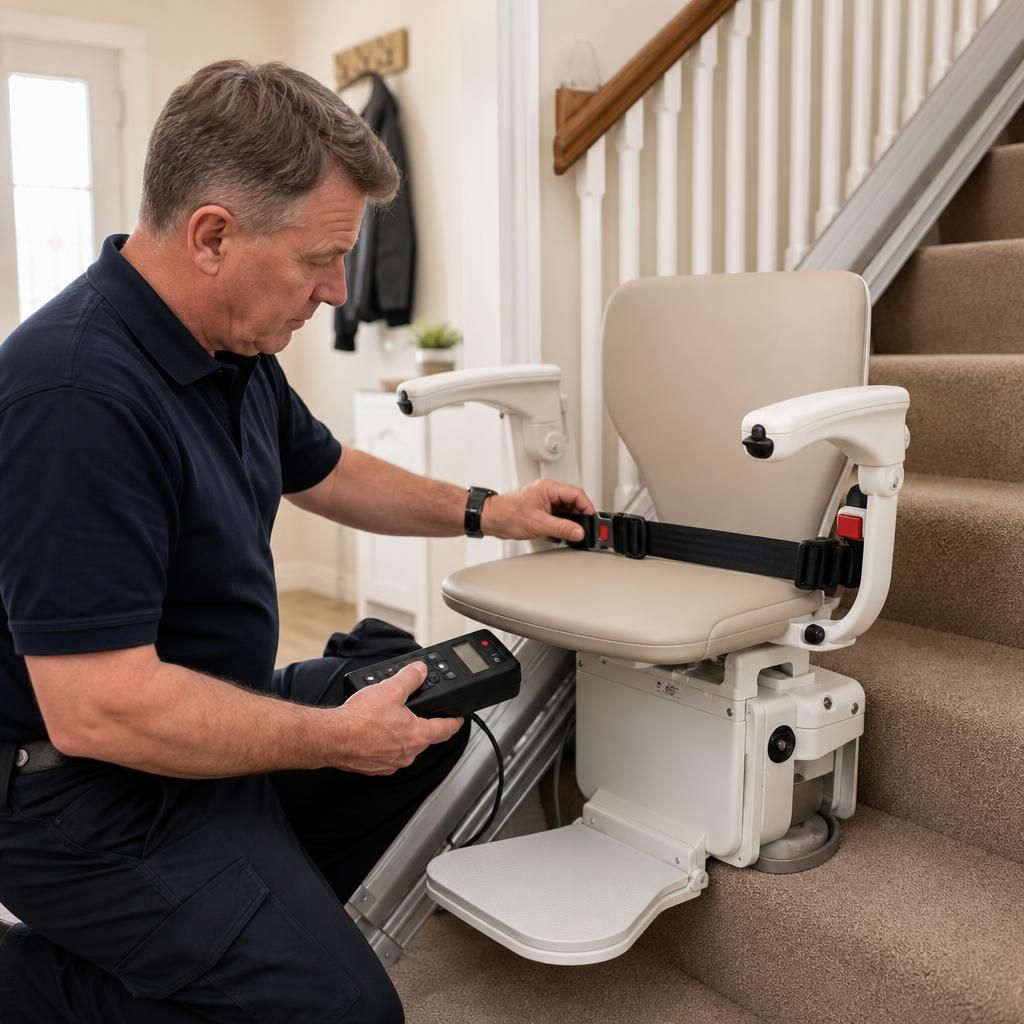
Arrange a Professional Used Stairlift Safety Assessment
Arrange a professional used stairlift safety assessment to confirm that the lift, track and safety systems are suitable for your staircase and the intended user. Independent Stairlifts can inspect, install and test the stairlift before use.