
How does the installation process work for used stairlifts?
A used stairlift is professionally assessed for condition and compatibility before being securely fitted to your staircase. The installer then tests its safety features, checks its operation and shows you how to use it correctly.
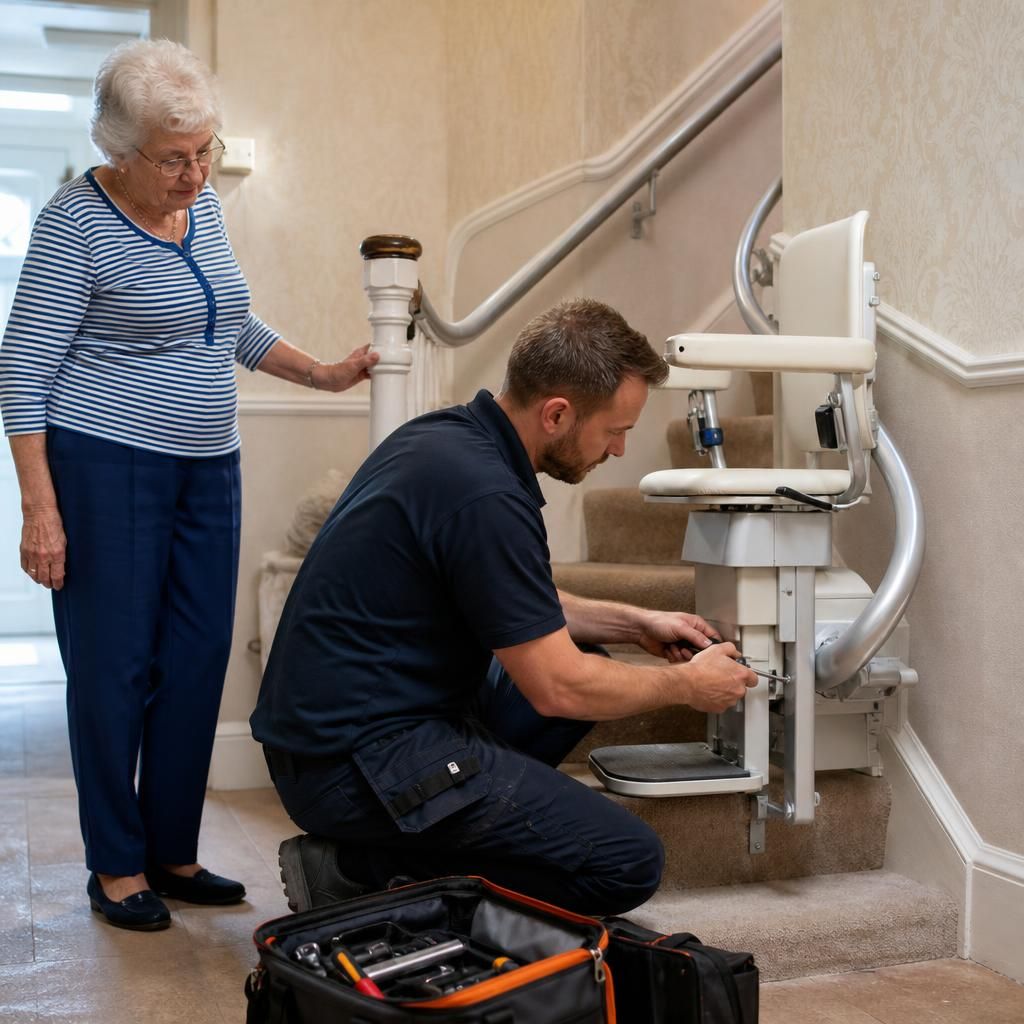
The installation of a used stairlift is a professional process that involves assessing the lift, checking its compatibility with your staircase, fitting it securely and testing every operating and safety function before handover. Although the stairlift has been used previously, it should not be treated as a simple second-hand appliance that can be installed without inspection. The installer must confirm that the equipment is suitable for your home and that its condition meets the required safety standards.
For a straightforward installation, the process generally includes the following stages:
- Assessing your staircase and requirements
- Inspecting and preparing the used stairlift
- Fitting the rail and stairlift
- Connecting and checking the electrical supply
- Testing the equipment
- Explaining operation and aftercare
The initial assessment
An installer first examines the staircase, surrounding space and access points. This confirms whether a used stairlift is appropriate and identifies any features that may affect the installation, such as narrow steps, bends, intermediate landings, unusual stair angles, doorways or limited space at the top and bottom.
The assessment also considers the person who will use the stairlift. The installer may discuss their mobility, posture, ability to transfer on and off the seat, and whether they need features such as powered swivelling, a folding footrest, a higher weight capacity or a particular control arrangement. The safest suitable option is not always the smallest or least expensive model.
For a straight stairlift, a suitable reconditioned rail may be adaptable to the staircase, subject to the model and the installation requirements. Curved stairlifts are different because their rails are made to follow the individual staircase. A previously used curved stairlift will normally only be suitable if its rail configuration matches the current property, or if the system can be professionally modified. A home assessment is therefore particularly important for curved, split-level or unusually shaped staircases.
Inspecting the used stairlift before fitting
Before installation, the stairlift should be inspected for wear, damage and missing components. This includes the seat, armrests, footrest, controls, safety sensors, seat belt, carriage, rail, charging equipment and batteries. Reconditioned equipment may be cleaned, serviced and have worn parts replaced before it reaches your home, but the installer should still confirm its condition as part of the fitting process.
The batteries are an important part of this inspection. A stairlift can appear to operate normally while its batteries are nearing the end of their service life. The installer should check charging, movement and battery performance rather than relying only on the appearance of the equipment. Any faults or concerns should be dealt with before the stairlift is put into regular use.
Preparing the staircase and fitting the rail
Most stairlifts are fitted to the stair treads rather than fixed directly to the wall. This allows the rail to be secured along the staircase while normally avoiding major structural alterations. The installer positions the rail so that the stairlift can travel safely and leaves suitable clearance for the user to board and leave the seat.
The rail is secured using the correct brackets and fixings for the staircase. On a curved installation, its position must follow the agreed route precisely so that the lift approaches landings, bends and stopping points correctly. The installer also checks that doors, handrails and other household features do not obstruct the lift or create a trapping risk.
Where the stairlift has a hinged or folding rail, the installer checks that it can be operated safely and does not obstruct a doorway or passage. If the staircase has a narrow landing or limited room at the top, the parking position and seat swivel should be considered carefully before the final fixings are tightened.
Connecting the power supply
The stairlift is connected to its designated charging point and electrical supply in accordance with the manufacturer’s instructions. The installer checks that the charger is positioned correctly and that the stairlift can charge when parked at its charging point or points.
Power should not be improvised with unsuitable extension leads or an inaccessible socket. If the existing electrical arrangement is not suitable, the installer should explain what needs to be changed. The stairlift should then be checked while charging and while travelling so that a loss of power, charging fault or connection problem is not overlooked.
Testing safety and operation
After the mechanical and electrical work is complete, the installer carries out a full operational test. This normally includes travelling up and down the complete rail, checking smooth starting and stopping, confirming that the seat locks correctly and testing the controls.
Safety features should also be checked individually. Depending on the model, these can include:
- The seat belt or harness
- Swivel-seat locking
- Footrest and armrest sensors
- Obstruction sensors that stop the lift if something is in its path
- Emergency stop controls
- Key switches and remote controls
- Battery charging and low-power warnings
- Overspeed or braking systems
The installer should check that the stairlift stops in the correct positions and that the user can transfer safely at the top and bottom of the stairs. Any unusual noise, movement, error message or intermittent fault should be investigated before the installation is signed off.
Demonstration and handover
Once the stairlift has passed its checks, the installer demonstrates how to use it. This should cover operating the controls, fastening the seat belt, using the swivel seat, folding the seat and footrest, parking the stairlift, charging the batteries and using the remote control where provided.
You should also be shown how to respond if the stairlift stops, how to use the emergency controls and who to contact for assistance. Ask the installer to explain any model-specific warning lights or sounds. The user should be able to operate the lift comfortably and understand that the stairlift is intended for one seated passenger unless its instructions state otherwise.
The installer should provide the relevant operating information, warranty details and servicing or breakdown contact arrangements. Keep these details in an accessible place. It is also sensible to record any limitations explained during the assessment, such as where the stairlift should be parked or whether a particular control must be used for charging.
What happens after installation?
A used stairlift still requires routine care. Keep the rail and charging areas clear, follow the cleaning instructions and report changes such as reduced travel speed, unusual sounds, repeated stopping or a battery that does not hold its charge. Do not attempt to bypass safety sensors or carry out electrical repairs yourself.
If the stairlift is being installed for someone who is not present during the assessment, arrange a demonstration with the actual user before relying on it. Their seating position, confidence and ability to reach the controls should be checked in practice. If their condition changes, contact the installer to discuss whether adjustments, accessories or further assessment are needed.
A professionally installed used stairlift should be supplied with clear information about its condition, compatibility, testing and support. Before the installer leaves, confirm that the lift has been tested on the whole staircase, that the user can operate it safely and that you know how to obtain help if a fault develops.
A professional assessment confirms that a used stairlift is suitable for both the staircase and the person who will use it. Before fitting begins, the installer checks the stairway’s width, bends, landings, doorways and available space, as well as the user’s seating position, transfers and ability to operate the controls.
This check is particularly important for curved staircases, where the rail must follow the individual layout. A previously used curved stairlift may only be suitable if its rail matches the property or can be safely modified. The installer should also identify any access issues, obstructions or safety risks before the equipment is secured, rather than relying on appearance or measurements alone.
Arrange your used stairlift assessment
Arrange your used stairlift assessment so we can confirm that the equipment is suitable for your staircase and the person who will use it. Our specialist team can advise on compatibility, installation and ongoing support.