
How can I ensure a used stairlift is compatible with my home's staircase configuration?
To ensure a used stairlift is compatible with your home, have the staircase assessed for its shape, width, landings, bends, obstructions and available space at the top and bottom. A professional installer can confirm whether the existing or replacement rail, seat and charging points will fit safely, and identify any modifications or bespoke components required.
A used stairlift is compatible with your home only when its rail, seat, controls and safety features suit the exact staircase configuration. A professional assessment should confirm the staircase shape, available width, landings, obstructions, clearances and fixing points before you buy or install the lift. A stairlift that worked safely in another property may not be suitable for yours without a replacement rail, alterations or bespoke components.
Start by identifying the staircase layout. Used stairlifts are generally designed for a particular type of staircase:
- Straight staircases: A straight rail may be suitable where the stairs run continuously between the floors without a bend or intermediate landing.
- Curved or multi-flight staircases: A curved stairlift normally requires a rail made to follow the individual staircase. The rail from another property will rarely fit accurately, even if the staircases appear similar.
- Staircases with landings or turns: The lift may need a continuous curved rail, a transfer arrangement or more than one lift, depending on the layout and the user’s ability to move between flights.
- External stairs: An outdoor model must be suitable for exposure to rain, temperature changes and other environmental conditions. An indoor used stairlift should not be assumed to be suitable outside.
Check the available staircase width. The lift must leave enough room for the user to sit securely and for other people to use the stairs where this is required. Measurements should include the width at the narrowest point, rather than only the widest part of the staircase. Handrails, radiators, dado rails, boxed-in pipework and wall coverings can reduce the usable space.
The folded seat, armrests and footrest also occupy space when the lift is parked. On a narrow staircase, a model with a compact folded profile may be more appropriate, but this still needs to be checked against the particular lift, rail and user requirements. The user must be able to sit upright, operate the controls and keep their feet safely supported during travel.
Assess the top and bottom of the stairs. The lift needs a safe place to stop and for the user to get on or off. At the top, check whether there is sufficient landing space to turn or transfer without standing too close to the stair edge. At the bottom, consider nearby doors, hallways, furniture, radiators and entrances. A straight rail may need to extend beyond the first or last step to create a safer transfer position, provided this does not obstruct a doorway or escape route.
Where space is limited, possible solutions may include a hinged rail, a shorter or alternative parking position, a powered swivel seat or a different seat arrangement. These options are not suitable for every staircase, so they should be selected during the assessment rather than added after installation.
Look for obstructions and hazards. The installer should examine the complete route, including:
- doors that open towards the staircase or rail;
- low ceilings, sloping ceilings and beams;
- window sills, radiators and wall-mounted fittings;
- newel posts, bannisters and projecting handrails;
- uneven, damaged or loose stair treads;
- changes in flooring at the top and bottom landings; and
- the position of electrical sockets and charging points.
These details affect where the rail can be fixed and how the stairlift travels. The rail is normally attached to the stair treads or another suitable structural surface, not simply to plasterboard or a decorative wall finish. The installer must confirm that the fixing method is secure and does not damage important services hidden beneath or beside the stairs.
Confirm that the existing equipment matches your staircase. Ask for the rail to be assessed separately from the stairlift carriage. A used carriage may be in good working condition but still be unsuitable if its rail is the wrong length, shape or specification. With a curved lift, the rail is usually the most property-specific component. With a straight lift, the rail may be adaptable in some circumstances, but its length, angle, charging position and fixing points still need to be checked.
Controls, safety sensors, swivel mechanisms, footrests and seat belts should also be compatible with the model and the intended user. If the user has limited knee movement, balance difficulties or needs to transfer from a wheelchair, the standard seat position may not be appropriate. The assessment should consider how the user will approach the lift, sit down, travel, exit and reach the controls safely.
Do not rely on photographs or measurements supplied by a seller alone. Photographs can miss changes in floor level, obstructions and the space needed to enter or leave the seat. Measurements taken at the wrong points can also give a false impression of compatibility. An installer should inspect the staircase in person, take accurate measurements and identify any relevant building or access issues before confirming the equipment.
A professional assessment will usually establish:
- the staircase type and direction of travel;
- the rail route and suitable fixing points;
- the required seat, swivel and control configuration;
- clearance from walls, doors and other obstructions;
- safe parking and transfer positions;
- the location of charging points; and
- whether the used lift needs a new rail, replacement parts, servicing or other modifications.
Before installation, tell the installer about any planned changes to the staircase, such as new flooring, decorating, replacement handrails or alterations to doors. These can affect clearances and the final position of the equipment. The lift should be installed, tested and adjusted by a suitably qualified professional, who can also explain its operation and maintenance requirements.
If a used stairlift is not compatible as it stands, it may still be possible to use the carriage with a newly manufactured or specially configured rail. However, this should be treated as a complete compatibility and cost assessment rather than assumed to be a simple exchange. The safest approach is to have your staircase surveyed first, then choose a used or reconditioned stairlift based on the confirmed layout and the user’s needs.
Used stairlift compatibility depends mainly on whether the rail fits the exact shape, length and fixing points of your staircase. A carriage that worked in another home may not be suitable with its existing rail, particularly on a curved or multi-flight staircase where the rail is usually made for one specific layout.
A professional survey should check the narrowest staircase width, bends, landings, obstructions and safe parking positions at the top and bottom. The installer can then confirm whether the existing rail is suitable or whether the stairlift needs a replacement rail, different seat arrangement or other modification. Do not rely on photographs or a seller’s measurements alone: small differences in landings, handrails, doors and floor levels can affect safe access and installation.
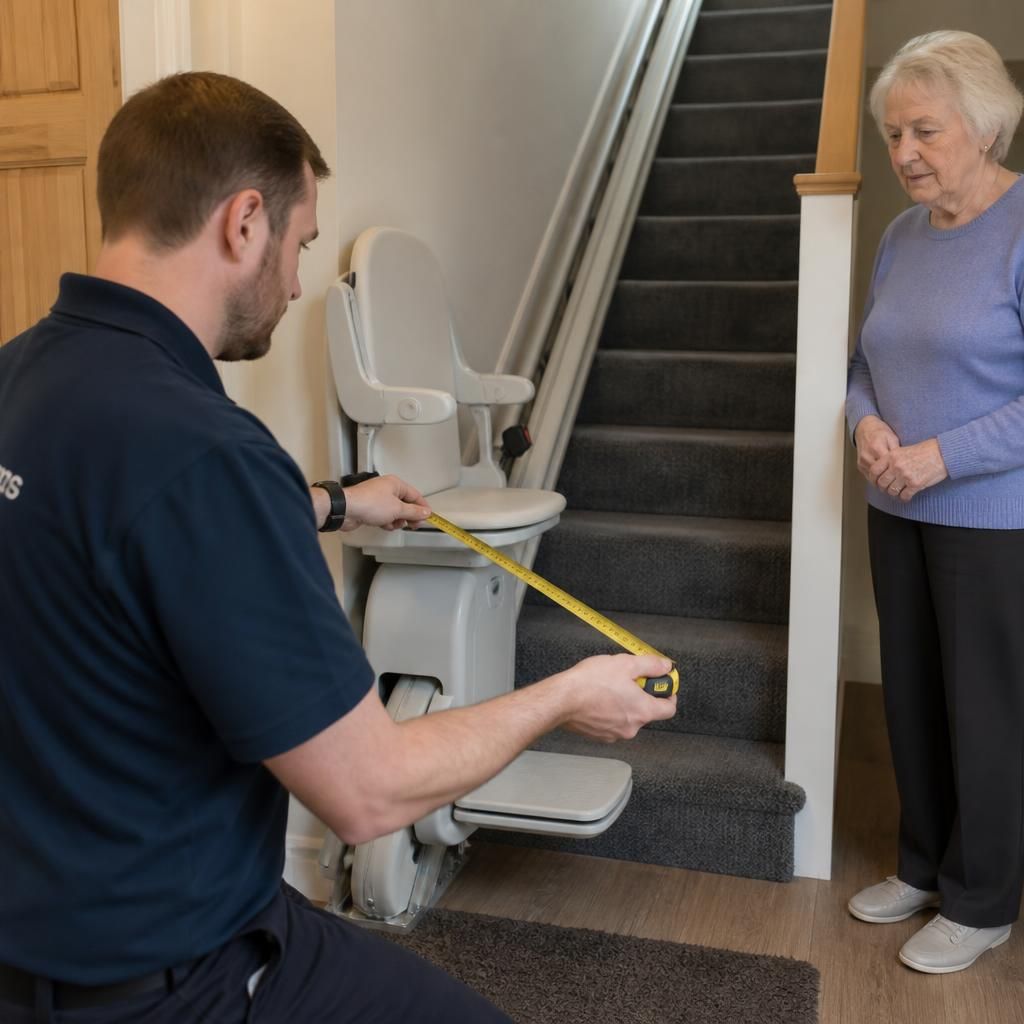
Arrange a Professional Staircase Compatibility Assessment
Arrange a professional staircase compatibility assessment with Independent Stairlifts before purchasing a used stairlift. We can check the rail, clearances, parking positions and user requirements, then advise whether the equipment will fit safely or needs modification.