
Are used stairlifts compatible with all staircase designs?
Used stairlifts are not compatible with every staircase design. Straight models generally fit straight stairs, while curved staircases require a rail made to match the staircase; a professional assessment is needed to confirm whether an existing used stairlift, rail, and installation will be suitable.
Used stairlifts are not compatible with every staircase design. A used straight stairlift is usually suitable only where the staircase is straight and the existing rail, stair width, steps, landings and fittings match the installation requirements. Curved staircases normally need a rail manufactured or configured specifically for that staircase, so an existing used curved stairlift is unlikely to fit unless its rail was made for the same layout or can be professionally adapted.
Compatibility depends on more than whether the stairs are straight or curved. The assessment must consider the staircase configuration, available space, the condition and dimensions of the equipment, how the stairlift will be mounted, and whether the user can safely get on and off at the top and bottom.
- Straight staircases: Used stairlifts are often easiest to match to a straight flight. The rail may sometimes be reused if its length and fixing points are suitable, but it cannot simply be assumed to fit. The installer will check the number and depth of steps, the angle of the stairs, the width available for the seat and carriage, and the space at both landings.
- Curved staircases: A curved stairlift follows bends, corners, intermediate landings and changes in direction. Its rail is normally made to the individual staircase, meaning a rail removed from another property will not usually be compatible. Even staircases that appear similar can differ in their curves, landing sizes and clearances.
- Stairs with an intermediate landing: A staircase with a half-landing or change of direction may require a curved system, or in some properties two separate straight stairlifts. The best arrangement depends on the landing space, the transfer required and whether the user can safely move between lifts.
- Narrow or steep stairs: A stairlift may fit narrower stairs than expected, but the seat, armrests and footrest must leave sufficient clearance. The installer also needs to check that the user can travel without catching walls, bannisters, doors or other obstructions.
- Spiral or unusually shaped stairs: These may need a specialist curved solution. A standard used straight stairlift is not suitable simply because part of the staircase runs in a straight line.
- Outdoor stairs: An outdoor stairlift requires equipment designed for external conditions, including suitable protection from rain, temperature changes and corrosion. An indoor used stairlift should not be installed outside unless the manufacturer and installer specifically confirm that it is suitable.
Other features can affect the fit. Bannisters, radiators, skirting boards, doorways, low ceilings, nearby furniture and limited landing space may restrict the stairlift’s route or the position of the seat when it is parked. A powered swivel seat, hinged rail or alternative seat configuration may be needed where there is an obstruction at the top or bottom of the stairs.
The condition and specification of the used stairlift are also important. The installer should confirm that the rail is straight and undamaged, the carriage and drive system are appropriate for the staircase, the batteries and charger are in serviceable condition, and the safety controls operate correctly. The lift must also be suitable for the user’s weight, posture, mobility and ability to transfer. A model that physically fits the stairs may still be unsuitable if the seat, controls or safety belt do not provide the required support.
Some used stairlifts can be adapted, particularly straight models where a rail can be cut or adjusted within the manufacturer’s permitted specification. This is not a do-it-yourself modification: altering a rail, changing fixing positions or combining components from different systems can affect alignment, safety and reliability. Curved rails are generally much less adaptable because their shape determines the route of the lift.
A professional home assessment is therefore essential before buying or reserving a used stairlift. The assessor should measure the staircase and landings, inspect access and obstructions, identify the required parking positions, and compare those findings with the exact equipment available. They can also advise whether the existing rail can be reused, whether a replacement or adapted rail is required, and whether a different stairlift design would provide safer access.
Do not rely on photographs, a previous installation address or a description such as “universal” to confirm compatibility. Provide accurate details of the staircase and, where possible, the stairlift’s make, model, rail length and installation history. A written assessment should make clear what equipment is included, what alterations are needed and whether installation, testing, servicing and warranty support are covered.
In practical terms, used stairlifts are most straightforward to match to suitable straight staircases. Curved, narrow, multi-flight, spiral and outdoor installations require more detailed checking, and a used stairlift may need a bespoke rail or specialist configuration. The safest approach is to have the specific stairlift and your staircase assessed together before purchase or installation.
Used stairlifts are not automatically compatible with every staircase because the rail and installation must match the staircase layout. This is particularly important on curved stairs, where the rail is normally made to follow the individual bends, landings and changes in direction.
A professional assessment will check the exact stairlift, rail, available space and any obstructions before installation. Straight models are often easier to match, but the rail length, fixing points, stair width and landing clearance still need to be confirmed. Do not rely on photographs or a description such as “universal” when deciding whether a used stairlift will fit.
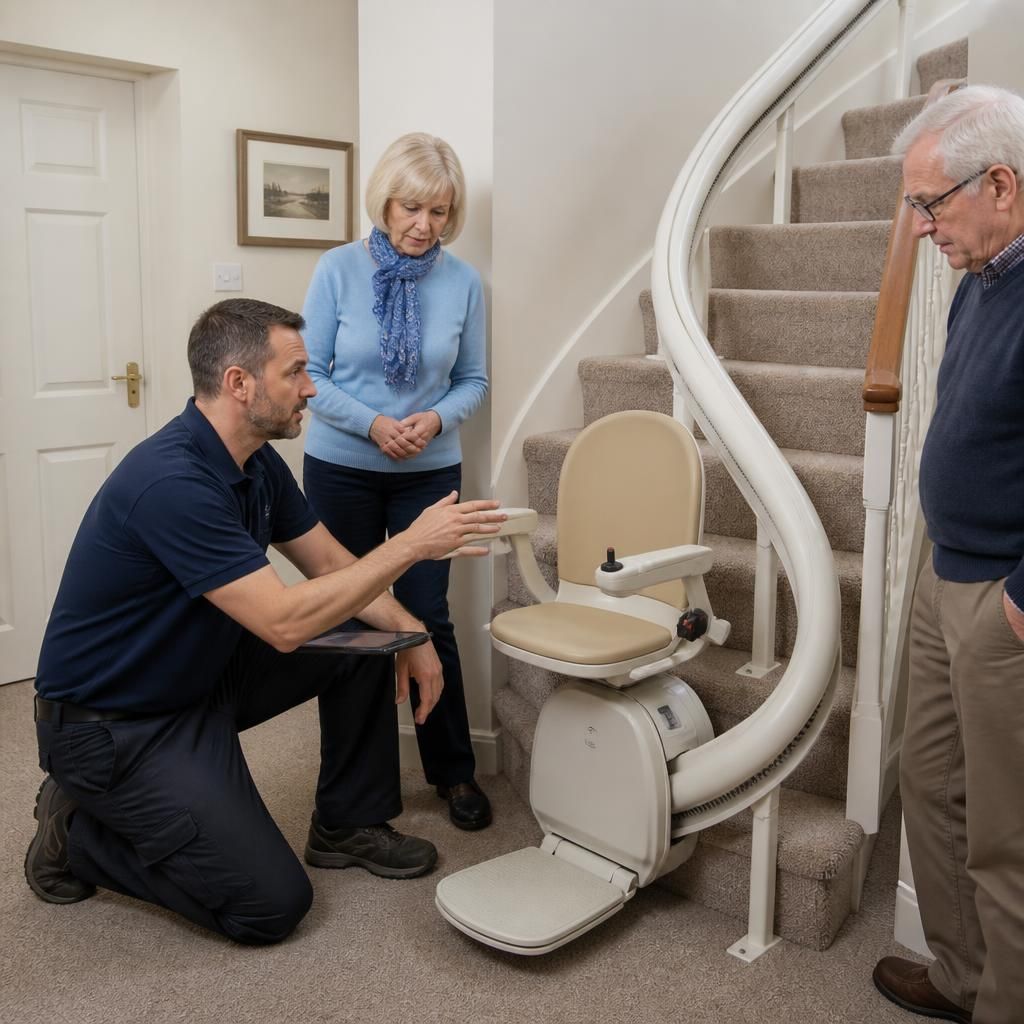
Arrange a Stairlift Compatibility Assessment
Arrange a professional stairlift compatibility assessment so we can check your staircase, available space and the exact used stairlift before you commit to purchase or installation.