
What safety features should I look for in a reconditioned stairlift to ensure it meets industry standards?
A safe reconditioned stairlift should have tested obstruction sensors, a secure seat belt, reliable braking and battery systems, a locking swivel seat, and clear, responsive controls. Ask for evidence that these features have been inspected and that the lift has been professionally refurbished, installed and tested to the manufacturer’s requirements and applicable UK safety standards.
A reconditioned stairlift should retain the same essential safety systems as a comparable new model. Before installation, check that its obstruction sensors, braking system, seat belt, swivel-seat safety lock, controls, batteries and charging equipment have been inspected and tested, and that the complete installation complies with the manufacturer’s instructions and applicable UK requirements.
Reconditioning should involve more than cleaning the upholstery or replacing a worn part. The lift should be assessed as a complete mobility device, with safety-critical components examined, faulty parts replaced and the stairlift tested after installation. Ask for a clear explanation of what was inspected, what was replaced and which checks were completed on your particular lift.
Obstruction sensors and safety edges
Sensors around the footrest, carriage and other exposed edges should stop the stairlift if it meets an object on the stairs. Once the obstruction is removed, the lift should not continue moving unexpectedly. These sensors are particularly important in homes where rugs, toys, footwear or other items could be left on the staircase. They should be tested in both directions during commissioning.
Seat belt and seating security
- The seat belt should fasten securely and be suitable for the user.
- The buckle should engage properly and release without difficulty when required.
- The seat should be firmly attached to the carriage, with no excessive movement or looseness.
- Armrests should lock into their intended position and provide stable support when entering or leaving the seat.
A belt is not a substitute for sitting correctly. Users should remain seated with the belt fastened throughout the journey and follow the operating instructions supplied with the lift.
Swivel seat and interlock
A swivel seat allows the user to turn towards the landing before getting off, reducing the need to twist on the stairs. The seat should lock securely in the travel position, and the stairlift should be prevented from moving if the seat is not correctly positioned. On models with a powered swivel or powered footrest, the controls and stopping action should also be checked.
Braking, speed and movement control
The stairlift should start and stop smoothly, travel at a controlled speed and stop securely when the control is released. Its braking system must hold the carriage safely on the rail, including when the lift is stopped between landings. There should be no jolting, uncontrolled movement, unusual noise or slipping during the test journey. The installer should confirm that the lift has been adjusted for the specific rail, staircase and user weight stated by the manufacturer.
Battery, charger and emergency operation
Most modern stairlifts use rechargeable batteries so they can operate during a power cut. Check that the batteries hold charge, the charger is working and the lift parks correctly on its charging points. A warning indicator should identify a low battery or charging fault where the model provides one. Ask how the stairlift can be moved or recovered if the power supply fails and the batteries are depleted. Do not use an unsuitable replacement charger or battery, as this can create a safety risk and may damage the lift.
Controls, key switch and emergency stop
The handset and armrest controls should be clearly marked, responsive and easy for the intended user to operate. Releasing the control should stop the lift. A key switch or similar access control can prevent unintended use, which is useful where children or other household members may operate the stairlift. If the model has an emergency stop button, alarm or communication feature, confirm how it works and test it during handover.
Track, carriage and landing safety
The rail should be securely fixed and follow the staircase without interfering with doors, walkways or safe access to the landings. The carriage should run smoothly, with end stops and travel limits operating correctly. Foldable footplates, armrests and seats should remain secure when folded, and the lift should park in the position specified for that installation. A professional survey is important because a reconditioned stairlift may need a compatible rail or a newly made rail for the staircase rather than a reused track.
What evidence to request
- A written record of the refurbishment, servicing and safety checks.
- Confirmation that safety-critical parts were inspected and replaced where necessary.
- Evidence that the stairlift was installed and commissioned by a competent technician.
- Confirmation that the installation follows the manufacturer’s instructions and the relevant version of BS EN 81-40, together with applicable UK product safety and electrical requirements.
- Operating, charging and emergency instructions in a form the user can understand.
- Details of the warranty, service arrangements and who to contact if a fault develops.
Markings such as CE or UKCA may be relevant depending on the product and when it was placed on the market, but a marking alone does not prove that a used stairlift is safe today. The condition of the individual unit, the quality of its refurbishment and the suitability of the installation must also be established. A safety certificate should therefore be supported by service records and a documented installation test.
After fitting, the installer should demonstrate every control and safety function, including the belt, swivel seat, obstruction sensors, charging points and emergency procedure. Watch a complete journey in both directions and report any hesitation, unusual sound, movement of the seat or failure to stop immediately when the control is released. Keep the stairs clear, follow the recommended weight limit and arrange servicing at the interval advised for the model.
If any safety feature is missing, unreliable or not explained clearly, do not accept the stairlift for normal use until it has been investigated. Independent Stairlifts can confirm the checks completed on a reconditioned unit, explain its controls and advise whether the model and rail are suitable for the staircase and the person using it.
Obstruction sensors are a key safety feature on a reconditioned stairlift. Sensors and safety edges around the footrest, carriage and exposed parts of the lift should stop it promptly if they contact an object on the stairs. During installation, the technician should test the sensors in both directions and confirm that the stairlift does not restart unexpectedly once the obstruction is removed.
Ask for this check to be demonstrated during handover. Keep the stairs clear of footwear, rugs and other items, and do not use the stairlift if a sensor is slow to respond or fails to stop the lift.
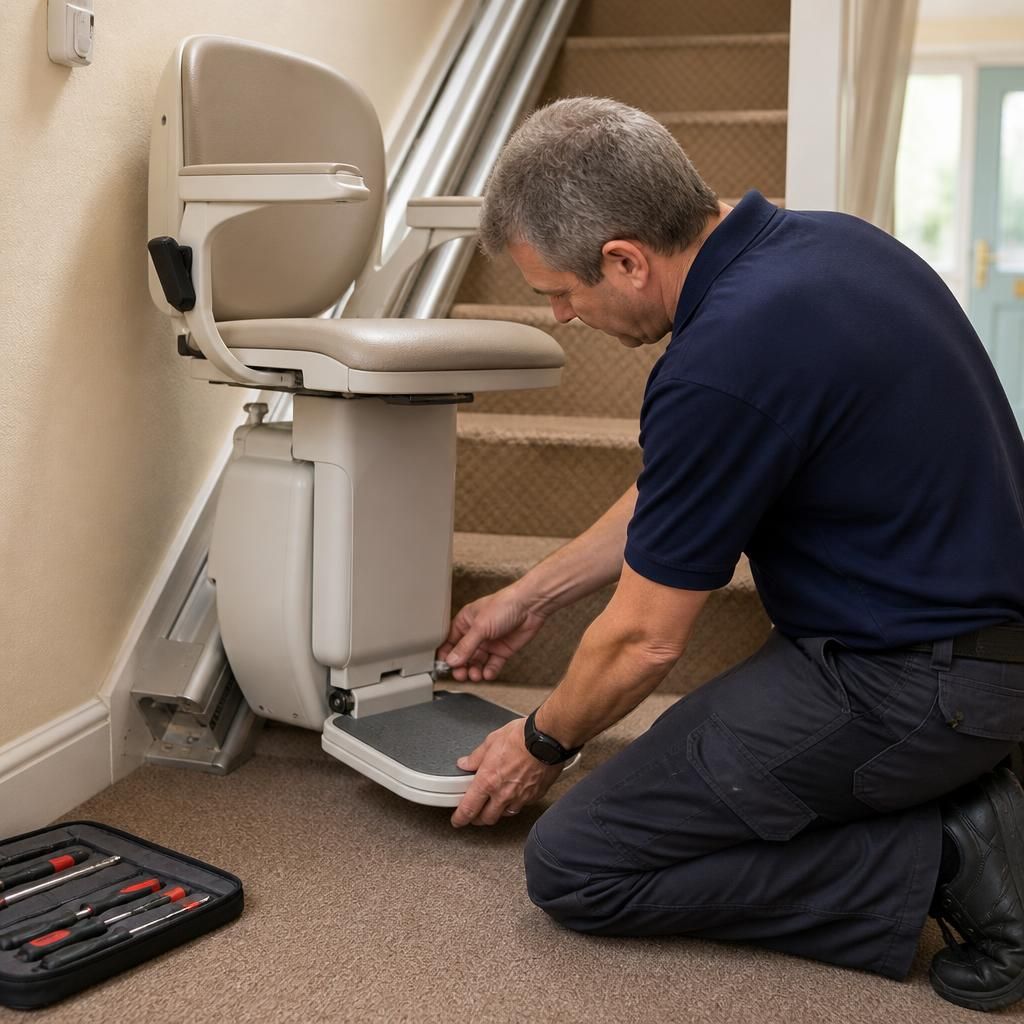
Ask us to check your reconditioned stairlift’s safety features
Ask Independent Stairlifts to check your reconditioned stairlift’s safety features, including its sensors, seat belt, batteries, controls and braking system. We can explain the checks completed and confirm whether the lift is suitable for your staircase and needs.