
What safety checks are performed on reconditioned stairlifts before installation?
Before installation, every reconditioned stairlift is inspected and tested for safe operation, including its rails, drive system, battery, controls, seat, sensors, safety belt and braking functions. Any worn or faulty components are repaired or replaced, followed by operational checks to confirm the stairlift is suitable for the staircase and ready for safe daily use.
Before installation, a reconditioned stairlift should undergo a structured inspection, repair and testing process to confirm that it is safe, reliable and suitable for the intended staircase. At Independent Stairlifts, the assessment covers the stairlift’s mechanical condition, electrical systems, safety devices, controls and compatibility with the customer’s home. Any worn, damaged or unreliable component is repaired or replaced before the stairlift is installed.
Visual and condition inspection
The technician first examines the stairlift for signs of damage, excessive wear, corrosion, loose fixings or previous faults. This includes the carriage, seat, armrests, footrest, covers, wiring and charging equipment. The inspection also checks that essential components are present, correctly fitted and suitable for the particular model.
Parts that affect safe operation are not accepted solely because they appear clean or functional. Items such as drive components, rollers, switches, belts and batteries are assessed for condition and remaining serviceability. Where a part does not meet the required standard, it is repaired or replaced as appropriate.
Rail and drive system checks
The rail is checked for secure construction, correct alignment and smooth movement. The technician inspects the fixings, joins and end sections, while also checking that the carriage runs correctly along the rail without unusual movement, juddering or excessive noise.
The drive system is tested during travel in both directions. This confirms that the motor, gearbox and drive mechanism start, stop and move at the expected speed, including when the stairlift is carrying its intended load. The stairlift must also stop correctly when the controls are released.
Battery, charger and electrical checks
Battery-powered stairlifts need dependable batteries because they must operate during a power interruption as well as during normal use. The batteries are inspected and tested for their ability to hold and deliver charge. The charger, charging points, connections and wiring are also checked for damage, poor contacts or signs of overheating.
Electrical safety checks help confirm that the stairlift is charging correctly and that there are no avoidable faults in the power supply. The technician also checks that the stairlift returns to, and remains correctly positioned at, its charging points.
Safety sensor and obstruction checks
Safety sensors and edges are tested to ensure that the stairlift stops or responds appropriately if it meets an obstruction on the stairs. Depending on the model, these may be located around the footrest, carriage and other areas that could contact an object, wall or person.
The technician checks that the sensors respond consistently and reset correctly once the obstruction is removed. The stairlift is also operated along the full rail to identify any clearance issue, snagging point or interference with doors, landings or nearby furniture.
Seat, belt and swivel mechanism checks
The seat must be secure and stable throughout travel. The technician checks the seat base, swivel function, armrests and footrest, including whether the seat locks safely in the required position for getting on and off. If the model has a powered swivel seat or folding mechanism, its controls and movement are tested as well.
The safety belt is examined for damage, secure attachment and correct operation. Its buckle or locking mechanism must fasten and release properly, while the stairlift should not operate if the relevant safety interlock is not engaged. Seat and armrest switches are checked so that the stairlift only runs when the operating conditions are safe.
Braking and stopping checks
The braking system is tested to confirm that the stairlift stops promptly and remains stationary when the control is released or the power is interrupted. The technician also checks the start and stop action for signs of hesitation, overshooting or uncontrolled movement.
Emergency stop controls and other relevant safety switches are tested to ensure they interrupt operation as intended. These checks are particularly important because a stairlift must remain controllable if a user needs to stop during travel.
Controls and user operation
All operating controls are checked, including the armrest controls, remote controls and any key switches. The technician confirms that the controls move the stairlift in the correct direction and that the controls stop the lift when released. Remote controls are paired and tested where applicable.
Displays, warning lights, audible alerts and fault indicators are checked so that the user can identify charging issues, an open safety circuit or another operating problem. Controls should be accessible and understandable for the person who will use the stairlift.
Staircase compatibility and installation checks
Safety testing is not limited to the stairlift itself. Before installation, the staircase and surrounding area are assessed to confirm that the rail, carriage and seat can be installed with suitable clearance. This includes checking the stair width, bends, landings, access points, doors and possible obstructions.
For a curved stairlift, the rail is checked against the approved design for the staircase. For a straight stairlift, the rail length, parking position and clearance at the top and bottom are confirmed. Outdoor installations require additional consideration of weather exposure, surface condition, drainage and protection of electrical components.
Operational testing after installation
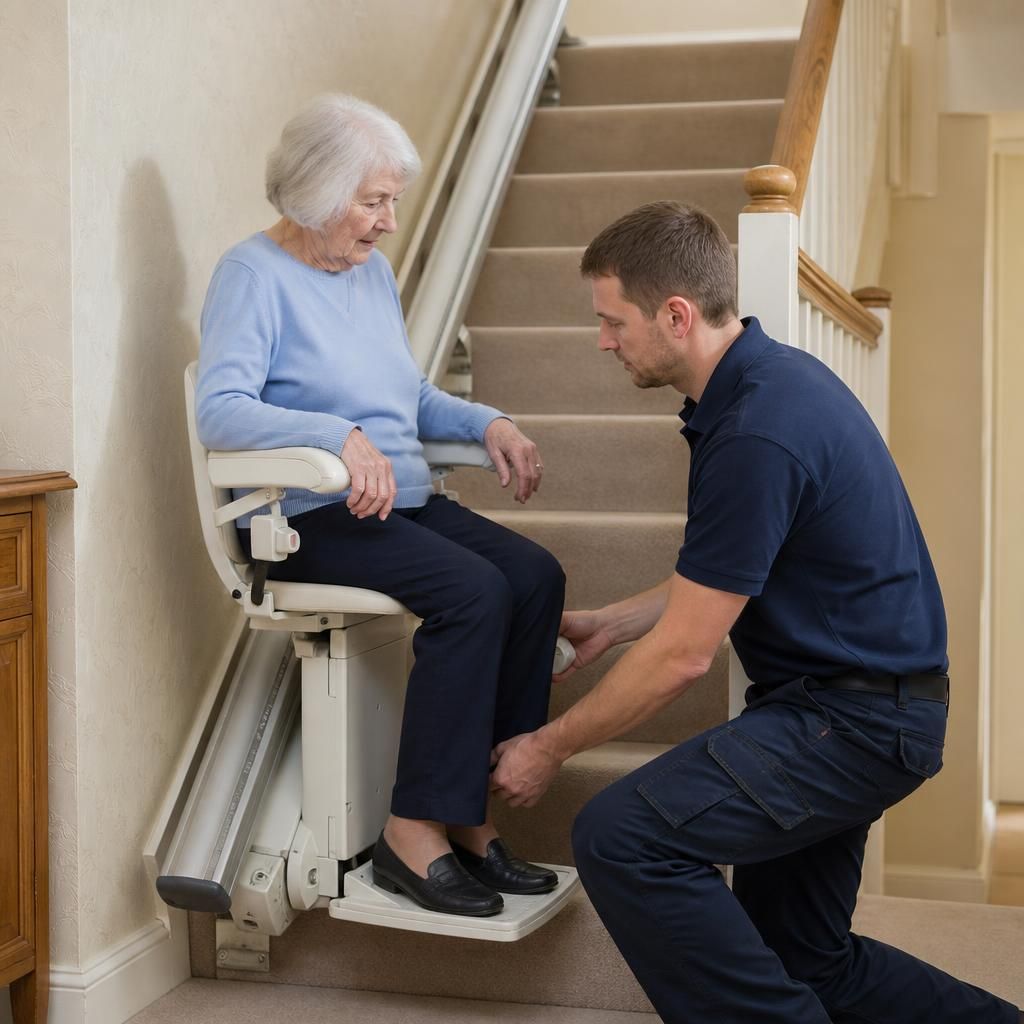
Once fitted, the stairlift is operated repeatedly over the complete route. The technician checks smooth travel, stopping positions, charging, safety sensors, belt and seat functions, controls, emergency features and clearance at every point on the staircase. Any adjustment needed after installation is completed before handover.
The customer is shown how to use the stairlift safely, including how to fasten the belt, use the controls, park and charge the lift, respond to an obstruction and contact the service team if a fault occurs. The installation and checks should be recorded so that the stairlift’s condition and commissioning can be properly documented.
A reconditioned stairlift is therefore assessed as a complete mobility system rather than simply being given a cosmetic refresh. Its condition, safety functions and suitability for the individual staircase all need to be confirmed before it is handed over for daily use. If you notice unusual noise, interrupted travel, a warning light, poor battery performance or a change in braking after installation, stop using the stairlift if it is unsafe and contact Independent Stairlifts for advice and service support.
After installation, the reconditioned stairlift is tested over the complete route to confirm that it operates safely on the customer’s staircase. The technician checks smooth movement, correct stopping positions, charging, clearance and the response of safety sensors if the lift meets an obstruction.
The seat, safety belt, armrest controls, remote controls, swivel mechanism and emergency stop are also checked during operation. Any adjustment or fault identified during these tests is dealt with before handover, and the customer is shown how to use the stairlift, charge it correctly and report problems.
Arrange Your Reconditioned Stairlift Assessment
Arrange your reconditioned stairlift assessment with Independent Stairlifts to check the equipment and your staircase before installation. We can confirm the required safety checks and explain any preparation needed for your home.