
What factors should be considered when choosing between new and reconditioned stairlifts in Birmingham?
When choosing between a new and reconditioned stairlift in Birmingham, consider your budget, staircase design, required features, expected usage, warranty and the available aftercare. A properly assessed and safety-checked reconditioned stairlift can provide reliable access at a lower cost, while a new model may offer the latest options and a wider choice of specifications.
The choice between a new and reconditioned stairlift in Birmingham should be based on the staircase, the user’s mobility needs, the expected frequency of use, the total cost and the support included after installation. A properly assessed and safety-checked reconditioned stairlift can provide dependable access at a lower purchase price, while a new stairlift generally offers a broader choice of models, features, finishes and warranty arrangements.
Start with the staircase and property. The layout of the staircase is one of the most important factors. A straight stairlift may be suitable for a single, uninterrupted flight, whereas a staircase with a bend, intermediate landing or multiple flights may require a curved system or another tailored solution. Narrow stairs, unusual step dimensions, limited space at the top or bottom, and doorways close to the stairs can also affect the specification.
Many Birmingham homes have varied layouts, including older properties with narrow staircases, split-level arrangements and limited landing space. An assessment should consider not only whether a lift can be fitted, but also how the user will approach the seat, transfer on and off it, and move safely around the stairlift when it is parked. Reconditioned options may be more readily available for some common straight layouts, while a new system can provide more flexibility where the staircase requires a particular design. The availability of a suitable reconditioned curved rail depends on whether the existing rail matches the staircase accurately.
Compare the total cost rather than the initial price alone. Reconditioned stairlifts usually cost less because key components have been previously used and then inspected, cleaned, tested and refurbished where necessary. However, the quotation should make clear what is included, such as the lift, rail, batteries, delivery, installation, removal of an old unit and aftercare. A lower purchase price is not helpful if essential work or support is excluded.
New stairlifts generally have a higher initial cost, but they may offer a wider range of specifications and a longer or more comprehensive manufacturer warranty. Ask for both options to be assessed on a like-for-like basis. This makes it easier to compare the actual equipment, installation requirements, warranty terms and servicing arrangements rather than comparing headline prices.
Consider the required features. The right features depend on the user, not simply on whether the stairlift is new or reconditioned. Useful points to discuss include:
- the weight capacity and seat dimensions;
- the ease of operating the controls;
- the position of the controls for the user’s stronger or more comfortable hand;
- swivel or powered seat functions where transferring is difficult;
- folding arms, seat and footrest where space is restricted;
- a powered or manual hinge or folding rail where a doorway or walkway could be obstructed;
- the position and visibility of the stairlift when parked; and
- battery operation, charging points and what happens during a power cut.
A new model may provide access to the latest available options, but a reconditioned stairlift can still include the features that matter most. The assessment should distinguish between essential functions, useful conveniences and features that may add cost without improving everyday use.
Match the stairlift to the user’s present and likely future needs. Consider whether the user can bend their knees, sit upright, transfer independently and operate the controls. Pain, weakness, balance problems or reduced dexterity may affect the safest seat and control configuration. It is also sensible to consider whether the user’s mobility is likely to change. A stairlift that is comfortable now may become less suitable if transferring becomes more difficult, so the choice should not be based solely on the easiest option to install.
Expected usage is relevant too. Someone using the stairs several times each day may place greater demands on the batteries, seat mechanism and controls than someone using the lift occasionally. This does not automatically make a new stairlift necessary, but it reinforces the importance of condition checks, correct installation and a clear maintenance and repair arrangement for a reconditioned unit.
Check how the reconditioned stairlift has been prepared. A reconditioned stairlift should not be treated as an unchecked second-hand appliance. Before installation, ask what inspection and refurbishment work is carried out. This should include checks of the rail, drive system, seat, controls, safety sensors, charging equipment, batteries, wiring and braking or stopping functions. Components that are worn, damaged or unreliable should be repaired or replaced, and the completed installation should be tested on the customer’s staircase.
The installer should also confirm that the model is appropriate for the proposed user and location. A reconditioned unit may be mechanically sound but still unsuitable if the seat is too narrow, the controls are difficult to use, the weight capacity is inadequate or the rail does not fit the staircase correctly. For outdoor use, weather exposure and the condition of outdoor components require separate consideration.
Compare warranty and aftercare arrangements carefully. Warranty cover can differ between new and reconditioned stairlifts, and the important details are what is covered, how long the cover lasts, whether labour and call-outs are included, and which parts are excluded. Confirm whether batteries, handset controls and accidental damage are treated differently from the main lift mechanism.
Ask what support is available if the stairlift stops working, how faults are reported and whether servicing or repairs can be arranged locally in Birmingham. Good aftercare should include practical guidance on daily use, charging, parking and basic cleaning, together with a clear process for obtaining assistance. A reconditioned stairlift can be a sensible long-term option when the equipment has been prepared properly and reliable support is available after installation.
Consider installation and future changes. Stairlifts are normally fitted to the stairs rather than fixed to the wall, although the exact method depends on the property and system. Discuss any concerns about access, decoration, obstruction of hallways and removal of an existing lift before work begins. If the customer may move home, ask whether the stairlift can be removed, adapted or transferred. A straight stairlift is more likely to be reusable in another suitable layout than a curved rail made for one particular staircase, but this should never be assumed.
Use the home assessment to make the final decision. The assessment should cover the staircase, landings, doors, electrical supply, user’s measurements, transfer ability and intended use. It should also identify whether a new or reconditioned model can meet the requirements safely. For a straightforward staircase and a customer seeking value, a suitable reconditioned stairlift may be the practical choice. A new stairlift may be preferable where the customer needs a specific configuration, particular powered features, a new appearance or the widest warranty choice.
Neither option is automatically better for every Birmingham home. The safest decision is the one that provides a suitable fit, straightforward operation, verified safety checks, transparent installation costs and dependable aftercare. Comparing these points during a personal assessment gives you a more reliable basis for choosing than comparing the age of the stairlift or the initial price alone.
The staircase assessment is the most important comparison when choosing a new or reconditioned stairlift in Birmingham. It confirms whether the proposed lift will fit the rail layout, landings, doorways and available space, while also checking that the user can approach, transfer onto and operate the seat safely.
A reconditioned stairlift may be a practical option for a straightforward staircase when a suitable rail and specification are available. New equipment can provide greater flexibility where the staircase has bends, restricted space or requires particular features. The assessment should also consider seat width, weight capacity, control position, swivel functions, parking space and battery charging points before either option is recommended.
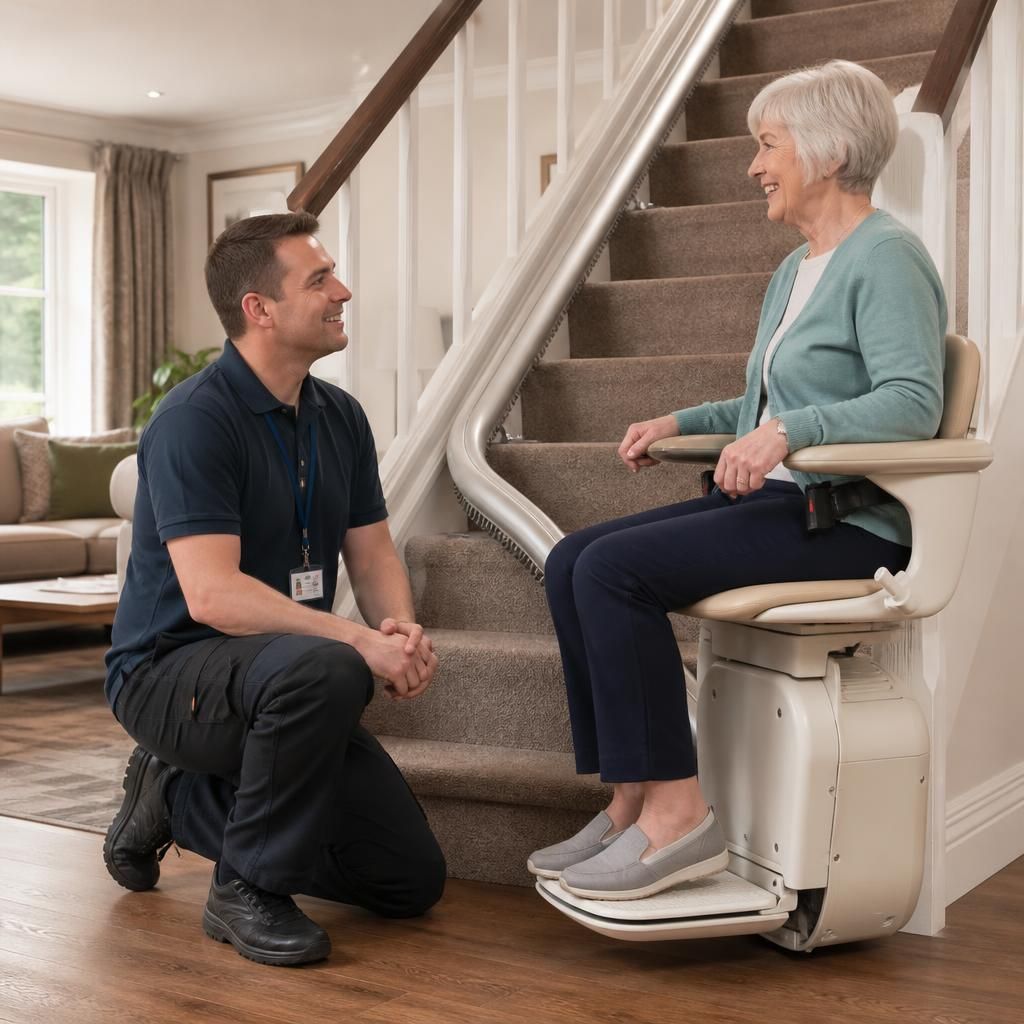
Arrange your Birmingham stairlift assessment
Arrange your Birmingham stairlift assessment to compare suitable new and reconditioned options based on your staircase, mobility needs and budget. Independent Stairlifts can advise on the specification, installation requirements and aftercare before you decide.