
How do reconditioned stairlifts ensure both environmental benefits and cost savings compared to new models?
Reconditioned stairlifts extend the useful life of existing equipment, reducing demand for new materials, manufacturing and disposal while diverting usable components from waste. Because the main unit has already been produced and is refurbished for further use, it is usually less expensive than a comparable new model, subject to the stairlift type, condition and installation requirements.
Reconditioned stairlifts can provide environmental benefits and cost savings because an existing lift is restored and used again rather than replaced with an entirely new unit. This reduces demand for new raw materials, manufacturing and packaging, while the refurbished stairlift is usually less expensive than a comparable new model. The exact saving depends on the stairlift type, its condition, the staircase and the work required for installation.
How reconditioning reduces environmental impact
A stairlift contains a motor, drive system, control equipment, batteries, rails and other components that require materials and energy to manufacture. Reconditioning keeps suitable parts in service for longer, helping to reduce the need to produce replacement equipment. It can also prevent usable components from being discarded prematurely.
- The main unit has already been manufactured, so it does not require the same level of new production as a new stairlift.
- Suitable components can be cleaned, tested, repaired or replaced instead of being sent for disposal.
- Reusing equipment reduces demand for new packaging and some of the resources associated with manufacturing.
- A longer working life can reduce the frequency with which mobility equipment needs to be replaced.
These benefits should be considered as part of the whole refurbishment and installation process. Transport, replacement parts, battery disposal and any work needed to adapt a rail or installation still have an environmental impact. Reconditioning is therefore not impact-free, but keeping safe, serviceable equipment in use is generally a more resource-efficient approach than discarding it and manufacturing a replacement without assessing whether the original unit can be reused.
Why reconditioned stairlifts usually cost less
The largest cost difference comes from reusing the main stairlift equipment. With a new model, the purchase price includes newly manufactured components and associated production costs. A reconditioned model has already been through that initial manufacturing stage, allowing the equipment to be offered at a lower price when it is suitable for the staircase and has passed the required checks.
There may also be savings where a suitable straight stairlift can be matched to an existing rail. However, the final price is not determined by the stairlift unit alone. It can include assessment, delivery, removal of an old lift, rail work, installation, testing, user instruction, warranty cover and future servicing. A curved staircase may require a rail that is made or adapted specifically for its bends and landings, so the saving compared with a new curved installation may be different from the saving available on a straight stairlift.
What happens before a reconditioned stairlift is installed
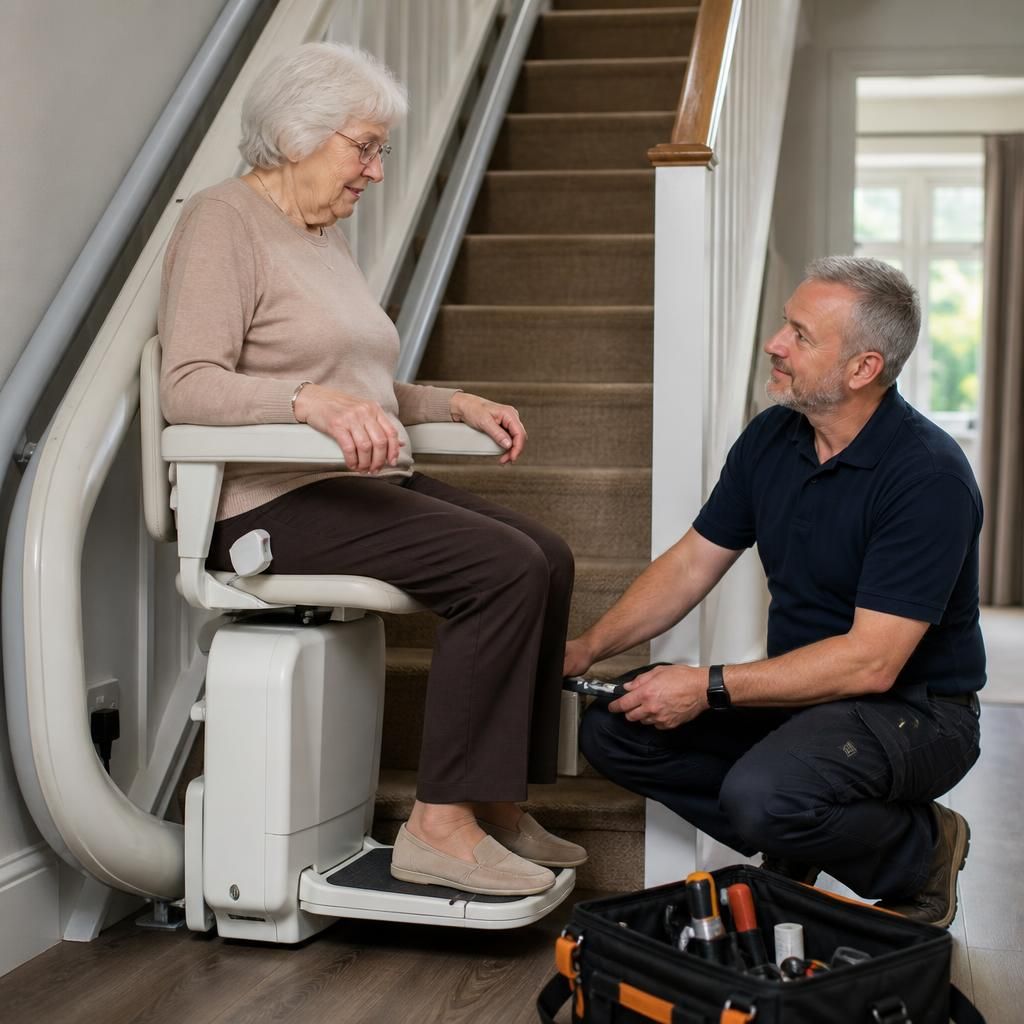
Cost and environmental benefits should never take priority over safe operation. Before installation, the equipment should be assessed for suitability and refurbished in line with its condition. This normally involves inspecting the frame, rail, drive system, controls, seat, armrests, sensors, charging equipment and batteries. Components that are worn, damaged or unreliable should be repaired or replaced, and the stairlift should be tested to confirm that it operates correctly.
The installation itself should include checks that the lift is secure, runs smoothly along the rail, stops correctly and responds to its safety controls. The staircase, landing space, power supply and the user’s requirements also need to be considered. A reconditioned stairlift is only a practical choice when its specification and condition are appropriate for the intended user and the property.
Comparing the total cost with a new stairlift
When comparing options, look beyond the initial quotation. Consider:
- whether the lift is straight, curved or suitable for outdoor use;
- the condition and age of the main components;
- whether the existing rail can be reused or requires alteration;
- what refurbishment and safety testing are included;
- the length and terms of the warranty;
- the likely cost of batteries, servicing and replacement parts;
- whether removal of an existing stairlift and installation are included; and
- how well the seat, controls and safety features suit the user.
A lower purchase price is not necessarily the best value if the equipment is unsuitable, has limited support or requires avoidable repairs. Conversely, a properly assessed and refurbished stairlift can offer dependable day-to-day assistance while reducing the upfront cost compared with a new equivalent.
When a new model may be more appropriate
A new stairlift may be preferable where the staircase has unusual dimensions, a complex curve or specific access requirements that cannot be met by available reconditioned equipment. It may also be appropriate where the user needs a particular seat design, control arrangement or additional feature. The decision should be based on compatibility, safety, expected use, warranty and overall value rather than price alone.
For a household in Birmingham, the most reliable comparison is based on an assessment of the staircase and the user’s mobility needs. This confirms whether a reconditioned lift can be installed safely, what work is included and how its warranty and aftercare compare with a new model. In suitable circumstances, reconditioning combines responsible reuse with a more accessible purchase price, without compromising the checks required for safe installation.
Reconditioned stairlifts reduce environmental impact by keeping suitable equipment and components in use for longer, rather than sending them for disposal and manufacturing a complete replacement. Refurbishment may include cleaning, inspection, testing and replacing worn parts, so the lift can be assessed for safe continued use.
This reuse also usually lowers the purchase price because the main stairlift has already been manufactured. The final saving depends on the staircase, rail requirements, installation work, condition of the equipment and warranty included. A properly assessed reconditioned stairlift can therefore combine responsible reuse with a more affordable alternative to a comparable new model.
Arrange a Reconditioned Stairlift Assessment
Arrange a reconditioned stairlift assessment to compare suitable options for your staircase, mobility needs and budget. We can explain the refurbishment, installation, warranty and aftercare included before you decide.