
Are reconditioned stairlifts a suitable option for all types of staircases in Birmingham homes?
Reconditioned stairlifts can suit many staircase types in Birmingham homes, including straight, curved and some outdoor installations, but they are not suitable for every layout or user. An expert assessment is needed to check the staircase, available rail system, measurements and stairlift condition before confirming compatibility.
Reconditioned stairlifts are suitable for many, but not all, staircases in Birmingham homes. They can be a practical option for straight stairs, curved stairs, split-level layouts and some external staircases, provided the available equipment can be correctly matched to the staircase and user. A professional survey is essential because compatibility depends on the shape and structure of the stairs, the rail system available, the condition of the stairlift and the person using it.
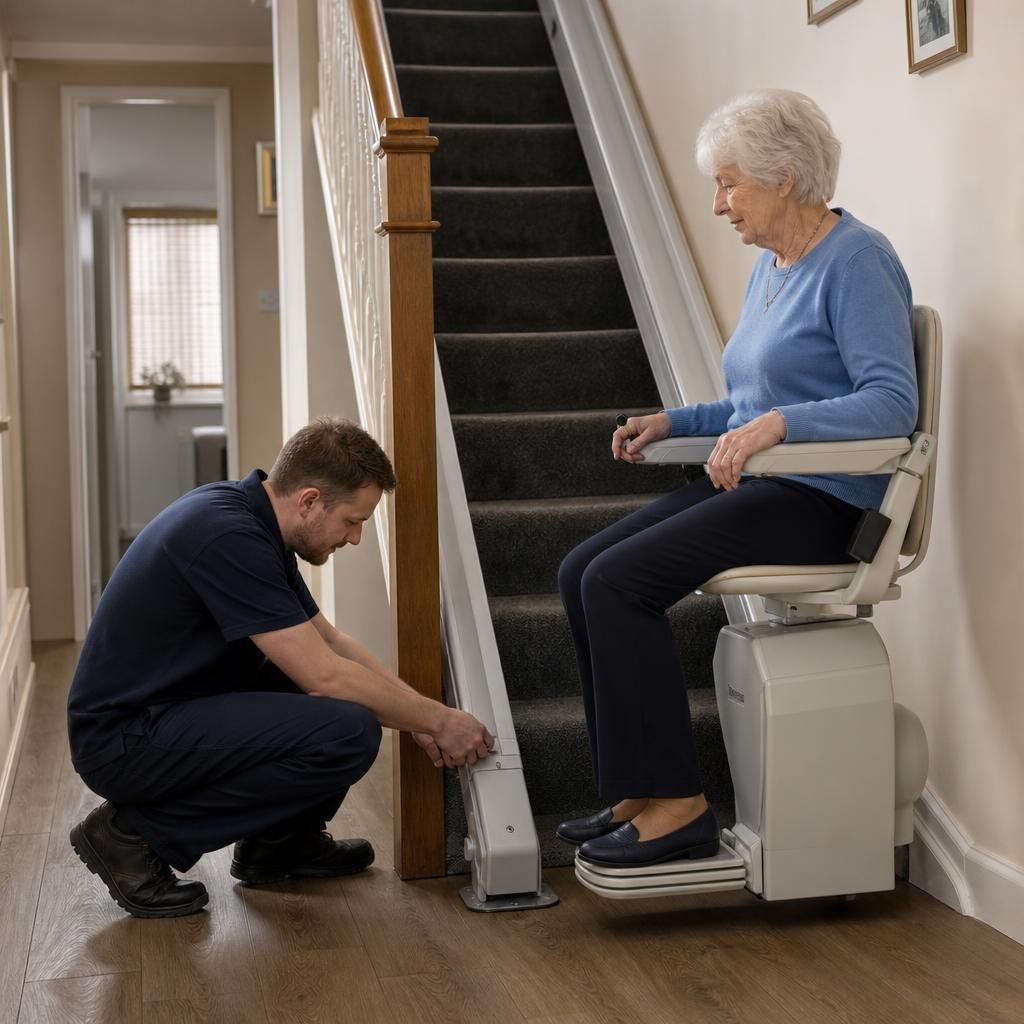
Straight staircases are usually the simplest layout for a reconditioned stairlift. A suitable unit may be fitted where the staircase runs in one continuous line without a bend or intermediate landing. The installer still needs to check the stair width, the position of doors and radiators, the top and bottom landing space, and whether the seat can be used safely without obstructing access.
For a straight staircase, a reconditioned unit may be available with a rail that fits the required length. In some homes, the rail may need to be adapted or replaced to achieve a safe installation. The stairlift must not be selected on appearance or price alone; the rail, charging points, controls, seat, safety systems and installation method all need to be appropriate for the staircase.
Curved and multi-flight staircases can also accommodate reconditioned stairlifts, but they require more careful matching. A curved stairlift uses a rail manufactured or configured for the staircase, taking account of bends, changes in gradient, landings and the available clearance. A reconditioned curved unit may be suitable when a compatible rail and drive system are available, but it is less likely to be an interchangeable, off-the-shelf solution than a straight stairlift.
Where a staircase has a half landing, dog-leg arrangement, tight bend or several changes of direction, the assessment should consider the complete route rather than one flight in isolation. The installer will check whether the stairlift can travel smoothly, whether the seat can swivel or park safely, and whether other people can still use the stairs. If an existing rail does not match the staircase accurately, it should not be forced into position or modified in a way that compromises its safety.
Narrow, steep or unusually shaped stairs are not automatically excluded. A compact seat, folding arms, footrest and rail position may help where space is restricted. However, the stairlift still needs sufficient clearance from walls, banisters, doors and other fixed objects. The user must also be able to sit securely, operate the controls and get on and off without excessive twisting or reaching.
Very narrow stairs, winding steps and staircases with limited landing space can present additional difficulties. In some cases, a different seat configuration or parking position may resolve the issue. In others, the available space, user requirements or escape route may mean that a reconditioned stairlift is not appropriate. These decisions should be made after measuring the staircase and considering how the lift will be used every day.
Spiral and helical staircases need particular caution. Their continuous curves, variable tread shapes and restricted inner edges can make a standard reconditioned stairlift unsuitable. Specialist equipment may be possible in some circumstances, but the rail and carriage must be designed or selected for the exact staircase. A survey is required before any view can be given on feasibility.
Outdoor staircases may be suitable for a reconditioned outdoor stairlift if the equipment is specifically designed for external use and remains in suitable condition. Indoor models should not be installed outside. An external assessment should consider exposure to rain, frost, sunlight and dirt, as well as drainage, electrical supply, weather protection and the condition of the steps and surrounding surfaces. Outdoor equipment may require more frequent cleaning, inspection and maintenance than an indoor installation.
Staircase compatibility is only one part of the assessment. The stairlift must also suit the user’s mobility, posture, weight, transfer ability, eyesight and ability to operate the controls. A unit that fits the stairs may still be unsuitable if the seat is too low, the arms do not provide adequate support, the user cannot manage the swivel mechanism or the controls are difficult to reach. Where more than one person may use the stairlift, the assessment should take each user into account.
Before installation, the condition of the reconditioned stairlift should be checked. This includes the rail and fixings, motor and drive components, batteries, charging system, seat, swivel mechanism, armrests, footrest, seat belt, sensors, controls and stopping systems. Safety devices should operate correctly, and the completed installation should be tested on the staircase. The installer should also explain normal operation, charging, safe use and what to do if the stairlift stops unexpectedly.
In Birmingham homes, other practical factors may affect the installation. Older properties can have uneven walls, restricted stairwells, tight hallways or limited electrical access. Alterations, extensions and changes to flooring may also affect measurements and parking positions. The survey should identify these issues before equipment is allocated, rather than relying on assumptions based on the general type of staircase.
A reconditioned stairlift may not be the best option where no suitable rail is available, where the staircase requires a highly specific configuration, or where the cost of adapting an existing system approaches that of a new bespoke installation. A new stairlift can provide more choice when the staircase is particularly complex or when specific features, finishes or controls are needed. The important comparison is between complete, safe and properly installed solutions, not simply between the purchase prices of the units.
The most reliable way to establish suitability is to arrange an assessment of the staircase and discuss the intended user’s needs. Independent Stairlifts can use the survey to determine whether a suitable reconditioned stairlift is available, whether the rail and equipment can be safely matched to the property, and whether another solution would be more appropriate. No installation should be confirmed until the staircase, equipment and user requirements have all been checked together.
Reconditioned stairlifts can be suitable for many Birmingham staircases, but suitability depends on matching the equipment to the exact layout rather than simply choosing a model by type or price. A professional assessment checks the staircase, rail, landing space and the user’s mobility needs together.
This is particularly important on curved, split-level, narrow or winding stairs. The rail must follow the bends and gradients accurately, while the seat, footrest and controls must allow the user to travel, get on and get off safely. For outdoor stairs, the stairlift must also be specifically designed for external conditions and assessed for weather exposure and drainage.
Before installation, the reconditioned stairlift should be inspected and tested, including its batteries, drive system, safety sensors, seat belt, swivel mechanism and charging points. If the available equipment cannot be matched safely, a different reconditioned unit or a new bespoke solution may be more appropriate.
Arrange a Birmingham stairlift suitability assessment
Arrange a Birmingham stairlift suitability assessment with Independent Stairlifts to check your staircase, available equipment and user requirements. We can advise whether a reconditioned stairlift is appropriate or whether another solution would provide a safer fit.