
What refurbishment process does each Acorn reconditioned stairlift undergo to ensure safety and reliability?
Each Acorn reconditioned stairlift is inspected, cleaned and function-tested, with worn or faulty components replaced before installation. It is then safety-checked by a qualified engineer and assessed in your staircase to confirm reliable operation and a secure fit.
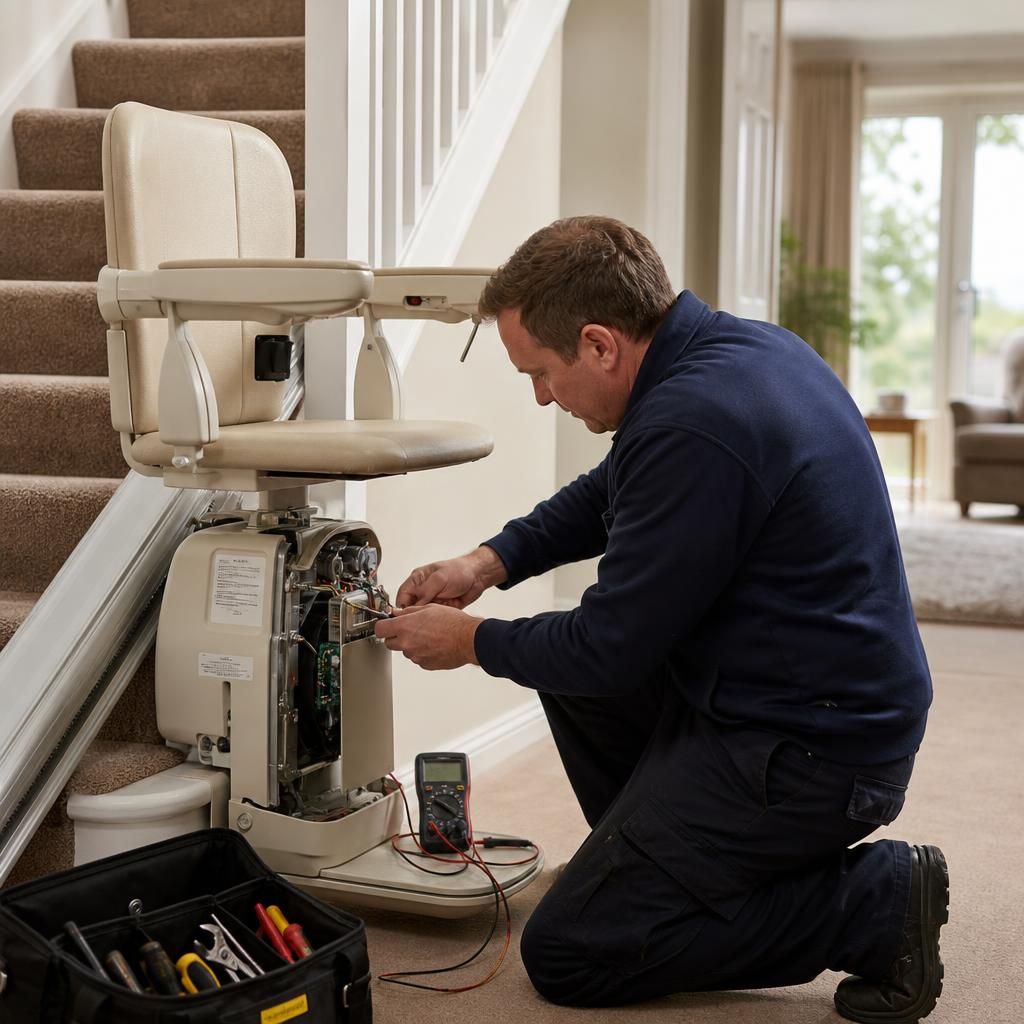
Each Acorn reconditioned stairlift undergoes a structured inspection, refurbishment and safety-testing process before it is offered for installation. The lift is assessed as a complete system, not simply cleaned and resold. Any worn, damaged or unreliable component is repaired or replaced, after which the stairlift is function-tested by a qualified engineer and checked again during installation in your home.
Initial inspection and identification
The refurbishment begins with an inspection of the stairlift’s main assemblies. This normally includes the motor and drive system, charging equipment, batteries, seat, armrests, footrest, sensors, controls, safety edges, track and fixings. The engineer looks for signs of wear, impact damage, corrosion, unusual noise, poor movement and faults that may not be visible during a basic demonstration.
The lift’s condition and specification are also checked so that the appropriate parts, controls and installation equipment can be prepared for its next staircase. A reconditioned stairlift must be suitable for the intended user and the layout of the property; a unit is not treated as ready for installation merely because it powers up.
Cleaning and physical refurbishment
Once the assessment is complete, the stairlift is thoroughly cleaned and prepared. Surfaces that are regularly touched, including the seat, armrests, controls and footrest, are cleaned as part of the preparation process. The track and other accessible components are checked for dirt or obstructions that could affect smooth travel.
Visible cosmetic wear may be addressed where appropriate, but safety and mechanical condition take priority over appearance. A reconditioned lift can show minor signs of previous use while still meeting the required operational checks. If a component is cracked, excessively worn or otherwise unsuitable, it should not remain in service simply because the lift looks presentable.
Repair and replacement of components
Parts that do not perform reliably are repaired or replaced during refurbishment. Particular attention is given to the batteries, charging system, drive components, safety sensors, control switches and mechanical fixings. Batteries are important because a stairlift may appear to operate correctly while having insufficient capacity for dependable use away from the charging points.
Controls and safety features are checked for correct response, including the user controls and any remote controls supplied with the lift. The seat, swivel mechanism, armrests and footrest are examined to ensure they move or lock as intended. Replacement parts are selected for compatibility with the Acorn model and its specification, rather than relying on an unsuitable substitute.
Operational and safety testing
After refurbishment, the stairlift is run through a series of functional checks. These checks are intended to confirm smooth travel, controlled starting and stopping, reliable charging, correct operation of the controls and appropriate response from the safety systems. The engineer also checks that the lift stops when a relevant obstruction or safety control is detected.
Testing covers the features that protect the user during normal operation, such as the seat belt, swivel seat, footrest sensors and other fitted safety devices. The exact checks depend on the Acorn model and its equipment. The purpose is to identify faults under operation, not just during a visual inspection.
Assessment of your staircase before installation
Even a properly refurbished stairlift must be checked against the staircase where it will be installed. An engineer assesses the stairway, landings, available space, fixing points and the position of the charging points. They also consider how the user will approach, sit on and leave the stairlift safely at the top and bottom of the stairs.
This assessment confirms that the track can be installed securely and that the seat, footrest and controls will provide suitable clearance. For a curved staircase, the track configuration is particularly important because it must follow the stairway accurately. For an outdoor installation, the equipment and proposed location must also be suitable for exposure to the local conditions.
Installation and final checks
During installation, the engineer secures the track, fits the stairlift and checks its alignment and clearances. The lift is then operated repeatedly on the staircase to confirm that it travels correctly from one end to the other and reaches the intended parking and charging positions. Fixings, cable routing, seat movement and safety features are checked as part of the final commissioning process.
The engineer should also demonstrate the controls and explain essential everyday use, including charging, safe seating, use of the belt, swivel operation and what to do if the lift stops because a safety sensor has detected an obstruction. Any relevant care and maintenance information, warranty details and arrangements for obtaining support should be provided at handover.
What this means for you
The refurbishment process is designed to establish that the Acorn stairlift is mechanically sound, electrically functional, correctly equipped and suitable for the staircase before it is placed into regular use. It does not mean that every used component is replaced; parts that pass inspection and testing may remain in service. However, components that could compromise safe or dependable operation should be dealt with before installation.
If your needs, staircase or intended use have changed since the initial assessment, tell the engineer before installation. Details such as difficulty transferring, the need for powered swivel operation, limited upper-body movement or outdoor exposure can affect the suitable specification. A tailored assessment ensures that refurbishment checks and installation decisions are considered together, rather than treating the stairlift as a standard product.
Safety testing is a central part of refurbishing an Acorn reconditioned stairlift; it is not simply a process of cleaning and reselling a used unit. A qualified engineer checks the drive system, batteries, charging equipment, controls, seat belt, swivel seat, footrest and safety sensors for reliable operation.
The stairlift is operated repeatedly to assess smooth travel, controlled stopping and correct response to obstructions. Before handover, it is also tested on your staircase to confirm secure fixing, suitable clearances, correct parking and charging positions, and safe access at the top and bottom of the stairs.
Arrange Your Acorn Stairlift Assessment
Arrange your Acorn stairlift assessment so a qualified engineer can confirm the most suitable reconditioned model, assess your staircase and discuss your mobility needs. Contact Independent Stairlifts for tailored advice and a quotation.