
What are the key factors to consider when determining if a reconditioned Acorn stairlift is suitable for my home?
A reconditioned Acorn stairlift may be suitable if its rail design matches your staircase, its seat and weight capacity meet the user’s needs, and its refurbished condition, warranty and installation support provide appropriate assurance. A professional home assessment should confirm the staircase layout, access at the top and bottom, electrical requirements, and whether a straight, curved or outdoor model is the right option.
A reconditioned Acorn stairlift is suitable for your home when the stairlift’s rail can be correctly matched to the staircase, the equipment meets the user’s mobility and weight requirements, and the refurbished unit is supplied, installed and supported to an appropriate standard. A professional home assessment should confirm these points before you decide, rather than relying on the model name or a general price guide alone.
Check the shape and construction of the staircase. The first consideration is whether your stairs are straight, curved, split into separate flights, or exposed to outdoor conditions. A straight stairlift normally requires a rail designed for one uninterrupted flight. A staircase with a bend, intermediate landing or change of direction generally needs a curved system with a rail made to follow its individual path. A reconditioned rail may be suitable if it can be accurately adapted or is already compatible with the staircase, but not every used rail will fit every layout.
The survey should also consider the width of the stairs, the position of doors and radiators, the available space at the top and bottom, and any obstruction around landings. The stairlift must allow the user to get on and off safely without blocking a doorway or creating an avoidable trip hazard. Where space is limited, a suitable parking position or a folding rail may be needed. These practical details are particularly important in homes with narrow halls, open landings or several doors near the staircase.
Match the stairlift to the user’s needs. The seat, armrests, footrest, controls and safety belt should be comfortable and usable for the person who will operate the lift. Consider whether the user can transfer onto the seat, sit upright during travel, operate the controls and turn safely at the top and bottom. A powered swivel seat, powered footrest or other control options may be appropriate where strength, balance or dexterity is limited, but these features must be available on the particular reconditioned model.
Weight capacity is another essential check. The user’s weight, clothing, any walking aid carried during travel and the manufacturer’s specified limit all need to be taken into account. The stairlift must not be used beyond its rated capacity. If more than one person may use it, assess the needs of the heaviest and least mobile user rather than selecting equipment solely for the person who currently uses the stairs most often.
Consider the user’s condition and likely changes in mobility. A stairlift should be comfortable and manageable now, but it is sensible to consider whether the user’s mobility may change. Someone who currently walks with a stick may later need more assistance when transferring or positioning their feet. Conversely, a standard seat may be unnecessary if a compact design or different control arrangement would provide better access. Discuss any concerns about balance, painful joints, involuntary movement, visual impairment or difficulty using a hand control during the assessment.
Confirm that the refurbished unit has been properly checked. Reconditioned does not simply mean previously owned. The stairlift should have been inspected, cleaned and tested, with safety-critical components assessed and worn parts replaced where necessary. The batteries, charging system, drive mechanism, sensors, seat belt, controls, rail and emergency features all require attention. Ask what work has been completed on the specific stairlift and whether its condition has been verified before installation.
The age, model and condition of the unit may also affect the availability of replacement parts and future servicing. A reputable assessment should identify whether the proposed model can be supported for the foreseeable future, rather than offering equipment that is difficult to maintain. You should receive clear information about any limitations or cosmetic marks that remain after refurbishment; appearance is usually less important than safe, reliable operation, but it should not be left unexplained.
Review the warranty and aftercare arrangements. A reconditioned stairlift should come with written information covering the warranty period, what is included, how faults are reported and which labour or parts costs may apply. Check whether batteries and call-out visits are included and whether any exclusions apply. Reliable installation support and access to servicing are important because a stairlift is a working mobility aid, not simply a one-off household fitting.
Ask who will carry out the installation and whether the installer will demonstrate the controls, charging procedure, safety belt, swivel mechanism and emergency lowering or release procedures. The user and anyone who provides care should know how to respond if the stairlift stops away from a charging point. Keep the operating instructions and contact details in an accessible place.
Assess the electrical and physical requirements. Most domestic stairlifts use a standard electrical supply, but the location and condition of the socket, charging points and wiring still need to be checked. The installation should not depend on trailing cables or an inaccessible power source. Battery-powered travel allows the lift to operate during a short power interruption, but the batteries must be charged correctly and replaced when required.
The rail is normally fixed to the stairs rather than the wall, although the surveyor will confirm the fixing method for the proposed equipment. The staircase and treads must be sound enough to support the installation. Any loose flooring, damaged steps, damp, exposed wiring or building work should be identified before fitting. These issues do not always prevent installation, but they may need to be resolved first.
Decide whether the model is for indoor or outdoor use. An indoor reconditioned Acorn stairlift should not be installed outside simply because the stairs are sheltered. Outdoor use requires equipment designed to withstand rain, temperature changes and other environmental conditions, together with appropriate protective materials and charging arrangements. If the stairlift is for external steps, confirm that the proposed model is specifically suitable for that environment and that its refurbishment and warranty cover outdoor use.
Compare the complete cost, not just the purchase price. The overall cost may include the stairlift, rail adaptation, installation, electrical work, removal of an old lift, servicing and any optional features. A reconditioned unit can be a practical alternative to a new installation, particularly where a suitable model is available, but the least expensive option is not necessarily the most suitable. A clear quotation should explain what is included and identify any costs that could arise if the survey finds an unusual layout or additional installation work.
Before proceeding, use the assessment to confirm:
- the proposed model and whether it is intended for a straight, curved or outdoor staircase;
- the rail route, parking position and access space at both ends of the stairs;
- the user’s weight, seating, transfer, control and safety requirements;
- the inspection and refurbishment work completed on the individual unit;
- the warranty, servicing, parts and fault-response arrangements; and
- the full installation price and any work required in the home beforehand.
If these checks are satisfactory, a reconditioned Acorn stairlift may provide a safe and practical way to improve access between floors. If the staircase layout, user requirements or support arrangements are not compatible, a different reconditioned configuration or a new stairlift may be more appropriate. An in-home assessment from Independent Stairlifts can establish the correct option for the property and the person using it.
A reconditioned Acorn stairlift is suitable only when its rail and operating features can be matched safely to your staircase and the person using it. A straight model is generally intended for one uninterrupted flight, while stairs with bends, landings or changes of direction usually require a curved system designed for that route.
A home assessment should check the staircase width, fixing points, parking positions, doorways and available space at the top and bottom. It should also confirm that the proposed seat, controls, safety belt and weight capacity are appropriate for the user. This is particularly important where the user has limited balance, strength or dexterity, or where the staircase has restricted access.
Do not rely on the Acorn model name or a photograph of the stairlift alone. The installer should confirm that the specific reconditioned unit, rail and installation plan are compatible with your home before you proceed.
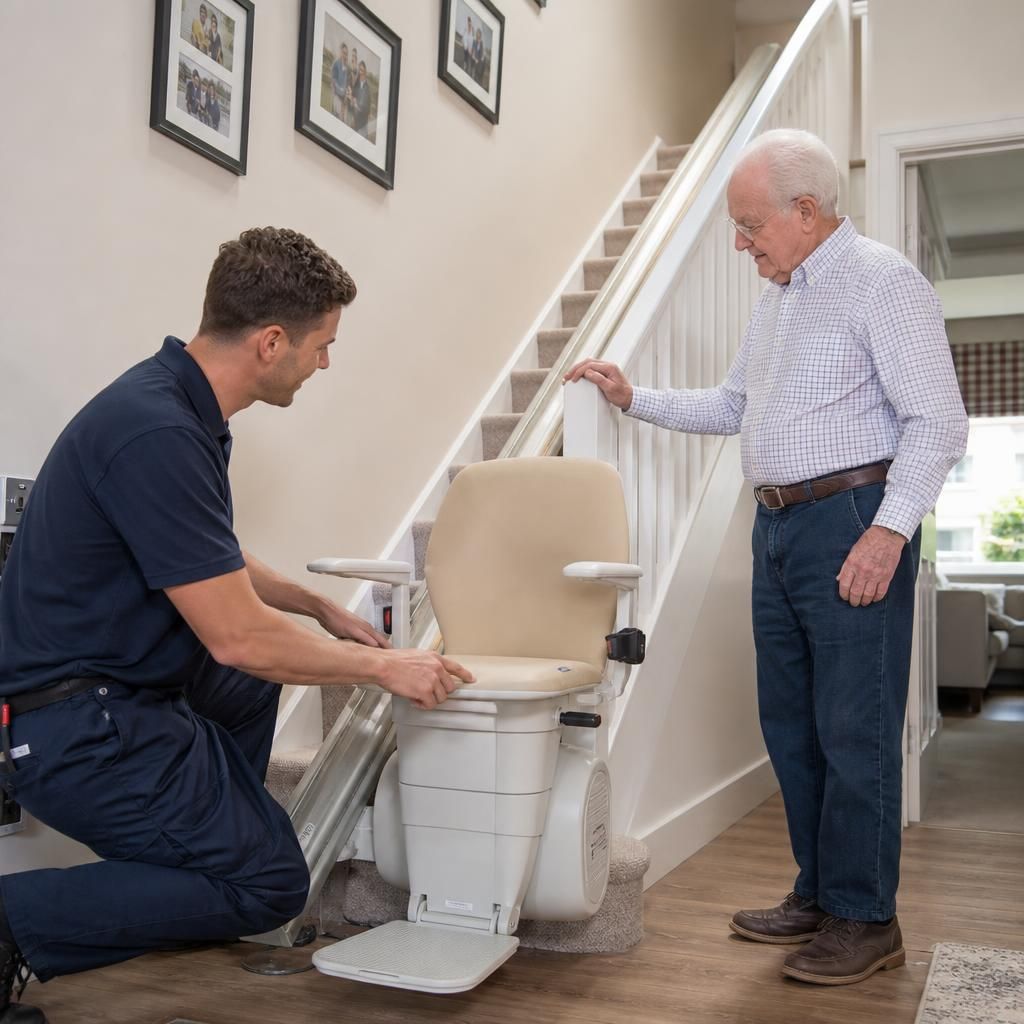
Arrange a Home Assessment for a Reconditioned Acorn Stairlift
Arrange a home assessment with Independent Stairlifts to confirm whether a reconditioned Acorn stairlift suits your staircase, access requirements and mobility needs. We can explain the suitable options, installation requirements, warranty and complete cost before you decide.