
What should I do if my stairlift suddenly stops working?
If your stairlift suddenly stops working, stop using it, remain seated safely if possible, and check the key, power supply, seat position and safety sensors. If it still does not operate, do not force it or attempt a repair; contact Independent Stairlifts for advice and an engineer’s assessment.
If your stairlift suddenly stops working, stop using it, remain seated safely if you are on the stairs, and check the simple controls and power supply only if it is safe to do so. Do not force the lift, try to bypass a safety feature or attempt an electrical repair. If it still will not move, contact Independent Stairlifts so the fault can be assessed by a trained engineer.
If you are stopped on the stairs
- Stay seated with your seat belt fastened, if one is fitted, and keep your hands and feet inside the stairlift.
- Do not try to climb over the stairlift or walk down the stairs while carrying yourself around it, particularly if you feel unsteady.
- Use the handset, alarm or telephone to contact a family member, carer or the service team.
- If you are injured, becoming unwell or cannot remain safe, call 999. Tell the operator that you are on the stairs and need assistance.
- If the stairlift is at the top or bottom and you can dismount safely, move to a secure position away from the staircase before making further checks.
Checks you can make without dismantling anything
Stairlifts may stop because of a simple operating condition rather than a major mechanical fault. Once you are safely positioned, check the following:
- Key switch: make sure the key is inserted and turned to the on position. Some stairlifts will not operate if the key has been removed or turned off.
- Power supply: check whether the usual power indicator is lit and whether other equipment nearby is working. If there has been a power cut, the lift may not operate until the supply returns. Check the stairlift’s dedicated switch or fused spur only if it is readily accessible and clearly labelled; do not remove covers or replace electrical components.
- Seat position: the seat may need to be fully returned to its travelling position. A swivel seat that has not locked into place can prevent movement.
- Armrests and seat belt: ensure the armrests are lowered and the belt is correctly fastened, where applicable.
- Footrest and safety edges: look for a shoe, bag, pet toy or other object touching the footrest or safety sensors. Remove an obstruction only if you can do so without reaching into the mechanism or putting yourself on the stairs.
- Remote control: if the lift works from its controls but not from the handset, the handset may be switched off, out of range or have depleted batteries. Do not continue using the lift if only one control works and its operation seems abnormal.
- Charging position: if the lift has been left away from its charging point, its batteries may be too low for travel. If you can move it safely using the normal controls, return it to the charging point. Do not push the chair along the rail or try to charge it with an incompatible device.
After each check, use the normal control once and observe what happens. A warning tone, flashing indicator, partial movement or complete silence can help an engineer identify the problem. Do not repeatedly operate the controls, as this can drain the batteries and may make the fault harder to diagnose.
When to stop troubleshooting immediately
Do not use the stairlift or carry out further checks if you notice a burning smell, smoke, sparks, a damaged cable, exposed wiring, fluid leakage, unusual grinding, a loose rail or seat, or movement that is jerky or uncontrolled. If there is smoke or a fire risk, switch off the power at the mains only if you can do so without approaching danger, leave the property if necessary and call 999. Never remove the stairlift casing or work on the batteries, wiring, drive unit or charging system yourself.
Contacting the service team
Contact Independent Stairlifts for advice and an engineer’s assessment if the basic checks do not restore operation, if the lift stops repeatedly or if a warning light or fault code remains displayed. Have the following information ready:
- the stairlift user’s location and whether they are safely seated or have dismounted;
- the make and model, if known;
- whether the fault affects the handset, the controls on the armrest or both;
- what the lift was doing when it stopped, such as travelling, starting, stopping or charging;
- any beeps, indicator lights, fault messages or unusual noises; and
- whether there has been a power cut, accidental impact, spill or visible obstruction.
Do not arrange for an unqualified person to bypass the safety sensors or make temporary repairs. These systems are designed to stop the stairlift when the seat, footrest, belt, rail or surrounding area is not safe, and overriding them can create a fall or collision risk.
An engineer may need to inspect the batteries, charging points, drive system, controls, safety sensors, wiring and rail alignment. The cause could be a discharged battery, an interrupted power supply, a sensor detecting an obstruction, normal component wear or a more significant electrical or mechanical fault. If the stairlift is covered by a maintenance agreement or warranty, check its service details when you contact us and keep the lift available for inspection. Until it has been confirmed safe, use an alternative route or mobility aid only if you can do so safely.
Once the stairlift is working again, report any recurring warning tones, slow travel, unusual noise or failure to charge rather than waiting for a complete breakdown. Prompt servicing can identify a developing fault and helps keep the lift safe and dependable.
If your stairlift stops while you are on the stairs, remain seated with the seat belt fastened, if fitted, and keep your hands and feet inside the lift. Do not try to climb over it or walk around it on the staircase.
Use the handset, alarm or telephone to contact a family member, carer or the service team. If you are injured, feel unwell or cannot remain safe, call 999 and explain that you are on the stairs and need assistance. If the stairlift is already at the top or bottom and you can dismount safely, move away from the staircase before carrying out any basic checks.
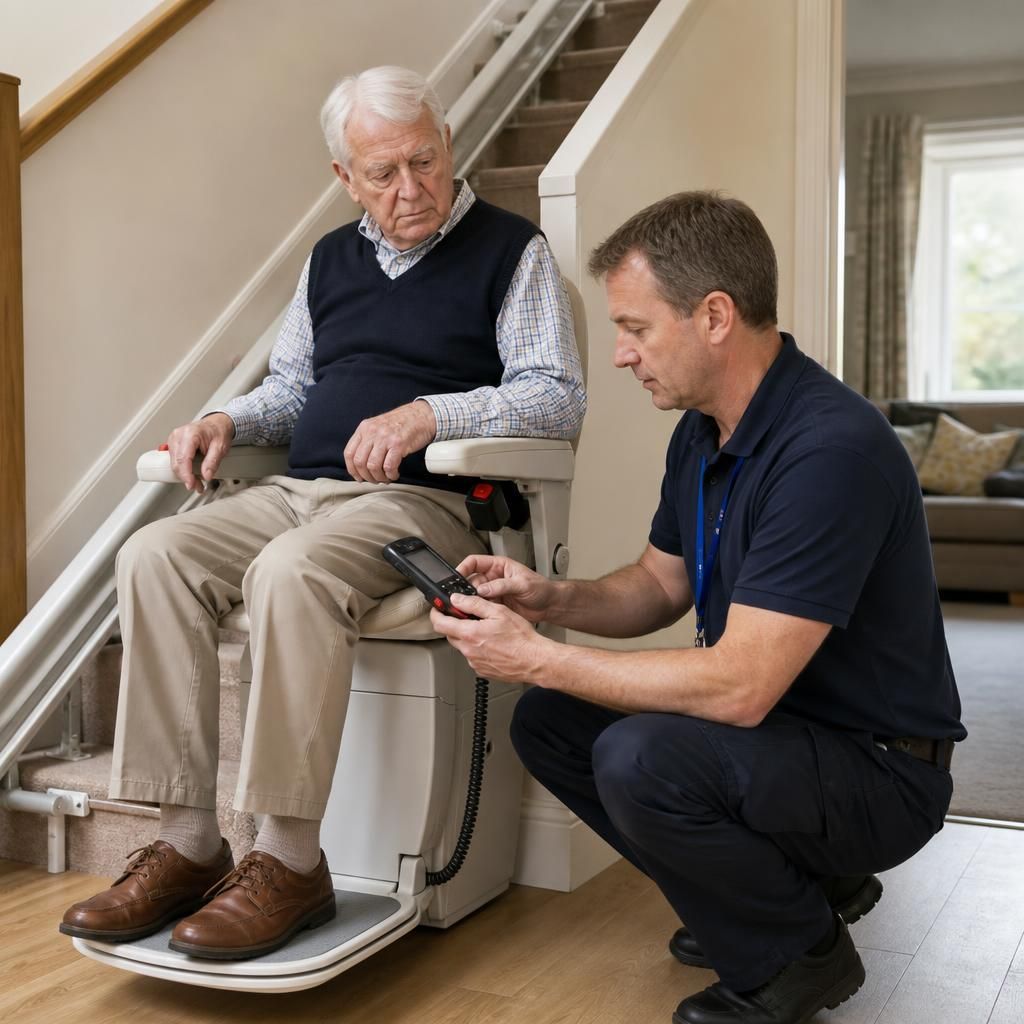
Get help with your stairlift fault
If your stairlift is still not working after the basic checks, contact Independent Stairlifts for advice and an engineer’s assessment. Tell us where the lift stopped, any warning lights or sounds, and whether the user is safely seated.