
What should I look for in a reliable Stannah stairlift servicing provider?
A reliable Stannah stairlift servicing provider should have trained technicians familiar with your model, use suitable parts, complete thorough safety checks and explain any work clearly. Check that they offer transparent pricing, practical appointment times and responsive support if your stairlift develops a fault between services.
A reliable Stannah stairlift servicing provider combines model-specific knowledge with a thorough, safety-led inspection and clear communication. Look for a provider that can identify your stairlift model, use suitable manufacturer-approved or compatible parts, explain the condition of the lift in plain English, provide a written price before chargeable work begins and offer dependable support if a fault occurs between planned services.
Relevant experience with Stannah stairlifts
Stairlifts are not interchangeable. Controls, batteries, charging systems, sensors, drive components and diagnostic procedures can vary between models and installations. Ask whether the technician regularly works on Stannah stairlifts and whether they are familiar with your particular model, age and configuration. A competent provider should be willing to check the model details before the appointment rather than assuming that every stairlift can be serviced in the same way.
Experience should include more than replacing obvious consumable parts. The technician should be able to assess unusual noises, intermittent stopping, uneven travel, charging faults, error indications and changes in starting or stopping behaviour. They should also understand how the stairlift interacts with the staircase, its charging points, swivel seat, safety sensors and controls.
Qualified and appropriately equipped technicians
Ask how technicians are trained and what equipment they use for inspection and fault diagnosis. A reliable service provider should have suitable tools, access to relevant technical information and a process for recording findings. They should not rely solely on resetting the lift or replacing a component without investigating why a fault has occurred.
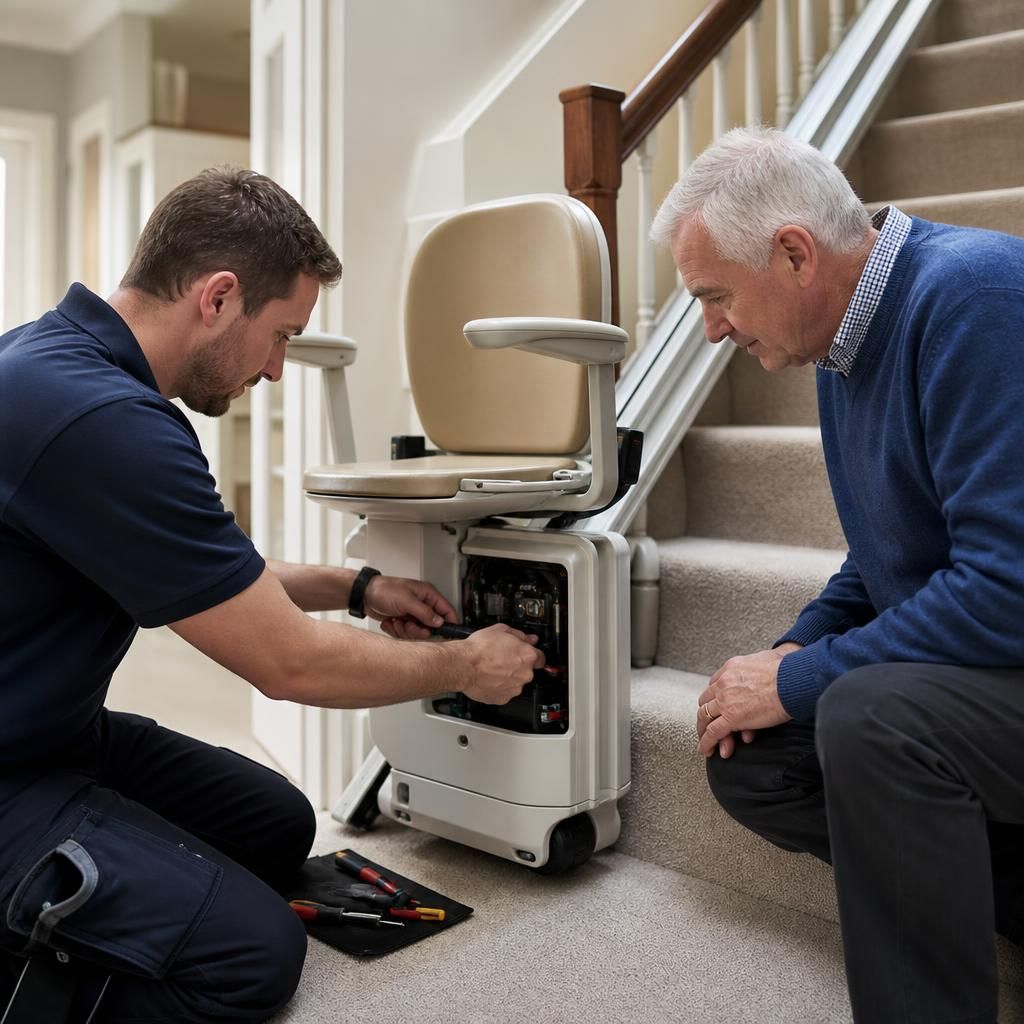
The technician should also work safely in the home. This includes protecting the staircase and surrounding area, following safe working procedures and checking that the lift is safe to return to use. If a defect creates a safety risk, the provider should explain the risk clearly and advise whether the stairlift should remain out of service until repairs are completed.
A genuinely thorough service process
Ask what the service includes before booking. A proper inspection will normally consider the stairlift’s operation, travel path, charging system, batteries, controls, safety sensors, seat and footrest, armrests, swivel or safety mechanisms, drive system and visible fixings. The technician should also check for signs of wear, damage, contamination or loose components that could affect reliable operation.
Servicing is not simply a quick test ride. The provider should operate the stairlift through its normal functions, investigate any concerns you report and make appropriate adjustments where required. They should distinguish between routine servicing, remedial repairs and replacement parts, as these are separate types of work and may have different costs.
Clear pricing and permission before repairs
Reliable servicing providers explain their charges before work starts. Check whether the quoted price covers the inspection, travel, labour, testing and any written report, and ask how additional repairs or parts will be priced. If a technician identifies work that was not included in the service, you should receive an explanation and an estimate before authorising it, except where immediate action is necessary to make the equipment safe.
Be cautious of vague prices, pressure to approve unnecessary work or recommendations that are not supported by an identifiable fault. A trustworthy technician can explain what has failed, what may happen if it is left unresolved and whether a repair is urgent, advisable or suitable for monitoring. You should not be made to feel that every observed mark or minor adjustment requires an immediate major replacement.
Suitable parts and honest advice about repairs
Ask what type of parts the provider uses and whether the part is suitable for your specific model. Parts should be correctly specified, properly fitted and tested after installation. Where an original part is unavailable, the provider should explain the proposed alternative and any relevant implications, rather than fitting an unsuitable substitute.
A good provider will also give balanced advice when a stairlift is older or has repeated faults. They should explain the likely repair options, the condition of related components and whether continued servicing remains practical. This helps you make an informed decision instead of replacing parts without considering the wider condition of the lift.
Responsive support between scheduled services
Regular servicing reduces avoidable problems but cannot prevent every fault. Before choosing a provider, find out how to report a breakdown, when calls are answered and how appointments are arranged. Ask whether support is available outside routine office hours and whether the provider distinguishes between a loss of convenience and a safety-critical fault.
Clear guidance is particularly important if the stairlift stops on the stairs, will not charge, emits an unusual sound or shows an error indication. Do not continue using a lift that appears unsafe. A responsible provider will give practical instructions, avoid asking you to carry out risky repairs and arrange an appropriate assessment.
Written records and understandable explanations
After servicing, you should receive a clear account of what was inspected, any faults found, work completed and parts fitted. The report should state whether the stairlift was tested after the work and identify any issues that need monitoring. Keep this information with previous service records, as it helps a technician recognise recurring faults and understand the lift’s maintenance history.
The technician should explain the result directly to the stairlift user and, with permission, to a family member or carer. This may include advice about charging, keeping the track clear, using the controls correctly and reporting changes in performance. Good communication is part of safe servicing, particularly where the user has limited mobility, sight or hearing.
Insurance, guarantees and customer protections
Check that the provider has appropriate business insurance and provides terms for its servicing and repair work. Ask whether parts and workmanship are covered by a guarantee, what is excluded and how to raise a concern if the stairlift develops the same fault again. The terms should be understandable and supplied before, or at the time of, agreeing to the work.
It is also sensible to confirm who will carry out the work, whether subcontractors may be used and who remains responsible for the service if another technician is involved. Consistent records and a clear point of contact make follow-up much easier.
Questions to ask before booking
- Are you experienced with my Stannah model and its particular installation?
- What checks are included in the service?
- Will you investigate reported symptoms as well as complete routine checks?
- What is included in the quoted price, and will you ask for approval before extra work?
- What parts may be used, and are they suitable for my model?
- What written information will I receive after the appointment?
- How do I report a fault between services, and what response can I expect?
- What guarantee or follow-up support applies to repairs and replacement parts?
For an existing Independent Stairlifts customer, your previous service records, model details and description of any recent changes can help the technician prepare properly. Note when the problem occurs, whether it happens travelling in one direction, whether the lift charges normally and whether any warning light or sound appears. This information can shorten the diagnostic process and reduce unnecessary disruption.
In practice, the most dependable provider is not necessarily the one offering the lowest initial price. It is the one that understands the equipment, carries out a complete inspection, uses suitable parts, separates servicing from repair recommendations and remains accountable after leaving your home. Those standards give you a clearer basis for deciding whether your Stannah stairlift is safe to use and what action, if any, is needed next.
A reliable Stannah stairlift servicing provider should give you a clear written record after every appointment. This should confirm which safety, operating and charging checks were completed, identify any wear or faults, list work carried out and state whether the stairlift was tested and considered safe to use.
The report should separate routine servicing from recommended repairs, replacement parts or issues that need monitoring. Before authorising additional work, ask the technician to explain what has caused the problem, how urgent it is and what the quoted cost includes. Keep the report with your previous service records so future technicians can identify recurring faults and tailor their checks to your stairlift.
Arrange your Stannah stairlift service
Arrange your Stannah stairlift service with Independent Stairlifts to keep its safety, charging system and operating components checked by a suitable technician. Contact us to discuss your stairlift model, servicing requirements and a convenient appointment.