
What signs indicate that the batteries in my Brooks stairlift need replacing?
Your Brooks stairlift batteries may need replacing if the lift travels more slowly, stops unexpectedly, sounds a low-battery warning, or repeatedly fails to complete a journey after being left on charge. If charging indicators are not working or the stairlift loses power soon after charging, arrange an assessment, as the charger, charging points or wiring may also be responsible.
The batteries in your Brooks stairlift may need replacing if it travels more slowly than usual, stops or loses power during a journey, gives a low-battery warning despite being left on charge, or only completes a short trip before running flat. A battery assessment is advisable because similar symptoms can also be caused by a faulty charger, charging contacts, wiring or another stairlift fault.
Common signs of failing Brooks stairlift batteries include:
- Reduced travel performance: the stairlift moves more slowly, struggles on the stairs or sounds different under load.
- Unexpected stopping: the lift stops before reaching the top or bottom, particularly when carrying its normal user.
- Rapid loss of charge: the stairlift works after charging but soon loses power or will not complete a normal journey.
- Repeated low-battery warnings: an audible alert or warning light continues even after the stairlift has been parked correctly on its charging point.
- Difficulty starting: the lift may hesitate, fail to respond immediately or require repeated attempts from the control.
- Charging indicators not behaving normally: the light or display may not show that charging is taking place, although this can also indicate a charger or contact problem.
- Failure after a period of non-use: older batteries can lose their ability to hold charge when the stairlift has been unused for some time.
Battery performance normally declines gradually. If the stairlift is reliable when fully charged but becomes noticeably weaker during use, the batteries are a likely cause. If it will not operate at all, however, do not assume that the batteries alone are responsible.
Checks to make before arranging replacement
- Park the stairlift fully on its designated charging point, following the operating instructions for your model.
- Check that the mains power supply to the charger is switched on and that any visible charger indicator is illuminated as expected.
- Inspect the charging contacts and the area around the rail for obvious dirt, obstruction or damage. Do not use abrasive materials or liquids on electrical contacts.
- Check whether the lift behaves differently when parked at another charging point, if your installation has more than one.
- Note when the problem occurs: immediately after leaving charge, only part-way through a journey, or after the stairlift has been unused.
These checks can help identify a charging issue, but they do not confirm battery condition. A battery can show an acceptable voltage when at rest and still fail under the load of carrying a person up the stairs. Proper testing should therefore be carried out by a suitably trained stairlift engineer.
When batteries are more likely to be the cause
Batteries are more likely to require replacement when the stairlift has been used regularly for a long period, has been left discharged, or has repeatedly been allowed to remain away from its charging point. Heat, cold and extended inactivity can also affect battery performance. The exact service life depends on the stairlift model, usage, charging arrangements and battery condition, so replacement should be based on testing and symptoms rather than a fixed timetable.
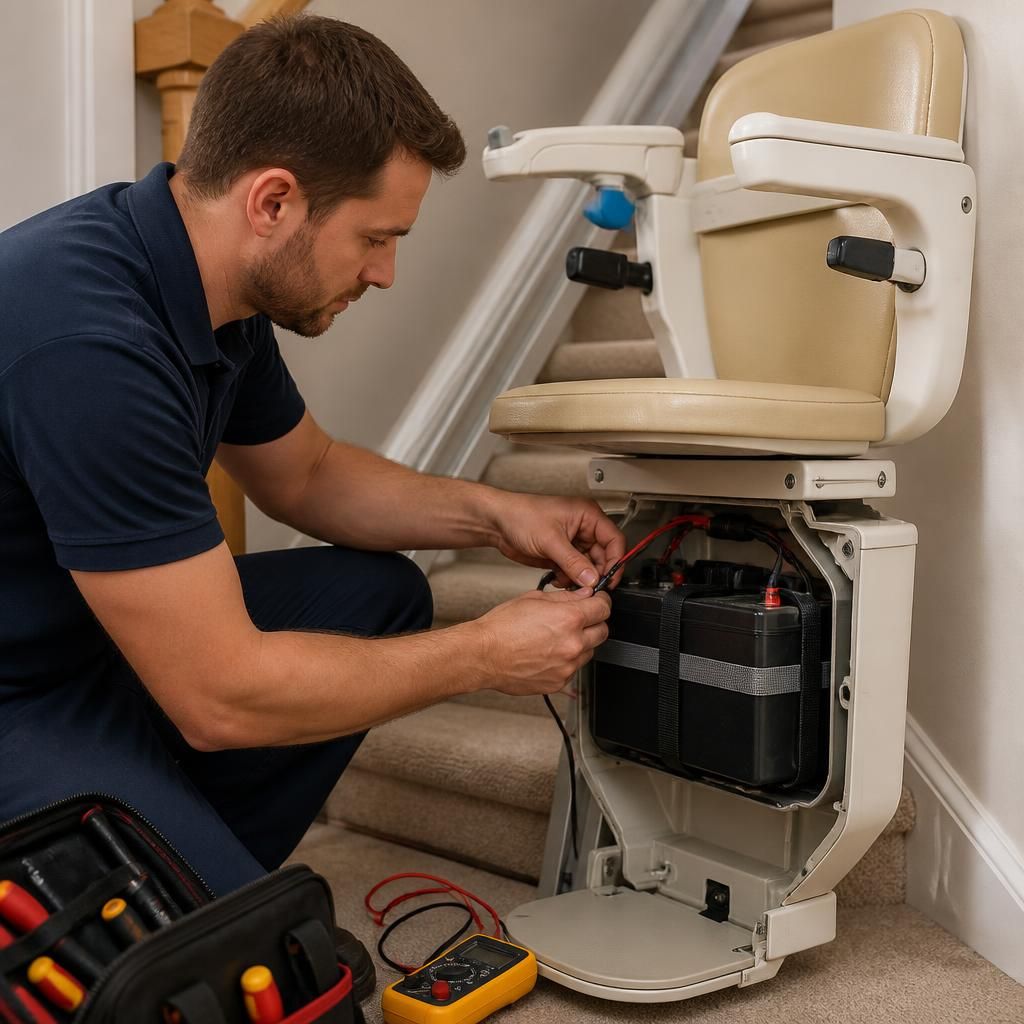
Brooks stairlifts generally use rechargeable sealed batteries fitted as a matched set. The correct replacement must match the stairlift model and the specification of the original battery. Fitting only one new battery alongside an older, weaker battery can affect charging and performance, so an engineer should confirm whether the complete battery set needs replacing.
Do not continue using the stairlift if:
- it stops unexpectedly or cannot complete the journey safely;
- there is a burning smell, unusual heat, visible swelling or damage around the batteries or charger;
- the charger or wiring appears damaged;
- the stairlift repeatedly loses power without an obvious explanation; or
- a warning remains after the stairlift has been correctly placed on charge.
Keep the stairlift parked on charge when it is not in use, unless your model’s instructions say otherwise. Do not open the battery casing, bridge connections, substitute automotive batteries or attempt electrical repairs without the appropriate training. Batteries can deliver a high current, and incorrect handling may damage the stairlift or create a safety risk.
Independent Stairlifts can assess the stairlift, test the batteries and charging system, and identify whether replacement batteries or another part is required. Providing the Brooks model details, the symptoms, any warning shown and when the problem occurs will help the engineer identify the correct replacement and minimise time without a dependable stairlift.
A Brooks stairlift that loses power soon after charging may have worn batteries, but the charger, charging contacts or wiring can cause similar symptoms. Check that the lift is fully parked on its designated charging point and that the charger indicator behaves normally. If the stairlift still travels slowly, stops part-way or gives a low-battery warning, arrange a professional assessment.
An engineer can test the batteries under load and inspect the charging system, rather than relying only on a voltage reading. This confirms whether the batteries need replacing and helps prevent an unnecessary part change. Do not open the battery casing or attempt electrical repairs yourself.
Arrange a Brooks stairlift battery assessment
If your Brooks stairlift is losing charge, travelling slowly or stopping unexpectedly, contact Independent Stairlifts to arrange a battery and charging-system assessment. An engineer can identify whether the batteries or another component needs attention and confirm the correct replacement.