
What key factors should be considered when selecting replacement parts for a Brooks stairlift to ensure compatibility and reliability?
When selecting replacement parts for a Brooks stairlift, check the exact model, part number, stairlift age and electrical specifications, and use genuine or fully compatible components. Reliability also depends on the part’s condition, safety compliance, warranty and correct installation, so confirm suitability with a qualified stairlift engineer before purchasing.
Compatibility and reliability depend on identifying the exact Brooks stairlift and matching the replacement part to its model, serial information and technical specification. A part that appears similar may have different connectors, dimensions, operating characteristics or safety functions. Before ordering, confirm the details with Independent Stairlifts or a suitably qualified stairlift engineer rather than relying on appearance alone.
Work through the following factors before selecting a replacement:
- Exact stairlift model: Brooks stairlifts have been produced in different models and versions, and components are not automatically interchangeable between them. Record the model name, serial number and any identification details shown on the stairlift, carriage, control board or battery compartment. Photographs of labels, plugs and the installed component can also help with identification.
- Part number and revision: Where possible, use the number printed on the existing part or shown in the manufacturer’s parts information. Some components may have updated versions or superseded part numbers. An updated part is suitable only when its compatibility has been confirmed; a similar-looking replacement is not necessarily an approved substitute.
- Function of the component: Identify whether the item is a battery, charger, handset, armrest control, key switch, circuit board, motor-related component, safety sensor, limit switch, wiring assembly or another part. Safety-critical and electronic components usually require more careful matching than simple external fittings.
- Electrical specification: Check voltage, current, polarity, connector type and charging requirements. Batteries must match the stairlift’s electrical system and physical arrangement, while a charger must provide the correct output for the fitted batteries and charging circuit. Using an incorrect electrical component can cause unreliable operation, damage or a safety hazard.
- Physical fit: Confirm dimensions, mounting points, cable length, connector position and clearance. A replacement may be electrically suitable but still unsuitable if it cannot be secured correctly or interferes with the seat, armrests, track, swivel mechanism or safety sensors.
- Condition and source: For reliability, select a new genuine Brooks component where available, or a replacement that has been properly verified as compatible. If considering a reconditioned part, establish what has been inspected, tested or renewed and whether the supplier can identify its source. Avoid unverified parts with damaged housings, corroded terminals, altered wiring or unclear labelling.
- Safety and regulatory suitability: The part should be intended for use with the relevant stairlift and meet applicable safety requirements. This is particularly important for components involved in braking, charging, movement control, seat security, obstruction detection or emergency operation. Do not modify a part, bypass a safety device or adapt wiring to make an incompatible component fit.
- Stairlift age and previous repairs: Older stairlifts may have been repaired or upgraded during their service life. The component currently fitted may therefore differ from the original specification. Check the complete system, including the control board, wiring, batteries and charger, rather than assuming that the visible part is the only version that has ever been used.
- Operating environment: Outdoor stairlifts and stairlifts installed in damp, dusty or particularly cold areas may need components with suitable environmental protection. External controls, connections, batteries and covers should be appropriate for their location. Indoor parts should not automatically be used outdoors.
- Warranty and after-sales support: Check whether the part carries a warranty, what it covers and whether installation by a qualified engineer is required for the warranty to remain valid. A supplier should also be able to provide compatibility advice and support if the part does not resolve the fault.
Battery and charger compatibility deserves particular attention. A stairlift that stops unexpectedly, travels slowly or fails to charge may have worn batteries, but the cause could also be a faulty charger, charging contact, wiring connection or control-board issue. Replacing batteries without checking the charging system may not solve the problem. Confirm the battery type, terminal arrangement, capacity and charger output, and have the charging circuit tested if the fault is unclear.
Reliability also depends on diagnosing the underlying fault. For example, repeated handset failure may result from a damaged cable, a control-board fault or a loose connection rather than the handset itself. Unusual movement, stopping on the track, a failure to swivel or a persistent warning indicator should be assessed before parts are ordered. Fitting an unrelated component can mask the original fault and may place additional strain on the stairlift.
When requesting a replacement, provide the stairlift model and serial details, the part number if available, a description of the symptoms, and clear photographs of the part and its connections. Explain whether the stairlift is installed indoors or outdoors and mention any previous repairs or modifications. This information allows the correct specification to be checked before dispatch and reduces the risk of receiving a part that cannot be installed.
Some parts should not be replaced by an untrained user. Batteries, handsets and certain external fittings may be straightforward for an engineer to change, but control boards, drive components, safety switches, wiring and charging equipment can require testing, configuration or adjustment. A qualified stairlift engineer can isolate the power safely, confirm the fault, fit the part correctly and test travel, charging, braking and safety functions afterwards.
After installation, the stairlift should be checked for secure fixings, correctly routed cables, smooth travel, effective controls, proper charging and normal operation of all safety features. Keep the part details and installation record with the stairlift documentation. If the same fault returns, stop using the stairlift if it is unsafe or unreliable and arrange a further inspection rather than repeatedly replacing components.
In practice, the safest choice is the part that is confirmed for the exact Brooks model, matches the required technical and physical specification, comes from a traceable source and is installed and tested correctly. Independent Stairlifts can help check these details and advise whether a replacement part is appropriate or whether a wider inspection is needed.
Choosing a replacement part for a Brooks stairlift means matching it to the exact stairlift model and specification, not simply selecting a component that looks similar. Check the model and serial details, the part number, electrical ratings, connectors, dimensions and mounting points before ordering.
This is particularly important for batteries, chargers, control boards, handsets, wiring and safety components. An apparently suitable part may have different polarity, charging requirements or connections, which can cause unreliable operation or damage. Provide Independent Stairlifts with clear photographs of the stairlift label, existing part and its connections so compatibility can be checked. Where the fault involves movement, charging or a safety function, arrange an engineer’s assessment before replacing the component.
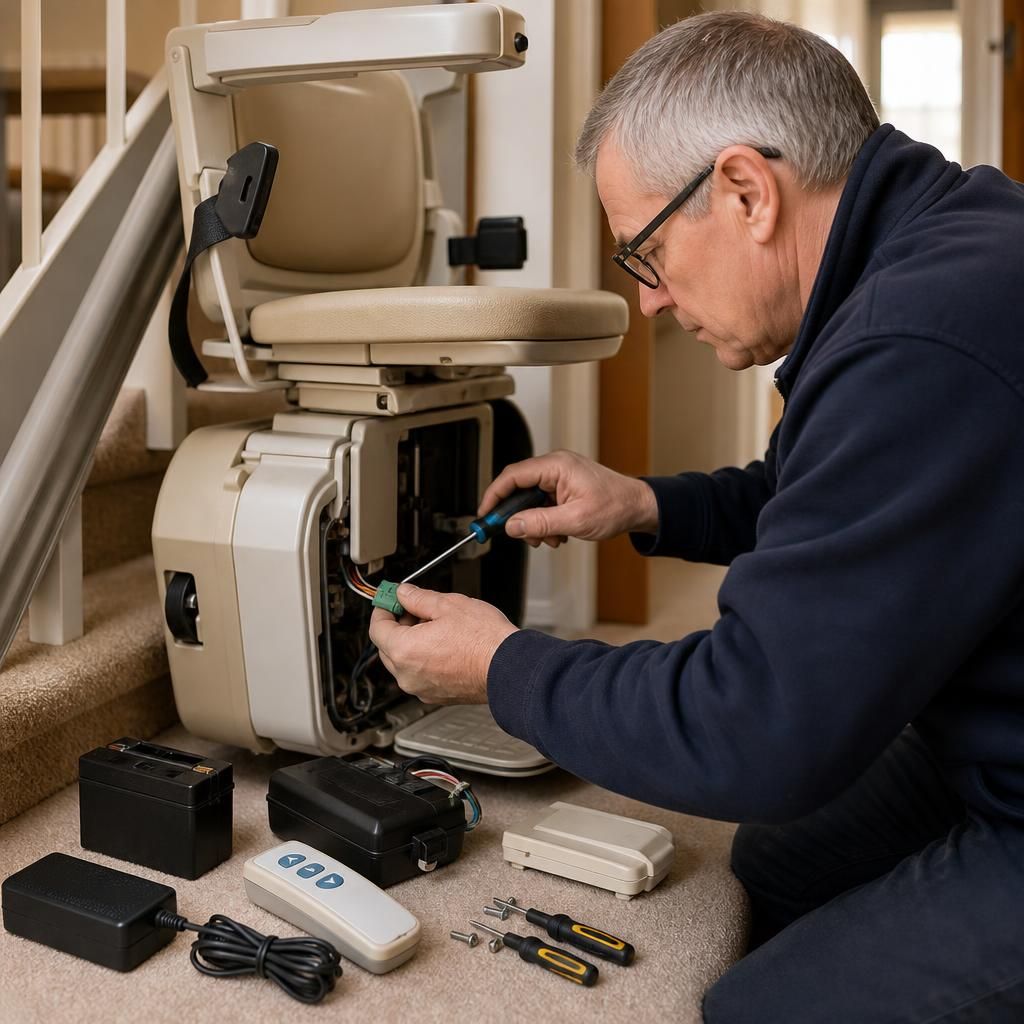
Check Your Brooks Stairlift Part Compatibility
Send Independent Stairlifts the Brooks model and serial details, part number if available, and clear photographs of the existing component and its connections so compatibility can be checked. If the part relates to movement, charging or a safety function, arrange an engineer’s assessment before ordering or fitting it.