
How can I ensure the stairlift spares I choose meet the latest safety standards and regulatory requirements?
Choose genuine or manufacturer-approved stairlift spares with clear part identification, traceable specifications and documented compatibility with your stairlift model; do not rely on appearance alone. Independent Stairlifts can check the part against the manufacturer’s guidance and ensure installation follows the applicable UK safety requirements, including relevant machinery and electrical safety legislation.
To ensure stairlift spares meet current safety and regulatory requirements, choose genuine or manufacturer-approved parts that are clearly identified, traceable and confirmed as compatible with the complete stairlift system. Safety-critical components should not be selected by appearance or price alone. Independent Stairlifts can check the part against the stairlift model, manufacturer’s technical information and the applicable UK requirements before arranging or completing installation.
Check the part is intended for your exact stairlift
Stairlift components can differ between models, production years and left- or right-handed configurations. A part that looks identical may have different electrical ratings, connectors, software, dimensions or safety characteristics. Before ordering, provide the stairlift make, model, serial number and, where possible, a photograph of the existing component and its identification label. This is particularly important for batteries, chargers, control boards, sensors, limit switches, safety edges, belts, drive components and charging equipment.
Ask for the manufacturer’s part number or a documented replacement reference. A reputable supplier should be able to explain whether the item is:
- an original manufacturer part;
- a manufacturer-approved equivalent; or
- a compatible replacement supported by appropriate technical information.
Where there is no clear evidence of compatibility, the part should not be fitted simply because it appears to match the original.
Understand the relevant UK safety framework
A stairlift is a powered machine incorporating electrical, mechanical and control systems. Depending on the component and how it is supplied, relevant requirements may include machinery safety legislation, electrical equipment safety requirements and electromagnetic compatibility requirements. Stairlift design and installation may also be assessed against applicable British or European standards, including standards relating specifically to stairlifts. The exact requirements depend on the equipment, its origin, the part being supplied and whether it is being placed on the market as part of a new system or used to maintain an existing one.
For products placed on the market in Great Britain, UKCA marking may be relevant, while CE marking continues to have legal significance in certain circumstances, including many products supplied into Northern Ireland. Marking alone is not proof that a spare is suitable for a particular stairlift. It should be supported by clear manufacturer identification, instructions and evidence that the component has been assessed for its intended use.
Do not treat a safety mark as a substitute for compatibility
Regulatory marking generally relates to the product or component’s conformity with applicable requirements. It does not confirm that an unrelated charger, battery, control unit or safety device will work correctly with your stairlift. Check both points separately:
- the spare must be appropriately designed and documented for its intended purpose; and
- the spare must be approved or confirmed as compatible with your specific stairlift model and configuration.
Be cautious of parts supplied without a manufacturer, part number, operating instructions, electrical ratings or traceable supplier details. Unbranded electrical components and copied safety devices may introduce risks that cannot be identified from a visual inspection.
Pay particular attention to safety-critical components
Some parts directly affect whether the stairlift stops, charges, travels or responds to an obstruction. These include safety edges, seat and swivel interlocks, sensors, limit switches, control boards, remote controls, drive assemblies, charging systems and batteries. Using an incorrect component can cause nuisance faults, prevent a safety function from operating or create a risk during travel.
Replacement batteries should have the correct chemistry, voltage, capacity, dimensions, terminal arrangement and charging characteristics. A battery with a similar appearance may still be unsuitable. Chargers and control boards must also be matched to the stairlift’s electrical system; substituting a part with a different output or connection can damage equipment or create a fire or shock hazard.
Check documentation and traceability
Before installation, retain the quotation, part description, part number and any manufacturer instructions. For higher-risk or less familiar components, ask whether conformity information, technical data or installation instructions are available. A competent installer should be able to record what was fitted and explain any limitations or follow-up checks required.
Traceability is especially useful if a manufacturer later issues revised instructions, identifies a defective batch or recommends a modification. It also helps ensure that future servicing uses the correct replacement rather than an increasingly uncertain substitute.
Use a competent person for installation
Regulatory compliance is not achieved by buying a correctly labelled part alone. The installation must be carried out in accordance with the manufacturer’s instructions, with the stairlift isolated safely where necessary and the relevant electrical and mechanical checks completed afterwards. Safety devices must never be bypassed, modified or left disconnected to overcome a fault.
After fitting a spare, the installer should check the component’s operation as part of the complete stairlift. Depending on the work, this may include checking travel, stopping, charging, controls, obstruction sensors, seat or swivel interlocks, emergency functions and any unusual noise or movement. The stairlift should not be returned to normal use if a safety function cannot be verified.
Ask Independent Stairlifts to verify the replacement
If you are unsure whether a spare meets current requirements, send Independent Stairlifts the stairlift details and the information supplied with the part before purchasing or fitting it. We can help establish whether the component is genuine or approved, compare its specification with the stairlift, identify safety-critical considerations and advise whether installation should be completed by a trained engineer.
Choosing a documented, compatible spare and having it fitted and tested correctly provides a more reliable basis for safe operation than relying on a generic part, an online image or a claim that a component is a universal replacement.
Meeting safety standards means more than choosing a spare with a conformity mark. The part must also be traceable, correctly specified and confirmed as compatible with your stairlift’s make, model and configuration.
- Check the manufacturer, part number and electrical or mechanical specifications.
- Ask whether it is an original part, an approved equivalent or a compatible replacement supported by technical documentation.
- Keep the instructions and fitting details so the component can be identified during future servicing.
- Have safety-critical parts, such as batteries, chargers, control boards and sensors, fitted and tested by a competent stairlift engineer.
A correctly labelled part can still be unsuitable if its voltage, connections, dimensions or operating characteristics do not match the stairlift. Independent Stairlifts can verify these details before installation and check that the relevant safety functions operate correctly afterwards.
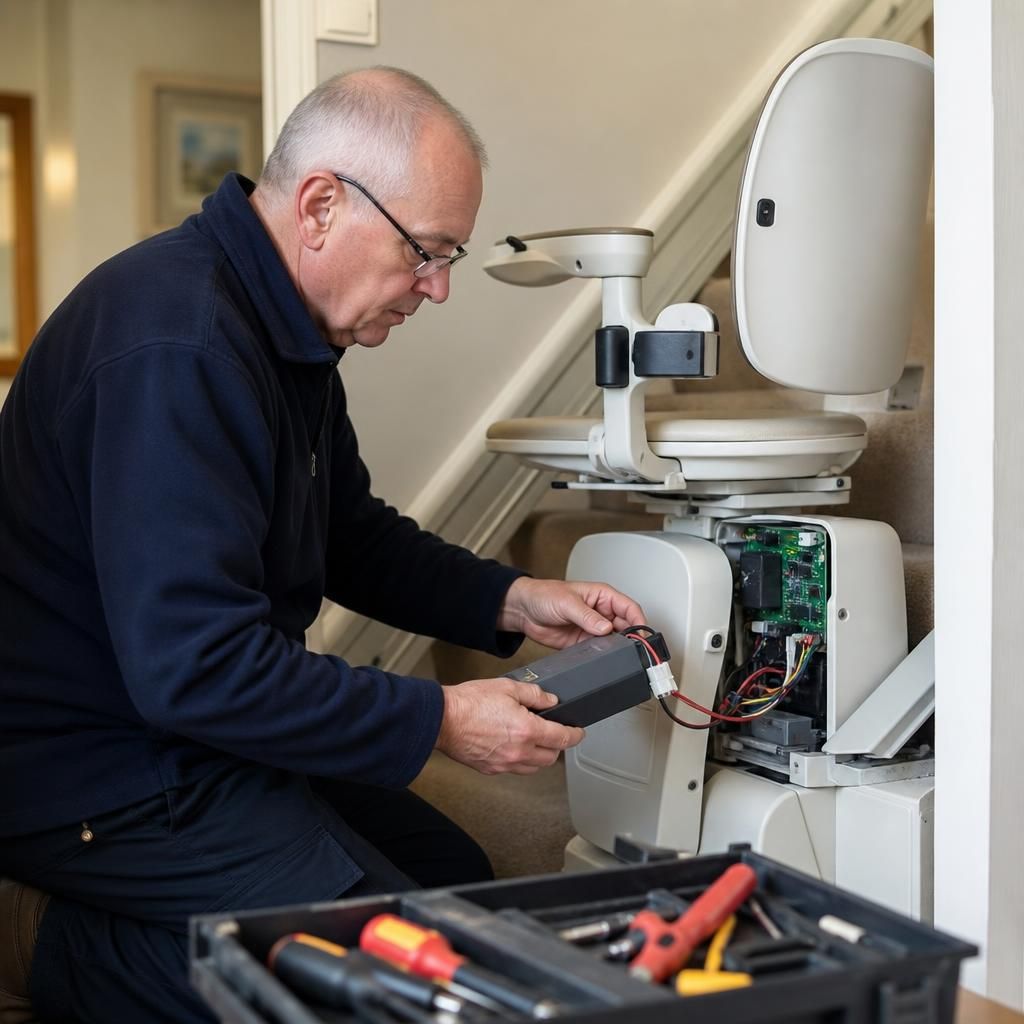
Check your stairlift spare with Independent Stairlifts
Before purchasing or fitting a stairlift spare, provide Independent Stairlifts with your stairlift make, model and part details so we can check compatibility, documentation and safety requirements. We can also arrange fitting and testing by a competent engineer where needed.