
How can I determine if a part needs replacing on my Brooks stairlift?
A part may need replacing if your Brooks stairlift shows repeated operating faults, unusual noises, jerky movement, reduced travel performance, charging problems or visible damage. Stop using it if it becomes unsafe, and contact Independent Stairlifts for a professional assessment so the faulty component can be identified and the correct replacement fitted.
A part on your Brooks stairlift may need replacing when it produces a recurring fault, shows visible damage, causes unusual noise or movement, or prevents the lift from charging or completing its journey. However, the same symptom can have more than one cause. For example, a stairlift that stops unexpectedly may have a battery, charging, switch, safety-edge or control fault. A professional assessment is therefore the safest way to identify the failed component and confirm that the replacement is compatible with your particular Brooks model.
Begin with the symptoms. Note exactly what the stairlift is doing and when the problem occurs. Useful details include whether the fault happens when travelling up, travelling down, starting from a charging point, using the remote control or operating the controls on the armrest. Also record whether the stairlift makes a sound, displays a warning, stops at the same point on the rail or works intermittently. These observations can help an engineer distinguish between a component that needs replacing and an issue such as an obstruction, poor electrical contact or incorrect parking position.
Common indications that a Brooks stairlift may require a replacement part include:
- Repeated operating faults: the stairlift regularly fails to start, stops during travel, reverses unexpectedly or only works after the controls are operated several times.
- Jerky or uneven movement: sudden changes in speed, hesitation or vibration may indicate wear or a fault in the drive system, motor, carriage components or associated controls.
- Unusual noises: grinding, clicking, knocking or persistent squealing should be investigated, particularly if the noise is new or becoming more pronounced.
- Reduced travel performance: the lift may struggle on part of the staircase, move more slowly than usual or fail to reach the end of the rail.
- Charging problems: the stairlift may not charge when parked correctly, may show a low-battery warning repeatedly or may run for noticeably less time. This could involve the batteries, charging contacts, charger or another electrical connection.
- Control problems: a handset, joystick, key switch or remote control may become unresponsive, work only intermittently or require excessive pressure.
- Safety-device faults: the stairlift may refuse to move because a safety edge, seat sensor, armrest switch or obstruction sensor is not operating correctly.
- Visible damage or wear: cracked covers, damaged wiring, loose fittings, worn seat or arm components and damaged rail or carriage parts should not be ignored.
Check the simple causes without dismantling the lift. Make sure the stairlift is switched on, the key is in the correct position and the seat, arms and swivel mechanism are fully returned to their travelling position. Check that nothing is obstructing the rail, footrest or safety edges. If your model has charging points at the top or bottom of the stairs, confirm that the stairlift is parked correctly and that the contacts are clean and able to connect. Do not remove covers, alter wiring or bypass a safety switch while investigating a fault.
If a warning light or fault code is present, make a note of it or take a clear photograph. Do not assume that a code identifies a single replaceable part in every case; it may indicate a wider circuit or safety issue. The model and serial information on the stairlift can also be important, because Brooks parts are not necessarily interchangeable between different models or production versions.
Consider the pattern of the fault. A stairlift that loses power or struggles to travel may have batteries nearing the end of their serviceable life, but it could also have a charger or connection problem. A lift that stops at one particular point may be affected by a rail obstruction, carriage issue or safety sensor rather than the motor itself. Likewise, a non-working remote control may need a battery or handset replacement, while a fault affecting both the remote and armrest control may require a different diagnosis. Replacing the first part that appears likely can waste time and may not resolve the underlying problem.
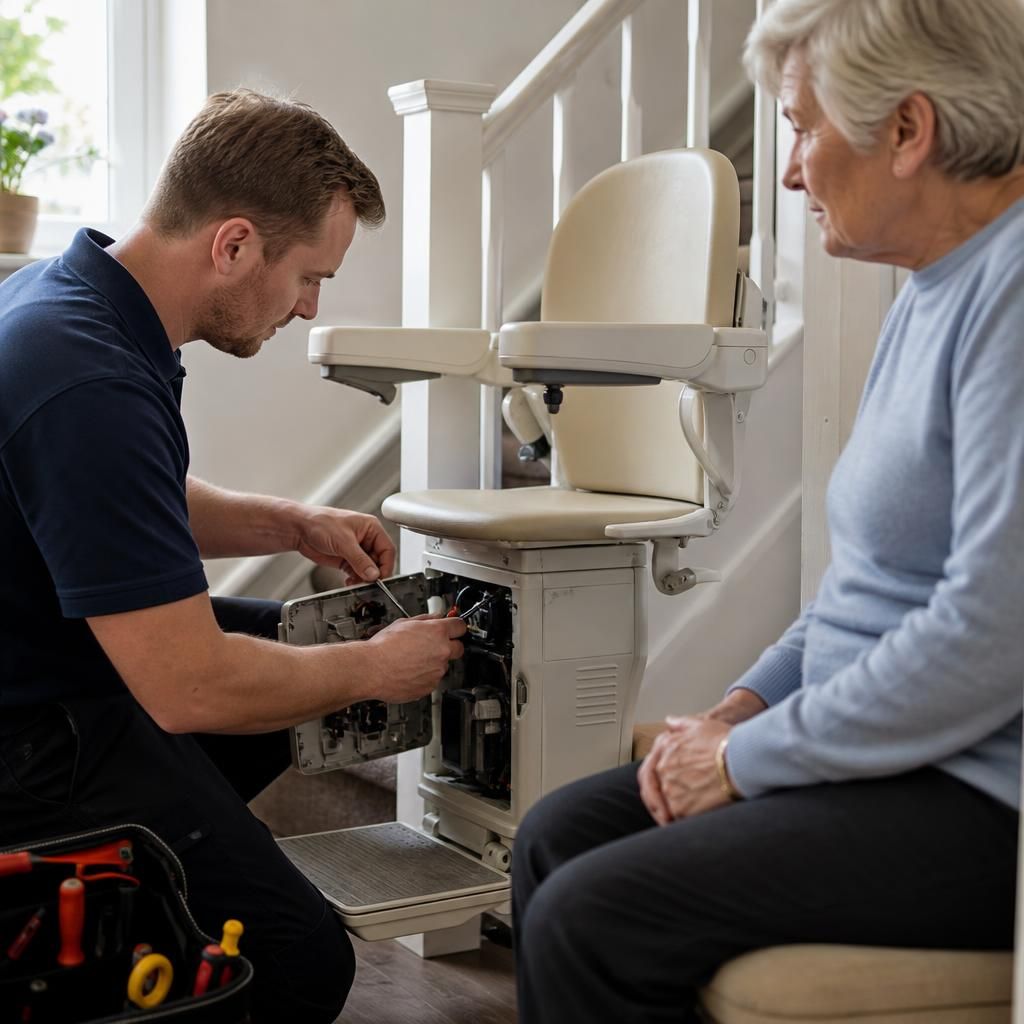
Arrange an assessment if the fault repeats. Contact Independent Stairlifts with the Brooks model details, a description of the symptoms and any warning information. Where possible, provide photographs of the identification label, damaged component and charging position. An engineer can inspect the stairlift, test its electrical and mechanical systems, identify whether the part is worn or failed, and check that the proposed replacement is suitable. They can also identify related parts that may have been affected, rather than fitting a component that only masks the original fault.
Stop using the stairlift and seek advice promptly if it moves unpredictably, emits a burning smell, has exposed or damaged wiring, makes severe mechanical noises, becomes unstable, fails to stop correctly or has a damaged safety component. Do not continue using it simply because it still completes part of the journey. If someone is unable to use the stairs safely without the lift, arrange an alternative means of access while the fault is being assessed.
Replacement parts should be selected using the exact Brooks model, serial information and the engineer’s diagnosis. A visually similar battery, handset, charger, switch or carriage component may have different electrical ratings, connectors, dimensions or safety functions. Using a genuine or confirmed compatible part helps maintain correct operation, but compatibility alone does not replace correct installation and testing. Parts affecting the drive, charging system or safety circuits should normally be fitted and checked by a suitably trained engineer.
After the repair, the stairlift should be tested through its normal operating functions, including travel, stopping, charging, controls and relevant safety devices. Ask what caused the fault, which part was replaced and whether any follow-up checks are recommended. Keeping this information with the stairlift records will make future diagnosis easier and help ensure that the correct Brooks spares are sourced if another component later requires attention.
A recurring fault does not always identify the part that needs replacing on a Brooks stairlift. For example, slow or unreliable travel may be caused by batteries, charging contacts, the charger, wiring or the drive system, while a lift that stops unexpectedly may have a safety switch or obstruction issue.
Note when the fault occurs, any warning light or code, unusual noise and whether the problem affects the armrest control, remote control or charging position. Check that the stairlift is switched on, parked correctly and free from obstructions, but do not remove covers, alter wiring or bypass safety devices.
Independent Stairlifts can assess the symptoms, identify the failed component and confirm that the replacement matches the exact Brooks model and serial information. Stop using the lift and seek advice promptly if it moves unpredictably, smells of burning, has exposed wiring, becomes unstable or fails to stop correctly.
Arrange an Expert Brooks Stairlift Parts Assessment
Contact Independent Stairlifts to arrange an expert assessment of your Brooks stairlift and identify the part that needs replacing. We can help confirm the correct compatible spare and arrange professional fitting where required.