
What specific qualifications or certifications should a stairlift servicing technician have?
A stairlift servicing technician should have recognised manufacturer-specific training for the model being inspected, along with demonstrable competence in electrical safety, mechanical maintenance and risk assessment. They should also follow the manufacturer’s service procedures and relevant UK health and safety requirements, with appropriate insurance and evidence of current technical training.
The most important qualification is current, manufacturer-specific training for the stairlift being serviced. A competent technician should also be able to demonstrate suitable knowledge of electrical safety, mechanical maintenance, fault-finding, risk assessment and the manufacturer’s service procedures. In the UK, there is not one universal statutory licence that every stairlift servicing technician must hold, so competence is usually evidenced through relevant technical training, practical experience, insurance and documented working procedures.
When arranging a service, ask which training the technician has completed and whether it covers the make and model installed in your home. This is particularly important for curved, outdoor, heavy-duty and reconditioned stairlifts, as their drive systems, charging arrangements, safety sensors and installation configurations can differ.
Look for the following qualifications and evidence:
- Manufacturer-specific training: The technician should have been trained to install, inspect, adjust and repair the relevant stairlift range. This should include the controls, drive mechanism, batteries, charging equipment, limit switches, sensors, swivel or folding mechanisms and safety features fitted to the model.
- Electrical safety competence: They should understand safe isolation, battery systems, chargers, wiring, fuses, connections and electrical fault diagnosis. Where the work involves fixed electrical wiring or alterations to the domestic supply, the appropriate electrical competence and procedures must be used rather than treating the task as a simple stairlift adjustment.
- Mechanical maintenance competence: Servicing involves more than cleaning the rail. The technician should be able to inspect fixings, gear and drive components, rollers, belts or chains where fitted, seat mechanisms, armrests, footplates and safety edges. They should know how to identify wear, looseness, damage and alignment problems before they create a safety issue.
- Health and safety training: The technician should follow documented risk assessments and safe systems of work. This includes considering the staircase layout, access to the equipment, trip hazards, moving parts, electrical risks, manual handling and the needs of the person using the stairlift.
- Fault-finding and diagnostic experience: A qualified technician should be able to distinguish between a low battery, charging fault, obstructed sensor, control problem, mechanical wear and a more serious electrical or drive-system fault. They should not simply reset the stairlift without identifying the reason for the fault.
- First-aid or site-safety training where relevant: This is not a substitute for technical competence, but appropriate workplace safety training supports safe working, particularly when the technician is working alone or visiting a vulnerable customer.
Relevant standards and legislation should support the technician’s work, but they are not personal qualifications. A reputable service provider should work in accordance with the stairlift manufacturer’s instructions and applicable UK product, electrical and workplace safety requirements. Standards relating to stairlift design and installation apply primarily to the equipment and the way it is installed; they do not, on their own, prove that an individual has the practical ability to service it. Similarly, a company holding a quality or safety accreditation can be useful evidence of structured procedures, but you should still ask who will carry out the inspection and what training they personally hold.
It is also sensible to check whether the provider has:
- current public liability insurance and, where appropriate, employers’ liability insurance;
- a written servicing procedure and risk assessment process;
- access to genuine or manufacturer-approved replacement parts;
- a clear process for recording faults that cannot be repaired during the visit;
- appropriate training for working with batteries, electrical equipment and moving machinery;
- an arrangement for technical support or escalation when a fault falls outside the technician’s competence.
Ask what the technician will provide after the service. A proper service record should identify the stairlift, record the checks and adjustments completed, note any defects or developing wear, and state whether the equipment was left safe to use. It should also distinguish between work completed and recommendations for later repair. If a safety-critical fault is found, the technician should explain the risk clearly and advise whether the stairlift should be taken out of use until it is repaired.
Be cautious if a provider cannot confirm model-specific training, refuses to explain what the service includes, relies only on a visual check, or recommends replacement without describing the fault. A technician should not bypass a safety sensor, remove a protective feature or make an adjustment that conflicts with the manufacturer’s instructions simply to return the stairlift to operation.
Before booking, have the stairlift make, model and any fault-code information available. You can then ask whether the visiting technician is trained on that equipment, whether the inspection follows the manufacturer’s service schedule and whether a written report will be supplied. For an existing customer, these checks help ensure that the servicing visit is matched to the actual installation rather than treated as a generic inspection.
Manufacturer-specific training is the most useful qualification to check when choosing a stairlift servicing technician. A technician should understand the make and model installed in your home, including its drive system, batteries, charging points, safety sensors, controls and seat mechanisms.
This is especially important for curved, outdoor, heavy-duty and reconditioned stairlifts, which can have different components and servicing requirements. Ask whether the technician’s training is current and whether the service will follow the manufacturer’s instructions rather than relying only on a general visual inspection.
After the visit, you should receive a service record showing the checks completed, defects found, adjustments made and whether the stairlift was left safe to use. If a safety-critical fault is identified, the technician should explain the risk and advise whether the stairlift needs to remain out of use until repairs are completed.
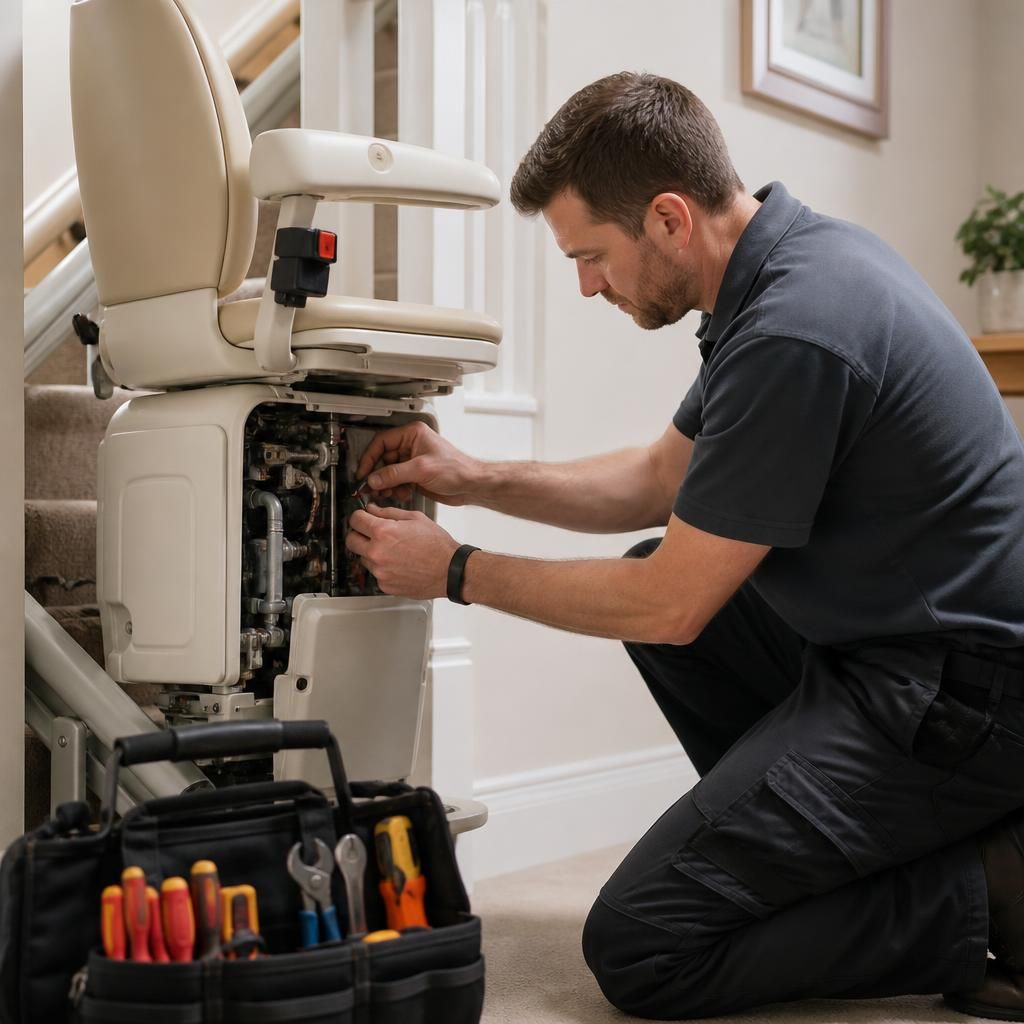
Book a qualified stairlift servicing technician
Book a qualified stairlift servicing technician to inspect your stairlift, follow the manufacturer’s servicing procedures and provide a clear record of any checks or repairs required.