
What should I do if my stairlift breaks down unexpectedly?
If your stairlift breaks down unexpectedly, stop using it, switch it off if it is safe to do so, and avoid forcing the seat, controls or carriage. Contact Independent Stairlifts or your servicing provider for advice, and use an alternative safe route until a qualified technician has inspected and repaired the lift.
If your stairlift breaks down unexpectedly, stop using it, keep calm, and do not force the seat, controls or carriage. If it is safe, switch the stairlift off, leave it in place and contact Independent Stairlifts or your usual servicing provider. Use another safe route where possible until a qualified technician has inspected the lift.
If you are on the stairs or unable to get off safely: remain seated with your seat belt fastened, keep your hands and feet clear of the mechanism and ask someone nearby for assistance. Do not try to climb off mid-staircase unless there is no safe alternative and you can do so without risking a fall. If there is an immediate medical or safety emergency, call the appropriate emergency service.
Check the simple causes only if you can do so safely. A stairlift may stop because its power supply has been interrupted, the battery is low, the seat is not fully in its travelling position, a swivel seat or safety arm is not correctly secured, or an obstruction has been detected. You can check that:
- the main power switch or fused spur has not been switched off;
- the stairlift is properly positioned on its charging point, where applicable;
- the seat is facing the correct direction for travel and the armrests or safety sensors are in their normal operating position;
- the remote control has working batteries and is set to the correct lift, particularly where more than one stairlift is installed;
- there is no visible object, clothing or debris obstructing the track, carriage or footrest.
Only remove an obstruction if the lift is switched off and the object can be taken away without reaching into moving parts. Never remove covers, alter wiring, disconnect safety switches or attempt to bypass a fault. Do not repeatedly operate the controls when the lift is making an unusual noise, stopping suddenly, moving unevenly or showing a fault indication.
Record useful information for the technician. Note where the stairlift stopped, whether it was travelling upwards or downwards, what the display or warning light showed, and whether you heard a beep or unusual sound. If possible, take a clear photograph of the control panel or fault indicator. Tell the servicing provider the stairlift model and whether the problem affects the handset, arm control, charging system, seat swivel or movement along the track. This information can help the technician prepare for the visit.
Do not assume that switching the lift off and on repeatedly has fixed the problem. A temporary reset may clear a minor interruption, but a recurring fault can indicate an issue with the batteries, charger, drive system, track, safety edge or control circuit. Continuing to use the lift could leave you stranded again or cause additional damage.
What happens when you report the breakdown? The provider should establish whether anyone is currently stuck, assess the symptoms, give safe interim instructions and arrange an appropriate response. A technician may inspect the power supply, batteries, charging contacts, controls, sensors, drive components, track and safety systems. The repair should be tested under normal operating conditions before the stairlift is returned to regular use.
For a curved stairlift, the technician may also need to examine the bespoke track, position sensors and changes in direction. Outdoor stairlifts require checks for weather exposure, moisture, corrosion and the condition of external charging equipment. With a reconditioned stairlift, the service history and condition of replacement parts may be relevant. The correct diagnostic process depends on the model, installation and type of fault, so avoid relying on instructions for a different stairlift.
If the batteries are failing, the lift may beep, stop away from its charging point, travel more slowly or operate intermittently. Do not replace batteries unless the manufacturer’s instructions and the installation arrangement allow this and you are competent to do so. Stairlift batteries are part of the electrical and charging system, and incorrect replacement can create a safety or reliability problem.
After a breakdown has been repaired, ask what caused the fault, whether any parts were replaced and whether the stairlift needs a follow-up service. Keep the service report and note any advice about charging, cleaning the track or reporting further symptoms. If the lift is used regularly, scheduled servicing and prompt attention to warning signs can help identify worn components before they result in an unexpected stoppage, although servicing cannot prevent every breakdown.
Until the technician confirms that the stairlift is safe, do not use it simply because it has started moving again. If you are unsure whether the fault has cleared, contact Independent Stairlifts for guidance and arrange an inspection. A qualified technician can determine whether the lift needs a minor adjustment, replacement part or more comprehensive repair.
An unexpected stairlift breakdown should be treated as a safety issue: stop using the lift, keep the seat belt fastened if you are still on the stairs, and do not force the controls, seat or carriage. If you can do so safely, switch the stairlift off and contact Independent Stairlifts or your usual servicing provider for advice.
- Keep your hands, feet and clothing away from the track and moving parts.
- Do not attempt to climb off mid-staircase unless there is no safe alternative and you can do so without risking a fall.
- Check only simple causes, such as a switched-off power supply, an unsecured swivel seat or an obstruction, and only when the lift is safely switched off.
- Do not remove covers, alter wiring, bypass safety switches or repeatedly operate a lift that is making unusual noises or stopping unexpectedly.
Tell the technician where the stairlift stopped, what warning light or display appeared and whether you heard any unusual beeping or noise. Continue using an alternative safe route until a qualified technician has inspected the lift and confirmed that it is safe to operate.
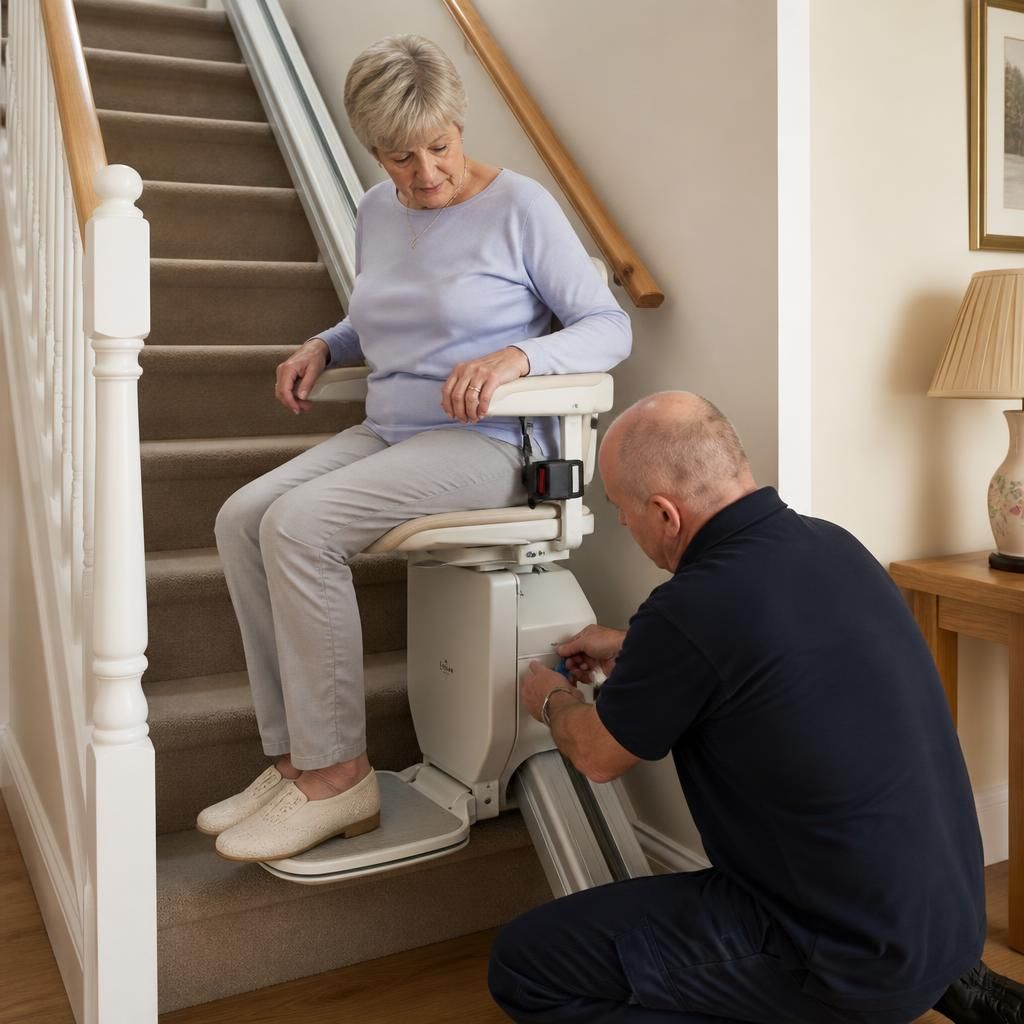
Need help with a stairlift breakdown?
If your stairlift has broken down, contact Independent Stairlifts for practical advice and help arranging an inspection or repair. Do not use the lift again until a qualified technician has confirmed that it is safe.