
What are the primary warning signs that indicate an immediate need for stairlift servicing?
Immediate stairlift servicing is needed if the lift stops unexpectedly, moves unevenly, makes unusual noises, fails to charge, shows warning lights or has faulty safety features such as the seat belt, swivel seat or sensors. Stop using it if it appears unsafe, switch it off where appropriate and contact a qualified stairlift technician for advice and an urgent inspection.
The primary warning signs requiring immediate stairlift servicing are an unexpected stop, jerky or uneven movement, unusual noise, failure to charge, visible damage, warning indicators or a fault affecting a safety feature. If any of these occur, stop using the stairlift unless moving it is necessary to reach a safe position, keep other people away from it and contact a qualified stairlift technician for advice.
A stairlift should provide controlled, predictable movement. A minor issue can develop into a breakdown or affect the safe operation of the seat, carriage, track or controls. Do not continue using the lift simply because it still completes the journey occasionally. Intermittent faults can be particularly difficult to diagnose and may become more serious without warning.
Stop-start movement or an unexpected stop
Arrange an urgent inspection if the stairlift stops between floors, starts and stops repeatedly, moves more slowly than usual or fails to complete its journey. A brief interruption may relate to a control, battery or charging problem, but repeated stopping can also indicate a fault with the drive system, motor, sensors or electrical supply.
Do not try to overcome a stop by repeatedly pressing the controls, rocking the seat or applying force. If the user is left on the stairs, remain seated with the seat belt fastened if it is safe to do so and contact the appropriate support person or emergency services if there is an immediate risk. A technician can advise whether the lift can be returned safely to a landing or requires specialist assistance.
Jerky, uneven or unusually slow travel
Changes in the way the stairlift travels are significant, even when the lift still reaches the top and bottom. Report juddering, surging, hesitation, tilting, excessive vibration or a carriage that appears to struggle on bends. These symptoms may be associated with the drive mechanism, rollers, track, motor, batteries or an obstruction, and should be assessed rather than monitored indefinitely.
Keep the track clear of clothing, toys, furniture and other objects. Do not attempt to lubricate, adjust or remove components unless this is specifically permitted in the manufacturer’s instructions. Incorrect lubrication or adjustment can affect braking, traction and sensor operation.
New, loud or worsening noises
Contact a servicing specialist if the lift begins making grinding, scraping, clicking, squealing, banging or repeated knocking sounds. A small change in operating noise can indicate wear, a loose part, an obstruction or a problem with the drive assembly. Stop using the stairlift immediately if the noise is accompanied by vibration, a burning smell, smoke, loss of control or a change in speed.
Do not remove covers to investigate a noise. Internal components may carry electrical power or require specialist adjustment, and opening the unit may create an additional safety risk.
Failure to charge or rapidly depleted batteries
Immediate servicing is appropriate when the stairlift does not charge at its parking position, repeatedly reports a low battery, loses power during normal use or only works after being left on charge for an unusually long period. Check that the power supply is switched on, the charging point is unobstructed and the stairlift is parked correctly on its charging contacts. If the problem continues, stop relying on the lift and arrange an inspection.
Battery performance naturally changes over time, but a sudden loss of capacity can also result from charging contacts, wiring, the charger or another electrical fault. Do not replace batteries with unsuitable parts or attempt electrical repairs yourself. If there is a burning smell, heat, smoke or visible damage, switch off the supply only if this can be done safely and without putting anyone at risk.
Warning lights, fault codes or repeated alarms
Take warning lights, audible alarms and displayed fault codes seriously, particularly when they recur after the lift has been reset. Record what the indicator shows, when it appears and what the stairlift was doing at the time. This information can help the technician identify the fault more efficiently.
A reset may clear a temporary interruption, but it does not confirm that the underlying problem has been resolved. Do not repeatedly reset the stairlift or continue using it when a warning remains visible.
Safety features that do not work correctly
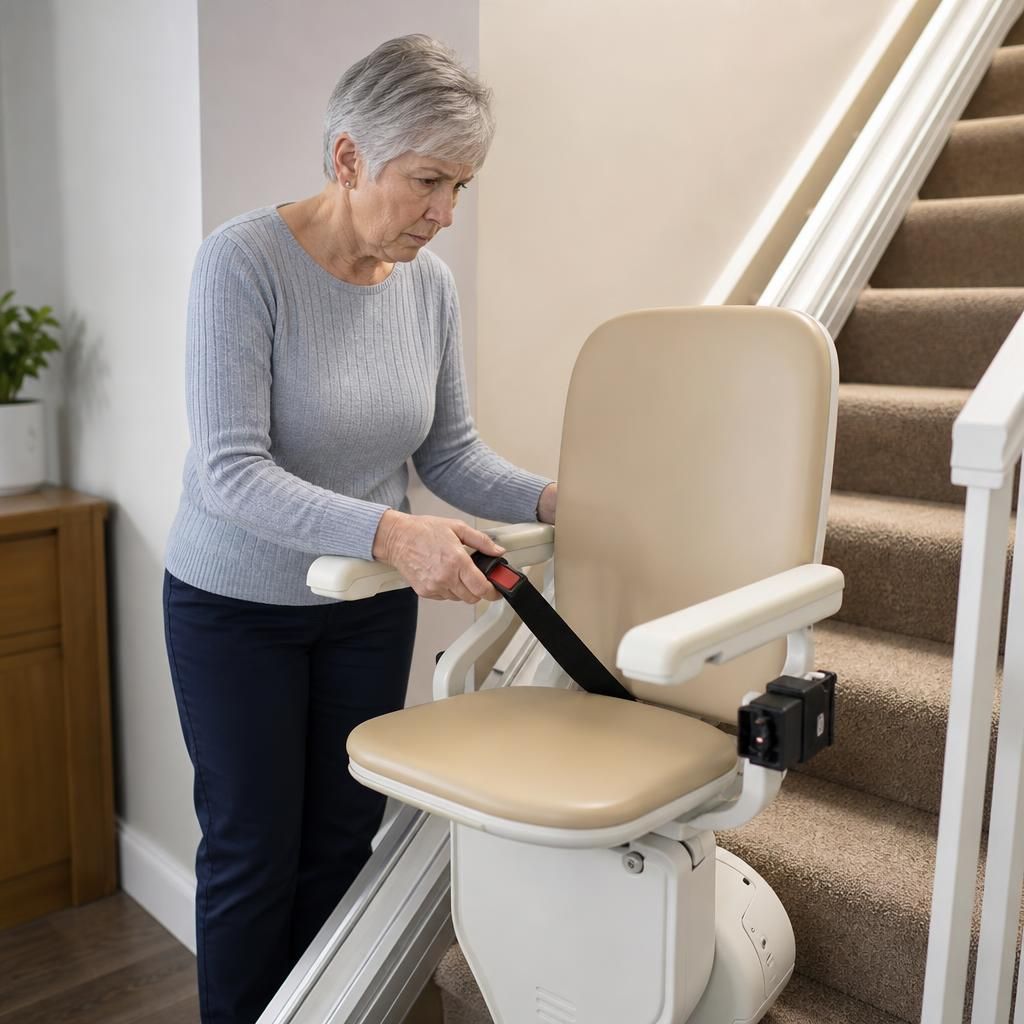
Stop using the stairlift if the seat belt does not latch or release correctly, the swivel seat does not lock securely, the armrests or footrest are loose, or a safety sensor fails to respond. Other important features include obstruction sensors, track-end controls, overspeed protection and controls that stop the lift when released. The exact features vary by model, so a technician should assess any change in their operation.
Never bypass a sensor, hold down a control continuously to defeat a safety function or use an improvised fastening. These features are designed to prevent movement when a person, object or unsafe condition is detected.
Visible damage, looseness or changes to the installation
Arrange servicing after a collision, impact, attempted forced movement or any damage to the seat, armrests, footrest, carriage, track or control unit. Also report loose fixings, cracked covers, exposed wiring, corrosion, fluid contamination and a track that appears to have shifted. Do not use the stairlift if it catches on the stairs, wall or surrounding fittings.
After building work, decorating or moving furniture, check that the route remains clear and that the stairlift has not been knocked. A change in the surrounding environment can create an obstruction even when the stairlift itself appears undamaged.
Problems with the controls
Urgent attention is needed if the joystick, remote control, call-and-send control or stop button sticks, responds intermittently or operates without being deliberately pressed. Remove any obvious obstruction from around the control, but do not dismantle it or continue using the lift if its movement cannot be stopped reliably.
Where more than one control is available, do not use an alternative control to work around a faulty one unless a technician has confirmed that it is safe. A control fault can affect the user’s ability to stop the stairlift or summon it to a landing.
What to do before the technician arrives
- Stop using the stairlift if movement, charging or a safety feature appears abnormal.
- If the lift is unoccupied, leave it in a safe position where it does not obstruct the stairs, provided it can be moved without risk.
- Keep children, visitors and pets away from the stairlift and track.
- Make a note of warning lights, fault codes, unusual sounds and when the problem occurs.
- Tell the service team the stairlift’s make and model, its location, whether anyone is currently on it and whether there is smoke, heat, impact damage or another immediate hazard.
- Do not dismantle the stairlift, bypass safety features, force the carriage or attempt electrical repairs.
A technician may need to inspect the batteries and charging system, controls, safety circuits, drive components, rollers, track, seat mechanism and fixings. The lift should be returned to service only after the fault has been identified, the necessary work completed and its safety operation checked. If the problem is not urgent but has appeared repeatedly, report it promptly rather than waiting for the next scheduled service.
A stairlift that stops unexpectedly or moves unevenly needs immediate servicing, even if it occasionally completes the journey. These changes can indicate a problem with the drive system, batteries, controls, sensors or track, and continued use may leave the user stranded or affect safe operation.
Stop using the stairlift if it is safe to do so, keep the stairs clear and contact a qualified technician. Do not force the carriage, repeatedly reset the controls or bypass a safety feature. Tell the service team what happened, including any warning lights, unusual sounds, loss of power or visible damage, so the fault can be assessed efficiently.
Need Immediate Stairlift Servicing? Contact Our Specialist Team
If your stairlift has stopped unexpectedly, developed unusual movement or shows a safety fault, contact our specialist team for advice and an urgent service assessment. Tell us the make and model, the symptoms and whether anyone is currently using the lift so we can advise on the safest next step.