
Are there specific maintenance requirements for different stairlift models?
Yes. Straight, curved, outdoor and reconditioned stairlifts have different maintenance needs, although every model should receive regular safety checks, cleaning, battery testing and inspection of its drive and control systems by a suitably qualified technician.
Yes. Although every stairlift needs routine safety checks, cleaning, battery testing and inspection of its drive and control systems, the exact maintenance requirements vary by model. Straight stairlifts usually have simpler servicing needs than curved models, while outdoor stairlifts require additional protection against weather and reconditioned stairlifts may need closer inspection of age-sensitive components. The manufacturer’s instructions and the condition of the individual installation should always guide the servicing plan.
Straight stairlifts run on a single rail and generally have fewer moving parts than curved stairlifts. During a service, a technician will typically inspect the rail, drive mechanism, seat, armrests, footplate, safety sensors, controls and charging points. The rail may need cleaning to remove dust and debris, while the drive system is checked for smooth, controlled movement and unusual noise. Batteries are also tested because a stairlift can appear to operate normally while its batteries are beginning to lose capacity.
Particular attention should be paid to the charging position and the lift’s ability to stop correctly at the top and bottom of the stairs. If the stairlift is used by more than one person, or is operated frequently, the technician may identify additional wear on the seat swivel, armrests, footrest or control switches.
Curved stairlifts are made to follow the shape of an individual staircase and use a bespoke rail. Their maintenance can therefore be more involved. As well as checking the lift itself, the technician should examine the rail joins, bends, mounting points and clearances along the route. The carriage must travel smoothly through curves, transitions and parking areas without contacting the stairs, walls or surrounding fixtures.
Curved models may have more complex controls, sensors and powered features, such as a swivel seat or folding mechanism. These should be checked for secure operation and correct interlocking. Any unusual juddering, stopping, rubbing or change in speed should be reported, as it may indicate an issue with the carriage, rail alignment, drive components or safety sensors. Adjustments to a curved rail or its mounting should only be carried out by a suitably trained technician.
Outdoor stairlifts need the same mechanical and electrical safety checks as indoor models, together with additional inspection for exposure to rain, damp, frost, sunlight and temperature changes. A service should include checks of weatherproof covers, seals, casing, charging contacts, exposed fixings and any signs of corrosion. The technician should also confirm that water has not entered electrical or control components.
Outdoor users should keep the lift as clean and dry as reasonably possible, park it in its recommended position and use a protective cover where one has been supplied or advised. Do not apply household oils, cleaning products or corrosion treatments unless they are approved for that stairlift. Moisture, grit and salt can affect rails, contacts and moving parts, particularly where the lift is installed near a public path, driveway or coastal location.
Reconditioned stairlifts should be serviced according to their actual model, age, previous use and refurbishment history rather than treated as identical to a new installation. A technician should verify the condition and compatibility of key components, including batteries, charger, drive system, rail, sensors, seat mechanism and controls. Safety features must be tested in operation, not simply checked visually.
Where the history of a reconditioned stairlift is incomplete, it is sensible to ask for the available service and refurbishment records. Replacement parts should be suitable for the model, and any older components that are showing wear should be discussed before they cause a breakdown. A reconditioned lift does not automatically require a different safety standard, but its condition may justify a more detailed initial inspection or closer monitoring.
Other features can change the maintenance requirements. A stairlift with a powered swivel seat, powered or automatic footrest, folding rail, retractable seat belt, remote controls or unusual parking arrangement has additional mechanisms to inspect. The technician should check that these features operate reliably and that the lift cannot move when a required safety position has not been reached. Any transfer aid, such as a seat that swivels at the landing, should be checked for secure locking before and after movement.
- Batteries and charging: battery condition, charging contacts, charger operation and the lift’s response when travelling under normal load should be assessed.
- Drive and rail: the technician should inspect the motor, gearbox, carriage, rack or drive surface and rail fixings for wear, damage, looseness or contamination.
- Safety systems: sensors, overspeed protection, limit switches, obstruction detection, seat-belt switches and emergency stop controls should be tested as applicable to the model.
- Controls: handset controls, armrest controls, remote controls and indicators should respond correctly, with no damaged cables or unreliable switches.
- Seating and access: the seat, swivel, arms, footplate and belt should be secure, clean and suitable for safe transfers.
- Electrical condition: wiring, plugs, fuses, charging points and visible connections should be checked for damage or overheating.
Maintenance is not limited to the scheduled service. Keep the rail and surrounding area free from objects, hair, pet bedding and other debris that could interfere with sensors or movement. Use only the cleaning method recommended for the model, and do not remove covers or attempt to adjust the drive system yourself. If the stairlift displays a fault code, repeatedly stops, moves unevenly, fails to charge, makes a new grinding or clicking sound, or does not stop reliably, stop using it if it is safe to do so and arrange an inspection.
Service frequency should follow the manufacturer’s guidance, the recommendations made after the installation assessment and the way the lift is used. A heavily used stairlift, an outdoor installation or a lift showing signs of wear may need attention sooner than a lightly used indoor model. Keeping the service record, reporting changes promptly and allowing access to all parts of the installation helps the technician identify developing faults before they affect safe operation.
When arranging maintenance, provide the model details if available and explain any changes in sound, movement, battery performance or controls. This allows the technician to bring appropriate information and parts and to tailor the inspection to the lift rather than applying a one-size-fits-all checklist.
Different stairlift models need different maintenance checks because their rails, drive systems, features and installation environments vary. A straight indoor stairlift usually has a simpler inspection, while a curved or outdoor model may need additional checks for rail alignment, weather exposure and powered mechanisms.
For an outdoor stairlift, servicing should include inspection of seals, covers, charging contacts, exposed fixings and electrical components for moisture or corrosion. Curved models require careful checks of rail joins, bends, mounting points and carriage movement through each section of the staircase. Reconditioned stairlifts should also be assessed according to their age, previous use and refurbishment history, with particular attention to batteries, controls and safety sensors.
Whatever the model, a technician should test the safety systems, drive mechanism, controls, seat, footplate and charging operation. Keep the model details and service history available, and report changes such as uneven movement, unusual noise, reduced battery performance or repeated stopping so the inspection can be tailored to the lift.
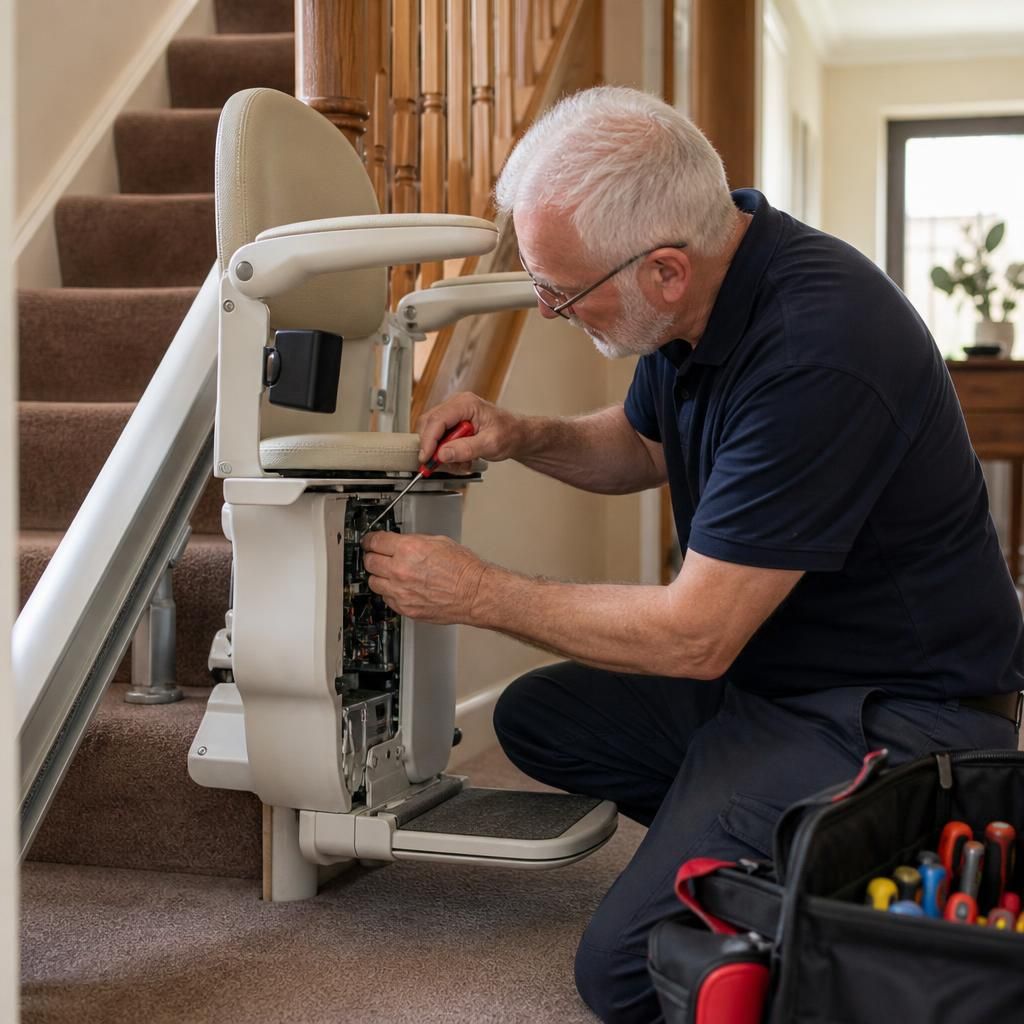
Book a model-specific stairlift service
Arrange a model-specific stairlift service so a qualified technician can check the features, components and installation conditions relevant to your lift. Have the model details and any recent changes in movement, noise, charging or controls available when booking.