
What qualifications or experience should I look for in stairlift maintenance technicians to ensure quality service?
Look for a stairlift maintenance technician with manufacturer-specific training, relevant electrical or mechanical servicing experience, and a clear understanding of safety checks, fault diagnosis and emergency procedures. They should also be able to provide evidence of suitable insurance, follow current safety guidance and document the work completed, including any parts that need replacing.
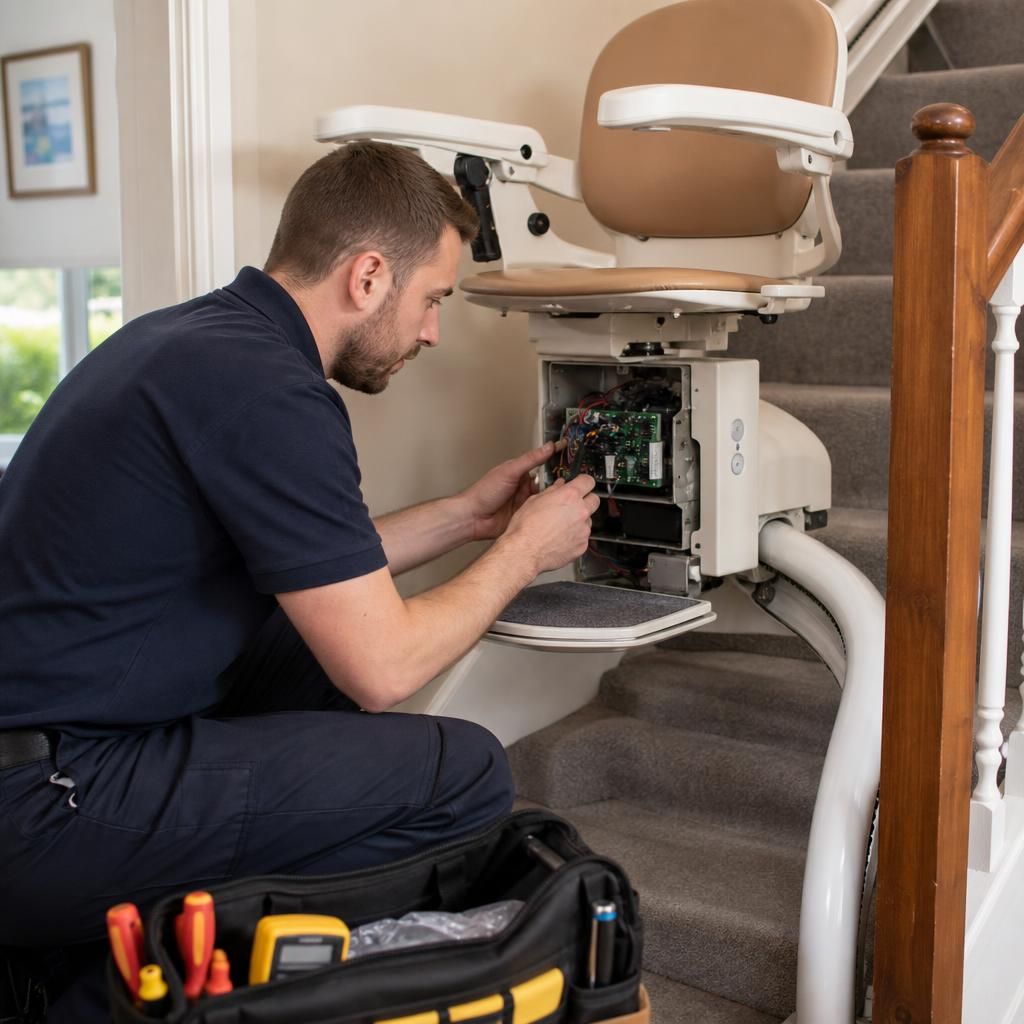
A suitably qualified stairlift maintenance technician should have relevant manufacturer training, practical experience with the type of stairlift being serviced, and a sound understanding of electrical, mechanical and safety systems. They should be able to inspect the lift methodically, diagnose faults, carry out safe adjustments or repairs, explain any limitations and provide a clear record of the work completed.
Check for manufacturer-specific training
Stairlifts differ in their control systems, batteries, drive mechanisms, charging arrangements and safety features. A technician who has been trained on the make and model being serviced is more likely to recognise normal operating characteristics and identify faults without relying on guesswork. Ask whether their training covers your particular stairlift, especially if it is a curved, outdoor, reconditioned or less common model.
Manufacturer training should include the installation, servicing and fault-finding procedures set out for the equipment. It should also cover approved replacement parts, diagnostic methods and the correct settings for safety switches, sensors and controls. General experience with mobility equipment is useful, but it does not always replace model-specific knowledge.
Look for relevant electrical and mechanical competence
A stairlift combines low-voltage electrical systems with mechanical components such as the carriage, drive system, rails, seat, armrests and safety edges. The technician should therefore be competent in both electrical fault diagnosis and mechanical inspection. Relevant experience may include servicing stairlifts, platform lifts, mobility equipment or other powered access systems, provided it is directly applicable to the equipment in your home.
They should understand how to isolate the power supply safely, test charging and battery systems, inspect wiring and connections, and identify signs of overheating or damage. Mechanically, they should be able to assess drive components, fixings, rail alignment, seat movement, swivel and locking mechanisms, footrest operation and any unusual noise or vibration.
Ask what formal qualifications, technical training or manufacturer certificates they hold. There is not one universal qualification that proves someone is competent to maintain every stairlift, so the relevance of their training and recent practical experience matters more than a certificate considered in isolation.
Confirm that safety checks are part of the service
A competent technician should inspect more than whether the stairlift travels up and down the stairs. The service should include the safety functions that protect the user during normal operation and in the event of a fault. Depending on the model, these may include:
- the seat belt or harness and its fastening point;
- swivel-seat locks and interlocks that prevent travel when the seat is not correctly positioned;
- obstacle sensors and safety edges;
- armrest, footrest and seat mechanisms;
- the emergency stop and controls;
- limit switches and travel controls;
- charging points, batteries and power connections; and
- rail fixings, carriage movement and general structural security.
They should follow the manufacturer’s service instructions and carry out an appropriate risk assessment. This is particularly important where there are children, pets, other people using the staircase, restricted access, unusual electrical arrangements or changes to the surrounding environment.
Assess practical experience, not just job titles
Ask how often the technician works on stairlifts similar to yours and whether they regularly handle the type of fault or service required. Useful experience includes diagnosing intermittent stops, battery or charging faults, unusual movement, control problems and safety-sensor activation, as well as completing routine preventative maintenance.
Experience with outdoor stairlifts is especially relevant because these units are exposed to moisture, temperature changes, dirt and corrosion. A technician should know how to inspect weather seals, covers, drainage, exposed electrical connections, charging equipment and corrosion-prone fixings. Indoor experience alone may not be sufficient for an outdoor installation.
For a reconditioned stairlift, ask whether the technician can assess the condition and compatibility of previously used components, batteries and controls. They should be able to explain when a part can be safely adjusted or reused and when replacement is the more appropriate option.
Check insurance and working procedures
The company or self-employed technician should be able to confirm suitable public liability insurance and, where relevant, employer’s liability insurance. You can also ask whether their engineers receive regular technical updates and whether work is carried out using documented procedures.
A professional service should leave the stairlift safe, clean and usable, rather than simply resetting a fault and leaving without explanation. The technician should tell you about any defect that has been found, any temporary measure used, parts that may need replacing and whether further work is recommended. They should not disable a safety feature to make the stairlift operate normally.
Expect a clear service record
After maintenance, request written details of the inspection and work completed. A useful service record normally identifies the stairlift, records the condition of important components, notes any adjustments or parts fitted, and states whether further attention is required. It should also record any advice given about safe use.
Keeping these records helps identify recurring faults, supports warranty or aftercare discussions and gives the next technician useful information. If a technician is unwilling to explain what has been checked or cannot provide any meaningful record, treat that as a reason to ask further questions.
Questions to ask before booking
- Are you trained to service this make and model?
- What electrical and mechanical maintenance experience do you have with stairlifts?
- Will you test the safety features as well as the drive system?
- Will you use manufacturer-approved or compatible parts where replacements are necessary?
- What will be included in the service report?
- How will you deal with a fault that cannot be repaired during the visit?
- Can you confirm your relevant insurance cover?
Be cautious if a provider cannot identify the technician’s relevant training, offers a very limited inspection, proposes bypassing a safety device, or recommends parts without explaining their compatibility. Quality maintenance depends on competent diagnosis and safe work, not simply on making the stairlift run temporarily.
For an existing Independent Stairlifts customer, the most useful information to have ready is the stairlift make and model, the symptoms you have noticed, any previous service records and whether the lift is installed indoors or outdoors. This allows the appropriate technician and parts to be arranged and helps ensure the inspection addresses the actual equipment in your home.
The most useful qualification to check is manufacturer-specific training for the make and model of your stairlift. This helps the technician understand its drive system, controls, batteries and safety features, rather than relying solely on general mobility-equipment experience.
Ask whether the technician has recent practical experience with your stairlift, including fault diagnosis and preventative servicing. They should be able to explain what will be inspected, use suitable parts and provide a written record of the checks, adjustments and any further work recommended.
Ask our team about qualified stairlift maintenance technicians
Contact our team to discuss your stairlift’s maintenance needs and arrange support from a suitably trained technician familiar with your equipment.