
What does a thorough stairlift maintenance service include?
A thorough stairlift maintenance service includes inspecting and testing the rail, seat, footrest, sensors, controls, safety features and batteries, together with cleaning and lubricating relevant components. The technician should also identify wear or faults, complete necessary adjustments or repairs where agreed, and confirm that the stairlift operates safely and reliably.
A thorough stairlift maintenance service includes a structured inspection, functional testing, cleaning, lubrication, safety checks and a review of any wear or faults. The technician should examine the complete stairlift system, explain any findings clearly and carry out adjustments or repairs where these have been agreed.
Initial condition and operation check
The service normally begins with a discussion about how the stairlift has been performing. This may identify symptoms such as unusual noises, hesitation, reduced travel speed, intermittent stopping or difficulty charging. The technician will then operate the lift and observe its movement, starting and stopping, travel along the rail and performance at the top and bottom of the stairs.
This practical test is important because a stairlift can appear clean and intact while still having an electrical, mechanical or alignment problem. The technician should also check whether the lift is being used as intended and whether anything in its surroundings could affect safe operation.
Inspection of the rail and drive system
- The rail is checked for secure fixings, damage, obstruction, contamination and signs of movement.
- The drive mechanism, rollers, gears and other moving parts are inspected for wear, looseness or abnormal noise.
- Connections and components beneath or around the seat are checked where accessible.
- The stairlift is assessed for smooth, controlled movement along the full length of the rail.
Lubrication is applied only to components for which it is suitable and in accordance with the manufacturer’s guidance. Applying lubricant to the wrong part can attract dirt or affect braking and grip, so routine lubrication should not be treated as a universal do-it-yourself task.
Seat, footrest and user controls
The seat should be checked for secure attachment, correct swivelling and locking, and any damage or looseness. The arms, seat belt, armrest controls and joystick or operating switch are tested to confirm that they respond correctly. If the model has a powered swivel seat, hinged rail or powered footrest, these functions should also be checked.
The footrest is inspected for damage, secure fixing and correct operation. The technician may check whether it folds or moves as designed and whether it presents any obstruction risk. Any visible damage to upholstery or trim can also be recorded, although cosmetic replacement is not normally part of a standard safety service unless separately agreed.
Safety device and sensor testing
Safety features must be tested rather than simply viewed. Depending on the stairlift model, this can include:
- obstacle sensors on the footrest, carriage or body of the lift;
- the seat belt and any seat-position or swivel interlocks;
- braking and controlled stopping;
- armrest, joystick and remote controls;
- key switches, isolation switches and emergency stop functions;
- charging contacts and the charging point; and
- alarm, warning indicators or other user alerts.
The technician should confirm that the stairlift stops when a relevant safety sensor detects an obstruction and that it cannot operate in an unsafe configuration. Testing procedures vary between straight, curved and outdoor models, so the inspection should be appropriate to the equipment installed.
Battery and electrical checks
Batteries are a key part of a stairlift’s reliability, particularly during a power cut. A maintenance visit should include an inspection of the batteries, terminals, wiring and charging system. The technician may check charging behaviour, battery condition and whether the lift holds sufficient charge during normal use. Corrosion, damaged cables, loose connections or a battery that is approaching the end of its useful life should be reported.
Battery replacement is not automatically included in every maintenance price. If replacement is recommended, you should be told why it is needed, what parts are proposed and whether the work is covered by the agreed service.
Cleaning and adjustments
Relevant accessible surfaces and components should be cleaned to remove dust, hair and debris that could interfere with sensors, rollers, charging contacts or moving parts. The technician may tighten fixings, adjust alignment, correct minor settings or make other routine adjustments within the scope of the service.
Cleaning does not mean that every part of the stairlift can be washed or treated with household products. Liquids, abrasive cleaners and unsuitable sprays can damage electrical components or affect moving parts. Follow the care instructions provided for your model between visits.
Faults, wear and recommended work
A proper service should identify developing problems as well as faults that have already caused a breakdown. The technician should distinguish between items that are safe to monitor, items requiring attention soon and faults that make the stairlift unsafe to use. Where a repair is needed, the findings should be explained before chargeable work is carried out, unless an immediate safety action is necessary under the agreed terms.
Some maintenance visits include minor adjustments, while replacement parts, battery changes and more extensive repairs may be quoted separately. A maintenance service should not be presented as proof that every component will remain serviceable until the next visit.
Service record and advice
At the end of the visit, you should receive a clear explanation of what was inspected, any work completed and any recommendations. A service record may note the stairlift’s condition, parts requiring observation, parts replaced and any limitations on the inspection. Keep this information with the stairlift documents, particularly if another person helps to manage its care.
If the technician identifies a safety-critical fault, stop using the stairlift until you have been advised that it is safe or the necessary repair has been completed. Between professional services, keep the rail and charging area clear, use the lift as instructed and report unusual noises, jolting, warning lights, poor charging or repeated stops promptly. Regular servicing cannot prevent every breakdown, but it helps detect wear early and confirms that the stairlift’s safety systems are operating as intended.
A thorough stairlift maintenance service tests the lift’s safety devices as well as inspecting its mechanical and electrical components. The technician should check that the stairlift stops correctly when it detects an obstruction and that it cannot operate when the seat, belt or other safety mechanism is in an unsafe position.
Depending on the model, this may include checking the obstacle sensors, seat belt, swivel-seat lock, armrest controls, emergency stop, key switch, braking system, charging contacts and warning indicators. These checks should be carried out during operation, not simply confirmed by looking at the components.
If a safety-critical fault is found, the technician should explain the risk clearly and advise whether the stairlift must remain unused until a repair is completed. Keep the rail and travel path clear between services, and report repeated stops, jolting, warning lights or unusual noises promptly.
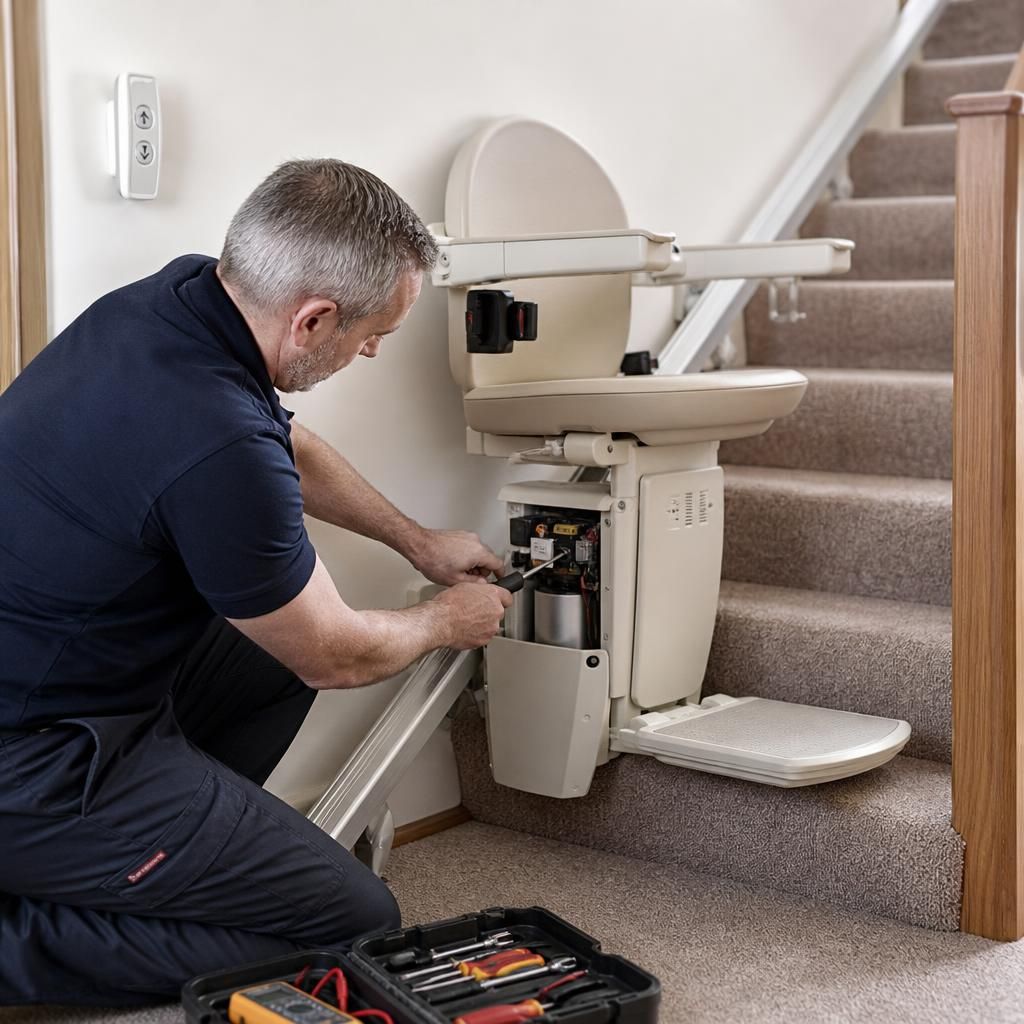
Arrange a thorough stairlift maintenance service
Arrange a thorough stairlift maintenance service with Independent Stairlifts to check your lift’s safety systems, batteries, mechanical components and controls. Contact us to discuss your requirements and any faults or changes in performance.