
What aspects should I consider when evaluating a stairlift maintenance provider?
When evaluating a stairlift maintenance provider, check that technicians are suitably trained, inspect all safety-critical components, understand your stairlift model and provide clear pricing before work begins. Also consider their availability for repairs, use of compatible parts, service records and the level of aftercare included.
The right stairlift maintenance provider should combine competent technicians, model-specific knowledge, thorough safety checks, reliable repair support and transparent pricing. Before booking, confirm that the provider can work on your make and model, uses suitable replacement parts, keeps clear service records and explains what is included in the maintenance visit.
Maintenance is more than cleaning the rail or checking whether the stairlift moves. A proper service assesses the systems that affect safe travel, stopping, charging, restraint and the stairlift’s ability to operate reliably in your home. The provider should be able to identify developing faults and explain whether an adjustment, repair or replacement part is required.
Check the technician’s training and experience
Ask who will carry out the work and what training or practical experience they have with stairlifts. A suitably competent technician should understand electrical and mechanical systems, stairlift safety controls, battery charging and the particular design of the model being serviced. Experience with curved, straight or outdoor stairlifts may be relevant because these systems have different rails, drive arrangements and environmental demands.
You can also ask whether the technician receives ongoing training and whether the company has procedures for assessing safety before returning a stairlift to use. Membership of a recognised trade or professional body may provide useful reassurance, but it should not replace questions about practical competence, insurance and the provider’s experience with your equipment.
Confirm that the provider knows your stairlift
Stairlifts vary in their controls, diagnostic systems, batteries, drive mechanisms and safety features. Before arranging a visit, provide the make, model and any details shown on the stairlift or its documentation. A provider should tell you whether it can service that equipment and whether compatible parts are available if a fault is found.
This is particularly important if your stairlift was installed by a different company, has been reconditioned or is no longer covered by the original manufacturer’s support arrangements. A responsible provider will not assume that a generic part or procedure is suitable. It should check compatibility and explain any limitations where parts are obsolete or difficult to source.
Ask what the service actually includes
Compare providers by the scope of the inspection rather than by the headline call-out price alone. A thorough maintenance visit will normally include appropriate checks of:
- the seat, armrests, footrest, swivel mechanism and seat belt or harness;
- the carriage, rail, drive system and visible fixings;
- start, stop and travel operation, including unusual movement or noise;
- safety edges, sensors, switches and obstruction detection;
- charging points, batteries and electrical connections;
- remote controls, call/send controls and other user controls;
- the stairlift’s emergency stop and warning indicators; and
- an outdoor model’s exposure to weather, seals, covers, corrosion and drainage where relevant.
The technician should also check for loose, worn or damaged components and make suitable adjustments or lubrication where the manufacturer’s instructions allow it. Not every component can be assessed in the same way on every model, so ask for an explanation of any inspection that is not applicable to your stairlift.
Look for clear pricing and agreed approval limits
A reputable provider should explain the maintenance charge before work begins, including whether it covers labour, travel, testing, a written report and minor adjustments. Ask whether batteries, parts, additional repairs, emergency attendance and follow-up visits are charged separately.
If the technician finds a fault, you should receive a clear description of the problem, the work recommended, the parts required and the total or estimated cost. Agree that no significant repair will be undertaken without your approval. A low initial price can be less useful if important checks or necessary labour are excluded, while a higher price may be reasonable when it includes a more comprehensive inspection and aftercare.
Assess repair availability and response arrangements
Maintenance cannot prevent every fault, so consider what support is available between planned services. Ask how to report a breakdown, when technical assistance is available and whether the provider offers emergency or priority support. Find out whether it covers your area and whether an engineer can attend your property if the stairlift becomes unusable.
Do not assume that a maintenance agreement includes unlimited repairs or out-of-hours attendance. Check the agreement for exclusions, response arrangements, call-out charges and the treatment of faults caused by damage, misuse or older components. If you rely on the stairlift every day, continuity of support may be as important as the servicing visit itself.
Check the parts and workmanship policy
Replacement parts should be suitable for the exact stairlift and installed according to the manufacturer’s requirements or accepted technical practice. Ask whether parts are new, refurbished or alternative compatible components, and whether the provider explains the difference before fitting them. For safety-critical items, the technician should be able to justify the proposed replacement and explain its expected function.
It is also sensible to ask whether parts and labour are covered by a warranty and what happens if the same fault returns shortly after the repair. A written warranty does not guarantee that every future problem is included, so read the conditions carefully.
Expect useful records after the visit
After servicing, request a record showing the date of the visit, the stairlift identified, checks completed, faults found, adjustments or parts fitted and any recommendations. The record should state whether the stairlift was left operational and whether further work is advised.
Keep service reports, repair invoices and information about replacement batteries or other parts. These records help a future technician understand the stairlift’s history, support warranty discussions and identify recurring problems. They may also be useful if the property is adapted for another user.
Consider communication and aftercare
The provider should explain technical findings in terms you can understand, especially where a repair is optional, preventive or safety-critical. The technician should not simply reset a warning or silence an unusual noise without investigating its cause. You should be told how to use any replacement control, what signs to monitor and whether the stairlift should remain out of use until further work is completed.
Good aftercare also includes practical advice about charging, keeping the rail and sensors clear, responding to warning lights and arranging the next service. If the stairlift is used by someone with limited mobility, the provider should take account of how the user operates the controls and whether any change affects safe access.
Review the service terms before committing
Read the maintenance agreement or quotation for its duration, cancellation terms, visit frequency, included parts, exclusions and renewal arrangements. Check whether the agreement applies to one stairlift only and whether it can be transferred if the equipment or property changes hands. If the stairlift is under a manufacturer’s warranty, confirm that independent servicing will not affect its terms.
Finally, compare the provider’s answers rather than choosing on price alone. The strongest option is one that gives you a precise scope of work, uses competent technicians, provides appropriate parts, documents the inspection and offers a realistic route to repairs when needed. If a provider cannot explain what will be checked or is unwilling to provide written costs and findings, seek clarification before allowing work to proceed.
A reliable stairlift maintenance provider should give you a clear account of the inspection, any faults found and the work recommended before carrying out chargeable repairs. Ask whether the quoted service includes travel, testing, minor adjustments and a written report, and confirm how parts or additional labour will be priced.
The technician should also explain whether the stairlift can remain in use safely, which issues are urgent and what can be monitored until further work is arranged. Clear records of the checks, parts fitted and recommendations make it easier to track recurring faults and plan future servicing.
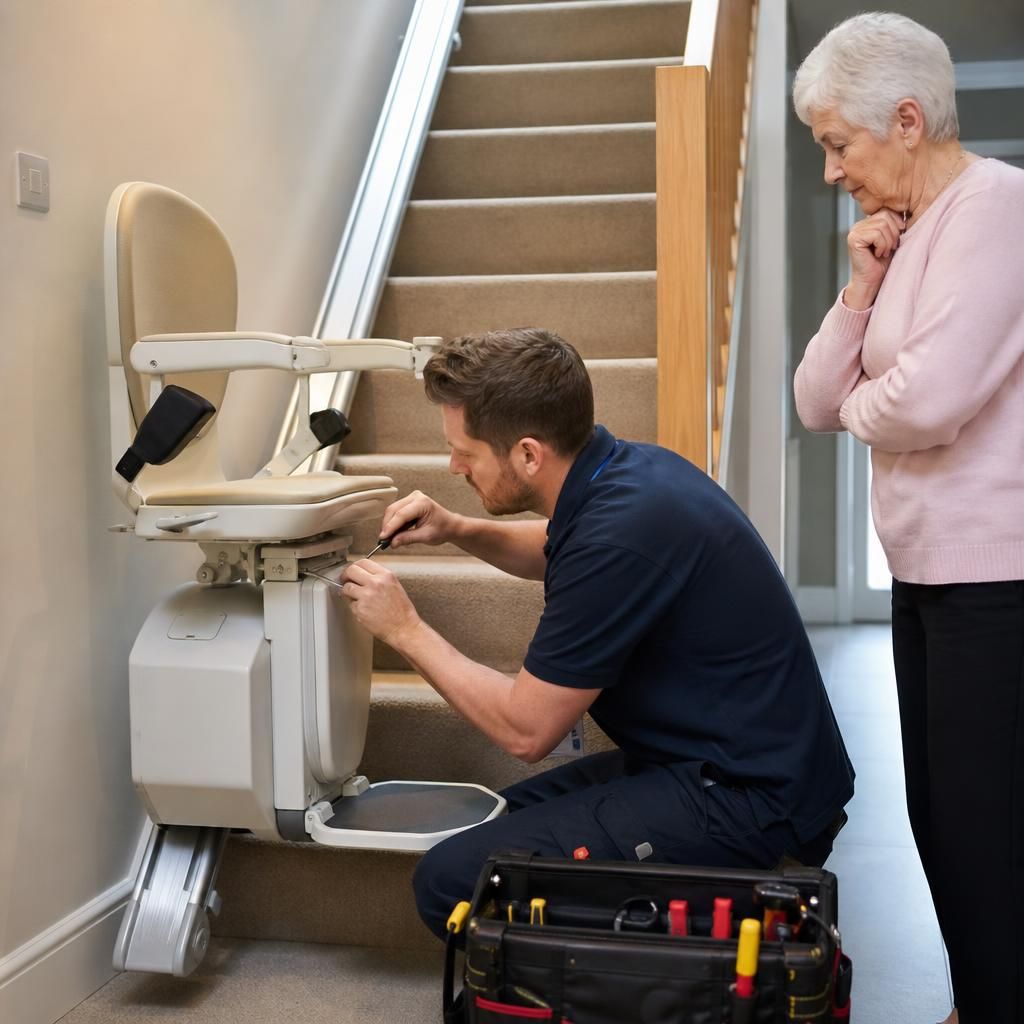
Arrange a stairlift maintenance assessment
Arrange a stairlift maintenance assessment with Independent Stairlifts to review your equipment, identify any developing faults and confirm the servicing or repairs required. Contact our team to discuss your stairlift and receive clear advice on the next steps.